The music of the primes: Riemann, Connes and physics
In 1859 Riemann built the primes from waves, one for each zero of the zeta function. These zeros behave like the energy levels of atomic nuclei, and Alain Connes reads them as a spectrum.
The tetractys orders the primes in grids, in the rhythm of six and in the division table. This page looks beyond it, onto one of the great open questions of mathematics. It shows how far the Pythagorean idea reaches that number and sound are the same.
Riemann’s waves
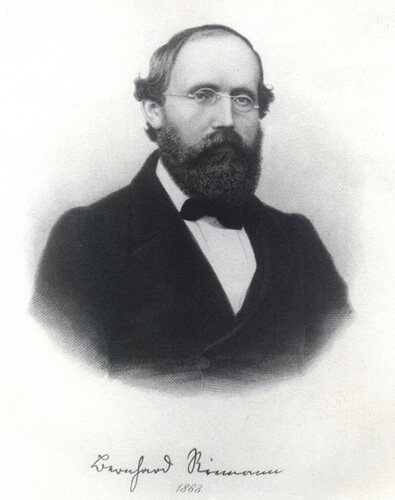
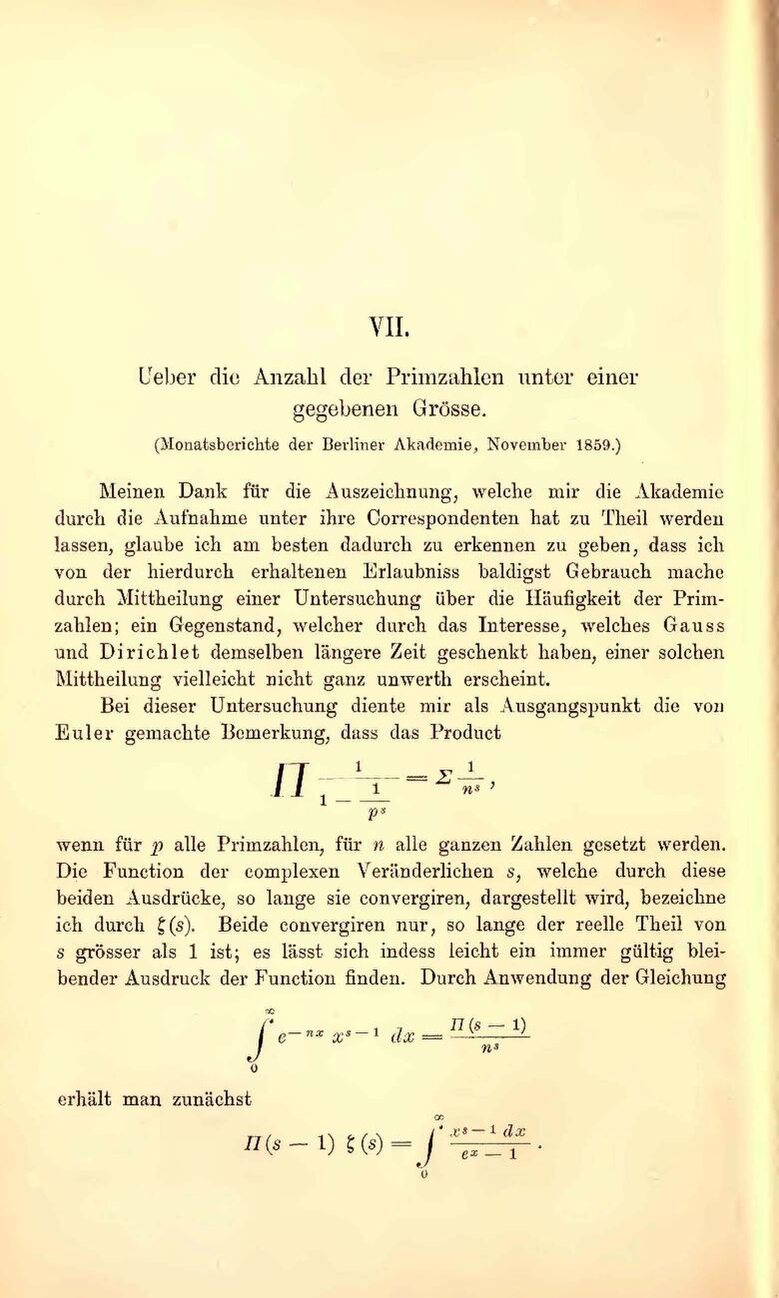
Bernhard Riemann showed in 1859, in a paper of only six handwritten pages, Ueber die Anzahl der Primzahlen unter einer gegebenen Grösse (manuscript at the Clay Institute, typeset text and English translation), that the distribution of the primes can be put together exactly from the zeros of a single function, even though a complete proof came only decades later, the zeta function ζ(s). Each zero contributes a wave with a frequency of its own. Take none at all, and a smooth line remains, the average growth of the primes. With each further wave the picture sharpens, until the sum makes a step exactly at every prime. The primes are a sound, as it were, and the zeros are its partials. Marcus du Sautoy accordingly called his book on the subject The Music of the Primes.
The prime staircase ψ(x) jumps by ln p at every prime p, and likewise at prime powers. The formula in the form Hans von Mangoldt proved in 1895 following Riemann's idea builds it from the line x and one wave for each zero of the zeta function. The slider chooses how many zeros sound along.
All the nontrivial zeros computed so far, and there are many trillions, lie on a single line: their real part is exactly 1/2. Whether this holds for all infinitely many is the Riemann hypothesis, unproven since 1859 and since 2000 one of the seven Millennium Prize Problems of the Clay Institute. Put simply, it says that the primes are distributed as evenly as their apparent disorder allows at all.
A counterpart in physics
David Hilbert and George Pólya are said to have suspected that the zeros could be the energy levels of a physical system, just as quantum mechanics knows such levels for every atom. Then the Riemann hypothesis would follow from the nature of the thing, for such energies are always real numbers, and the zeros would have to lie on their line.
In 1972 the number theorist Hugh Montgomery met the physicist Freeman Dyson over tea in Princeton. Montgomery had worked out how the spacings of the zeros are distributed. Dyson recognised the formula at once: it was the same distribution that appears in the theory of random matrices used to describe the spacings of the energy levels of heavy atomic nuclei that Eugene Wigner and he himself had developed. Andrew Odlyzko confirmed this from 1987 on huge numbers of zeros far out. The primes themselves scatter like chance. Their zeros, however, avoid each other like the energy levels of a nucleus.
How often which spacings occur, measured against the mean spacing. The zeros of the zeta function follow the curve of the random matrices that are also used to describe the energy levels of heavy nuclei, very small spacings are rare. The primes follow rather the curve of chance. Their spikes arise because prime gaps are even and favour multiples of 6, the rhythm of six.
Connes and noncommutative geometry
This is where Alain Connes comes in. In the 1980s he founded noncommutative geometry, a geometry for spaces whose coordinates cannot be swapped, just as position and momentum cannot in quantum mechanics. He had already received the Fields Medal in 1982 for his work on operator algebras, from which it grew. With Ali Chamseddine he set up in 1996 a single principle, the spectral action, from which the equations of the Standard Model of particle physics together with gravity follow, if the particle content is chosen suitably. And in 1998 he presented a geometric interpretation of the Riemann hypothesis: in it the zeros appear as a spectrum, like absorption lines, on a noncommutative space that comprises all primes at once. Just as the Balmer lines in the light of hydrogen follow whole numbers, the hidden orders of number would then themselves be lines in a spectrum. This does not prove the hypothesis. Connes reduced it to another statement that is also open.
What would follow
The question of the primes would then have a counterpart in physics. One might then suspect that the division table and the circle geometry of the simplexes, which make the order of the primes visible on these pages, are also related to the physics of our world. That is a conjecture of this website, not a consequence of mathematics. That would match the world view of the Pythagoreans 2,500 years ago: number is not merely a tool for describing the world but its blueprint. A caution: the physical system whose energy levels the zeros would be has not been found to this day. More under All is number, all is frequency.
Sources and further reading
Sources
- Bernhard Riemann, Ueber die Anzahl der Primzahlen unter einer gegebenen Grösse, Monatsberichte der Berliner Akademie, 1859
- Hugh L. Montgomery, The pair correlation of zeros of the zeta function, Proceedings of Symposia in Pure Mathematics 24, 1973
- Andrew M. Odlyzko, On the distribution of spacings between zeros of the zeta function, Mathematics of Computation 48, 1987
- Alain Connes, Trace formula in noncommutative geometry and the zeros of the Riemann zeta function, Selecta Mathematica 5, 1999
Further reading
- Marcus du Sautoy, The Music of the Primes, London 2003