The School of Athens
In Raphael's famous fresco a boy holds a small tablet up to Pythagoras. On it is the tetractys, together with the music theory of the Pythagoreans.
Anyone looking for traditions about Pythagoras and his tetractys will inevitably come across Raphael’s fresco The School of Athens. It was painted only in 1509 to 1511, some two thousand years after Pythagoras. But since much speculation about the tetractys goes back to this picture, it deserves a close look.
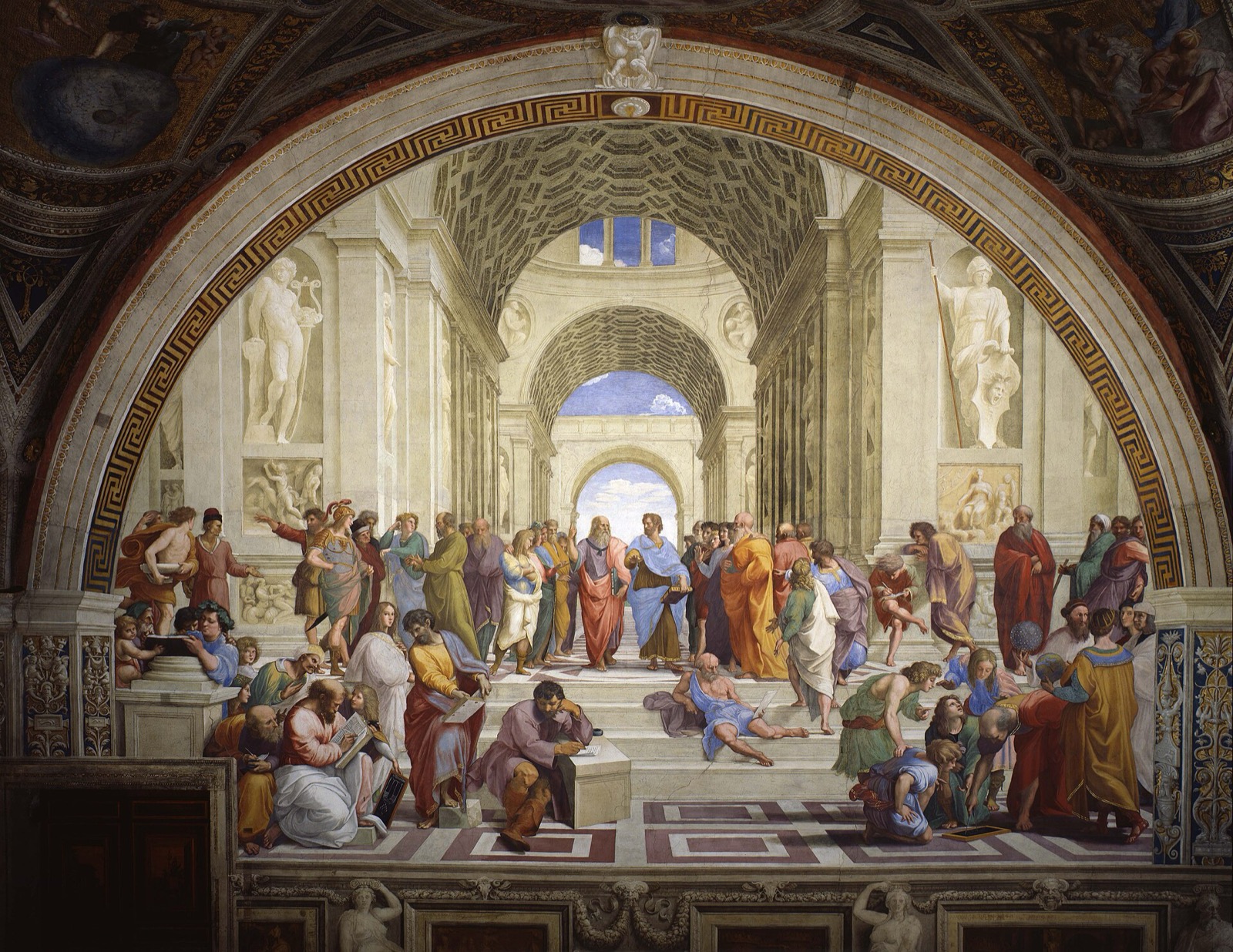
Raphael painted the fresco for Pope Julius II in the Stanza della Segnatura of the Vatican, originally the pope’s private library. It is named after the papal tribunal of the Segnatura, which later met there. It belongs to a cycle with the Parnassus, the Disputa on the sacrament of the altar, and the cardinal and theological virtues with the law. In the spirit of the Renaissance the picture celebrates ancient thought as the origin of European culture, its philosophy and science. The title School of Athens was first used by Giovanni Pietro Bellori in 1695.
At its widest the fresco is about 7.70 metres across and shows a vast hall in central perspective. In it the thinkers of antiquity gather: at the centre Plato and Aristotle, around them Socrates, Euclid, Heraclitus, Diogenes and many others. On the left stand the Platonists, on the right the Aristotelians, in the background the philosophers, in the foreground the scientists, mathematicians and artists. Aristotle holds his Ethics and points with a horizontal gesture to the ethical order of the world. Plato holds the Timaeus and points upwards, from the world of the senses to the ideas.
The picture falls into three main groups: at the top centre the group around Plato, at the lower left the one around Pythagoras, at the lower right the one around Euclid.
Pythagoras and the tablet
In the lower left of the picture Pythagoras sits writing in a book. In front of him a boy holds a small black tablet. It is easily overlooked, but carefully inscribed:
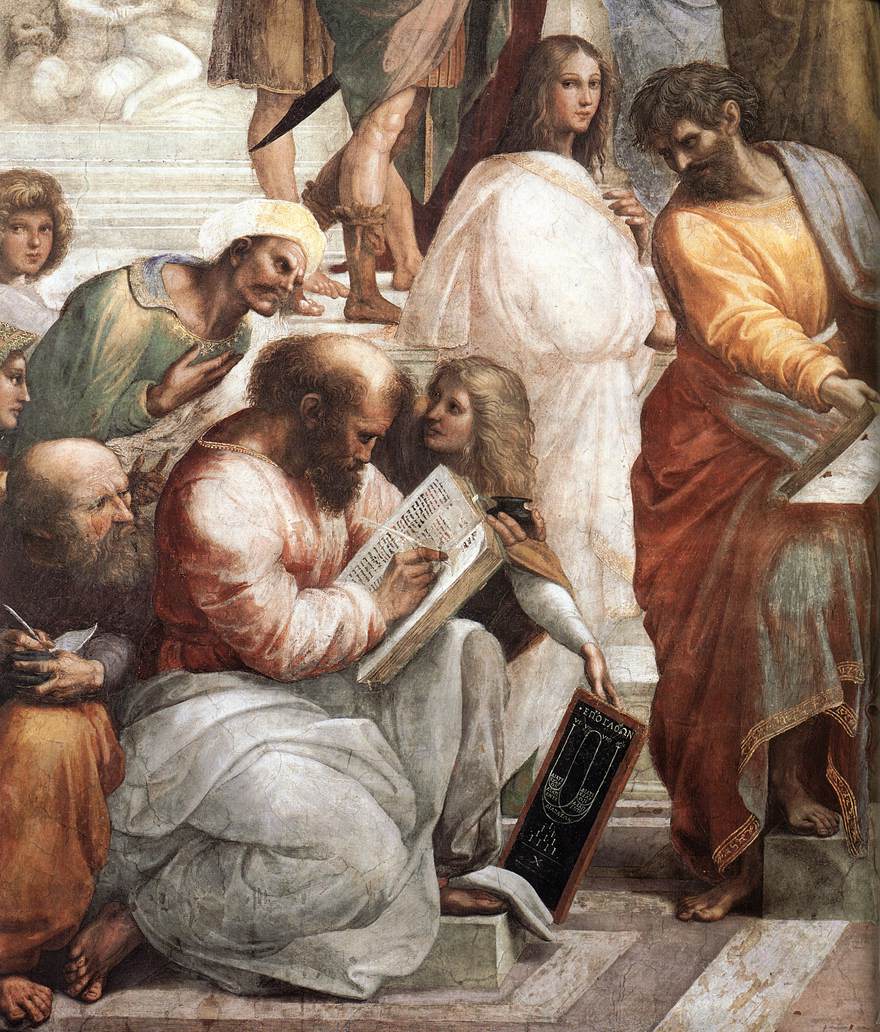
- At the top is the Greek word ΕΠΟΓΔΟΩΝ, epogdoon, “an eighth over”. It means the ratio 9 : 8, the whole tone.
- Below it are the numbers VI, VIII, IX and XII, linked by arcs. These four numbers contain all the basic intervals of Pythagorean music theory: 6 : 12 is the octave, 6 : 9 and 8 : 12 are fifths, 6 : 8 and 9 : 12 fourths, and 8 : 9 is the whole tone.
- At the bottom is a triangle of strokes with the number X beneath it. This is the tetractys with its sum of ten.
The arcs also carry the Greek names of the three intervals octave, fifth and fourth. Music theorists like to assign the numbers 6, 8, 9 and 12 to the beginning of the overtone series. At least they form a fourness, and they contain the ratios of the numbers 1 to 4: octave 1 : 2 = 6 : 12, fifth 2 : 3 = 6 : 9 = 8 : 12, fourth 3 : 4 = 6 : 8 = 9 : 12.
So Raphael did not show Pythagoras with the theorem of the right triangle for which he is known today, but with music and the tetractys. In his time, the Renaissance, precisely this counted as the heart of Pythagorean teaching: the insight that harmony rests on ratios of numbers. You can hear how these ratios sound on the page Number and sound.
Open questions
Since the Pythagoras group is one of the three main groups of the picture, Raphael must have known, or at least sensed, the great importance of Pythagoras in Greek thought. But where did he get his knowledge of the Pythagoreans and their secret teachings?
And one must remember: the picture is by a sixteenth-century painter, two thousand years after Pythagoras. May one give his unknown sources so much weight? As an artist Raphael achieved great things, but that did not make him a careful historian.
Above all one question remains open: the loop diagram contains a fourness, the numbers 1 to 4 as intervals. Directly beneath it, however, stands the ten of the tetractys. Where does music theory offer a counterpart to 1 + 2 + 3 + 4 = 10? The page Error and conjecture in music theory pursues this question.