The ancient sources
What ancient texts report about the tetractys, from Philolaus to Lucian, and how reliable this tradition is.
Not a single line by Pythagoras himself survives. Everything we know about the tetractys comes from later texts, most of them centuries younger. That does not make them worthless, but for every source one has to ask who wrote it and when.
Philolaus
The oldest Pythagorean from whom fragments of text survive is Philolaus of Croton, who lived in the fifth century BC. He is regarded as the first and at the same time the last “genuine” Pythagorean to write the teaching down, counted among the younger Pythagoreans and a contemporary of Socrates. Archytas of Tarentum, Eurytus and Democritus are named as his pupils. According to Diogenes Laertius, Plato bought Pythagorean writings from him and took them into his Timaeus. In one fragment (numbered 44 B 11 in the standard edition by Diels and Kranz) he praises the power of the decad: it is great and perfect, brings everything about, and is the beginning and guide of divine as well as human life. Without it, everything would remain unlimited, unclear and hidden.
The other fragments handed down under his name circle around the same ideas. In summary:
- Limiting and unlimited. The world and everything in it is joined together from limiting and unlimited parts. If everything were unlimited, there would be nothing that could be known.
- To know is to count. Everything knowable has number. Without number nothing can be thought or grasped.
- Even, odd and their mixture. Number has two proper forms, the odd and the even, and a third mixed from both, the “even-odd”. How this threefold division returns in the rhythm of six of the primes is shown in The order of the primes.
- Harmony. Because the first principles are unlike and unrelated, a harmony is needed to bind them. Philolaus describes it as a scale: the octave (1 : 2) comprises the fourth (3 : 4) and the fifth (2 : 3), and the fifth exceeds the fourth by a whole tone (8 : 9). He works it out on the strings of the lyre: from hypate to mese a fourth, from mese to nete a fifth, between trite and mese a whole tone. So the octave consists of five whole tones and two semitones, the fifth of three whole tones and a semitone, the fourth of two whole tones and a semitone. Harmony for him is the unification of the much-mixed and the concord of the differently minded.
- The One at the centre. The first thing fitted together, the One at the centre of the world sphere, he calls the hearth, Hestia. The One is the beginning of all things.
- By nature, not by convention. The order of numbers is not made by humans.
- Number makes things knowable. The nature of number gives knowledge, guides and teaches everyone in everything that is doubtful or unknown to them. Without it nothing would be clear, either in itself or in relation to anything else. In the soul it brings all things into harmony with perception and gives them a body, as it were. Its power works not only in the divine but in all human deeds and words, in every craft and in music.
- Four principles of the living being. Brain, heart, navel and genitals. The brain is the seat of reason and the principle of the human, the heart the seat of soul and feeling and the principle of the animal, the navel the principle of rooting and growing and so of the plant, the genitals the principle of generation, common to all, for everything grows from seed.
- The body as a prison. According to the old seers the soul is bound to the body as a punishment and buried in it as in a tomb. God holds everything as if in custody, and humans are part of his possessions. That is why some ideas and passions are not in our control. There are, as Pythagoras is said to have put it, thoughts that are stronger than we are.
- Number does not deceive. Deception and envy belong to the unlimited and irrational. They cannot enter the nature of number and harmony.
- Five bodies. The world sphere contains fire, water, earth and air, and as a fifth the one that encloses the sphere.
The authoritative collection of these texts is Die Fragmente der Vorsokratiker by Hermann Diels, later revised by Walther Kranz. Philolaus is listed there as number 44.
Whether the fragment on the decad really comes from Philolaus is disputed among scholars. Some consider it a later attribution. Either way it shows what rank the ten held in Pythagorean thought.
Speusippus
Speusippus, son of Plato’s sister Potone and head of the Academy after Plato, compiled from the Pythagorean teachings, above all from the writings of Philolaus, a booklet On the Pythagorean Numbers. It is lost. An excerpt is preserved by the Neoplatonist Iamblichus in his Theology of Arithmetic, and it reveals the structure:
- The first half deals with numbers relating to lines, to polygons and surfaces, and to solids.
- Then come the five solids assigned to the elements of the cosmos, with their properties and their relations to one another.
- The second half is devoted entirely to ten. Speusippus declares it the most natural and perfect of all numbers, the archetype held before the eyes of the god who shapes the world as a model, and this from its own nature, not on the strength of human opinion.
In essence he argues: Greeks and all peoples rightly arrive at ten of their own accord when counting. It must be an even number, so that odd and even numbers are equally represented in it, since the odd always comes first. And it must contain first, incomposite and second, composite numbers in equal number. This holds for ten and for no smaller number. Larger numbers have the property too, but their basis is ten, the first and smallest to possess it. Added to this are the geometric reasons:
- In the numbers one to four lie point, line, surface and solid.
- Ten contains as many primes (2, 3, 5, 7) as composite numbers (4, 6, 8, 9), if one and ten are regarded as the frame.
- The tetrahedron, the simplest solid, can be connected with ten through its vertices, edges and faces.
Speusippus shows that already in antiquity the tetractys was understood not only as a sacred symbol but as a geometric argument. Nobody knows what became of his booklet. A selection of the fragments in German translation is offered by Wilhelm Capelle’s Die Vorsokratiker (Kröner).
A geometric reading
Some authors have tried to follow Speusippus’ praise of ten and in the end dismissed it as a strange superstition. With the geometry of the simplexes, however, it makes clear sense. In the decagon there are four kinds of figure (see The key to the tetractys):
| Divisor | Figure | Kind |
|---|---|---|
| 1 | decagon | polygon |
| 2 | two pentagons | compound polygon |
| 3 | star in one stroke | star polygon |
| 4 | two pentagrams | compound star |
The first, incomposite figures belong to the odd divisors 1 and 3, the second, composite ones to the even divisors 2 and 4, built of two part-figures. Both are present in equal number, and ten is the first number at which this succeeds with all four kinds. That it is precisely two pentagrams that form the ten-pointed star is no accident: the pentagram was the Pythagoreans’ sign of recognition and stood for health, and according to Lucian the fourness that produces ten was also regarded as the source of health.
On this view the tetractys has at first nothing to do with mysticism. The mysticism attributed to it arises only from ignorance. The Pythagoreans developed their philosophy from the clarity of the simplest arithmetic-geometric relations. Seen this way, they were not believers but knowers.
The oath
Several later authors record an oath of the Pythagoreans. They swore not by the gods but by the one who had handed down the tetractys to them, that is, by Pythagoras. In it they call the tetractys itself the source and root of ever-flowing nature. The wording is found in the so-called Golden Verses and in Sextus Empiricus, both from long after Pythagoras.
Lucian
A vivid, if mocking, scene is told by the satirist Lucian in the second century AD. Pythagoras asks someone to count. When the man has reached four, Pythagoras interrupts: what he takes for four is in truth ten, a perfect triangle and the oath of the Pythagoreans. The joke only works if one has the tetractys in mind: counting to four already assembles the rows of the figure.
Aristotle
The most sober source is Aristotle. In his Metaphysics he reports that the Pythagoreans considered ten so perfect that they wanted the heavenly bodies to number ten as well. Since only nine could be seen (Earth, Moon, Sun, five planets and the sphere of fixed stars), they invented an invisible counter-earth. Aristotle tells this critically, as an example of how a number can overrule observation.
Limiting and unlimited: an interpretation
Philolaus’ basic idea, that the world is joined from limiting and unlimited elements, can be read geometrically, as the contrast between space and life, macrocosm and microcosm.
- The unlimited. Only a few regular polygons fill the plane and space without gaps: triangle, square and the hexagon built from triangles (see Circle, triangle and square). The numbers 1 × 2 × 3 fix the rhythm of six of the twin primes, whose figure is the hexagram. And 1, 2 and 3, vertex, edge and face, together make the space for solids, four. Only a space of triangles and squares has the property that from every vertex straight lines lead unhindered into infinity. The face-centred cubic lattice consists of exactly such faces, alternately upright and inverted triangles, and each node is connected with the whole unbounded lattice. The six-pointed star thus stands for the union of energy and unbounded space, for the macrocosm.
- The limiting. Five is the first prime after three, and the pentagon the first polygon that cannot tile. Albrecht Dürer and Johannes Kepler tried to join pentagons into surfaces. Their drawings show: symmetries around a centre are possible, an unbounded gap-free surface is not. In space, too, fivefold symmetry exists only around a centre, in the dodecahedron, the icosahedron and their star solids. The five-pointed star therefore stands for fleeting becoming and passing away, for time and matter, for the microcosm.
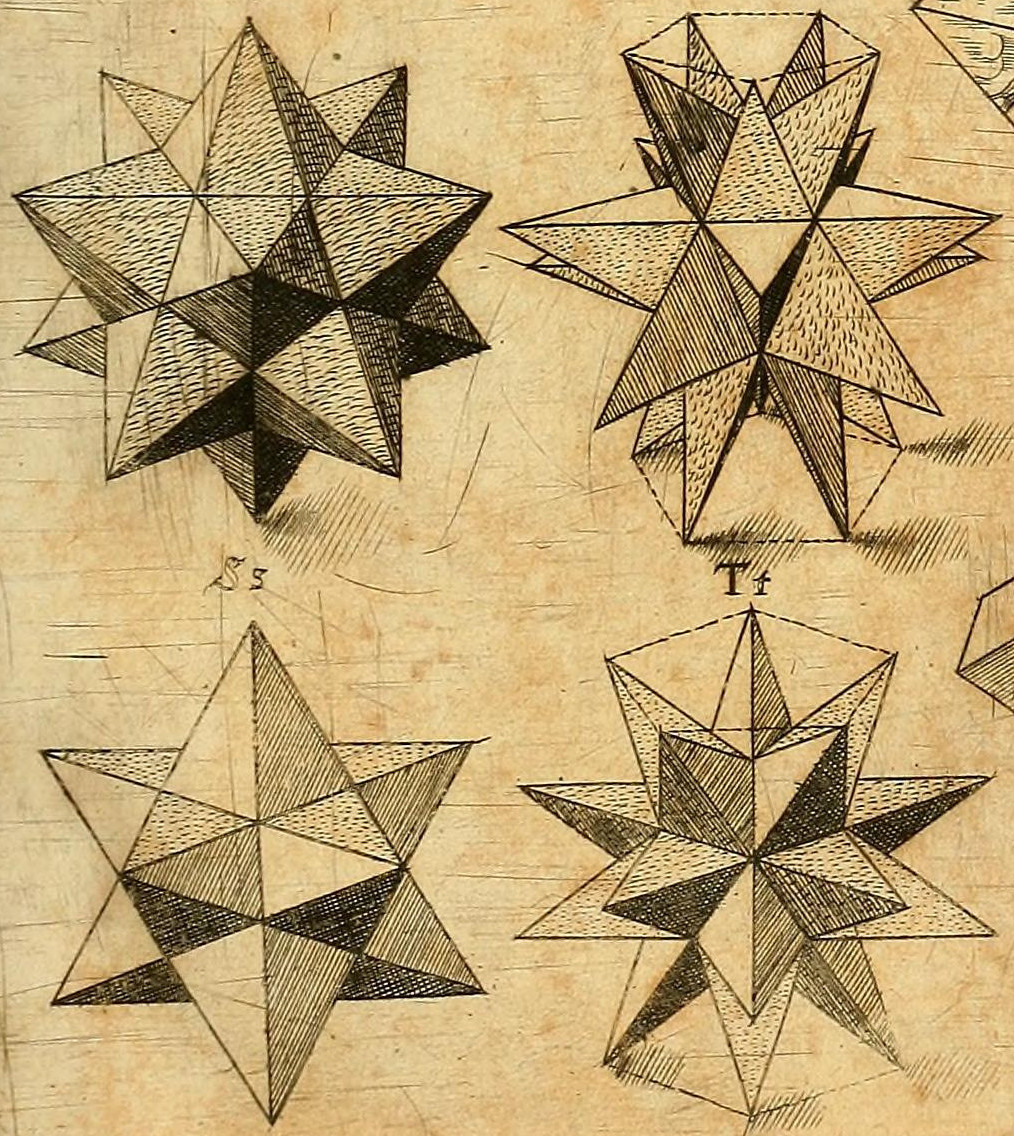
Images for human life can be derived from this. The human mind is self-centred, it wants to realise itself and uses its surroundings for its own ends: bounded and transient like the pentagon. The “divine spark” of the soul, by contrast, feels joined with all others in a unity, like space filled without bounds by cubes and hexagons. The soul is with God insofar as it joins with the macrocosm. This view agrees with many philosophies of religion. The Christian founding fathers of Freemasonry took over the same Platonic images: the cubic stone as a symbol of human perfection and a harmonious community, and square and compasses, tools for square and triangle (see Freemasonry).