The Platonic solids and the tetractys
Five perfect solids, two dual pairs and one solid that is dual to itself, assigned to the start figures of the tetractys.
The five Platonic solids. 'Dual' shows the figure formed by their face centres.
There are exactly five solids whose faces are identical regular polygons and at whose vertices the same number of faces meet: tetrahedron, cube (hexahedron), octahedron, dodecahedron and icosahedron. Join the face centres of such a solid and you get its dual:
- The tetrahedron is dual to itself.
- Octahedron and cube are dual to each other.
- Icosahedron and dodecahedron are dual to each other.
All of them can be built from tetrahedra: the octahedron as the intersection of two tetrahedra, the cube as their hull, the icosahedron from five tetrahedra (bulging outwards), the dodecahedron from five tetrahedra (inwards). Conversely, each solid can be described by several of the others. A dodecahedron, for example, by five cubes or five octahedra.
| Tetrahedron | Octahedron | Cube | Icosahedron | Dodecahedron | |
|---|---|---|---|---|---|
| Vertices | 4 | 6 | 8 | 12 | 20 |
| Edges | 6 | 12 | 12 | 30 | 30 |
| Faces | 4 triangles | 8 triangles | 6 squares | 20 triangles | 12 pentagons |
| Dual to | itself | cube | octahedron | dodecahedron | icosahedron |
| Fills space | with the octahedron | with the tetrahedron | alone | no | no |
Right angles in the dodecahedron
The right angle, the cross, is present directly or indirectly in all five solids, because they can be inscribed in and circumscribed about one another. The dodecahedron shows this especially well. Eight of its twenty vertices form a cube, and each of the twelve cube edges lies as a diagonal in one of the twelve pentagonal faces. There are exactly five such cubes. Each face receives five diagonals from them, one from each cube, and these five diagonals form a pentagram. So five cubes give rise to twelve pentagrams.
Since each cube in turn holds two tetrahedra whose edges cross on the cube faces, the stella octangula, the dodecahedron contains ten tetrahedra and, on the 5 × 6 = 30 cube faces, thirty crosses.
One cube, five cubes and ten tetrahedra in the dodecahedron. Each colour belongs to one cube.
Assignment to the start figures
The solids can be assigned to the four start figures via the figure you see when looking at the solid along an axis of symmetry:
The four start figures: triangle, hexagram, pentagram and double pentagram.
| Solid | View along symmetry axis | Start figure |
|---|---|---|
| Tetrahedron | triangle, onto a face | triangle (3) |
| Octahedron and cube | sixfold, along the space diagonal | hexagram (6 : 2) |
| Icosahedron and dodecahedron | fivefold and tenfold | pentagram (5 : 2) and double pentagram (10 : 4) |
Looking at each solid from a vertex, an edge and a face, the flat projections show polygons with exactly the vertex counts of the start figures. In the first products of the first primes 2, 3 and 5, that is 4, 6 and 10, the numbers of vertices, edges and faces also come out: 4 vertices and 4 faces in the tetrahedron, 6 and 12 in octahedron and cube, 12, 20 and 30 in icosahedron and dodecahedron. That there is a connection here is hard to deny even by eye.
That the primes 3 and 5 double, triangle to six-pointed star, five-pointed star to ten-pointed star, is on this reading a consequence of even and odd numbers (see Number theory). Drawn upright and inverted, the start figures show the two dual pairs, 2 × 2 = 4, a tetractys. The tetrahedron, the only self-dual solid, thus stands above the other four in a fractal hierarchy.
The star polyhedra
It is said that the five Platonic solids are, apart from the sphere, the only perfectly symmetrical solids. That is only partly true. The star polyhedra belong with them: the four Kepler–Poinsot polyhedra and the stella octangula. They correspond to the star polygons among the start figures, just as the Platonic solids correspond to the polygons.
Two of the four were described by Johannes Kepler in 1619 in his Harmonices Mundi, the small and the great stellated dodecahedron. The other two were found by Louis Poinsot in 1809. Three years later Augustin-Louis Cauchy proved that there are exactly these four. Their faces are pentagrams, pentagons or triangles that pass through one another, and five is present in all four.
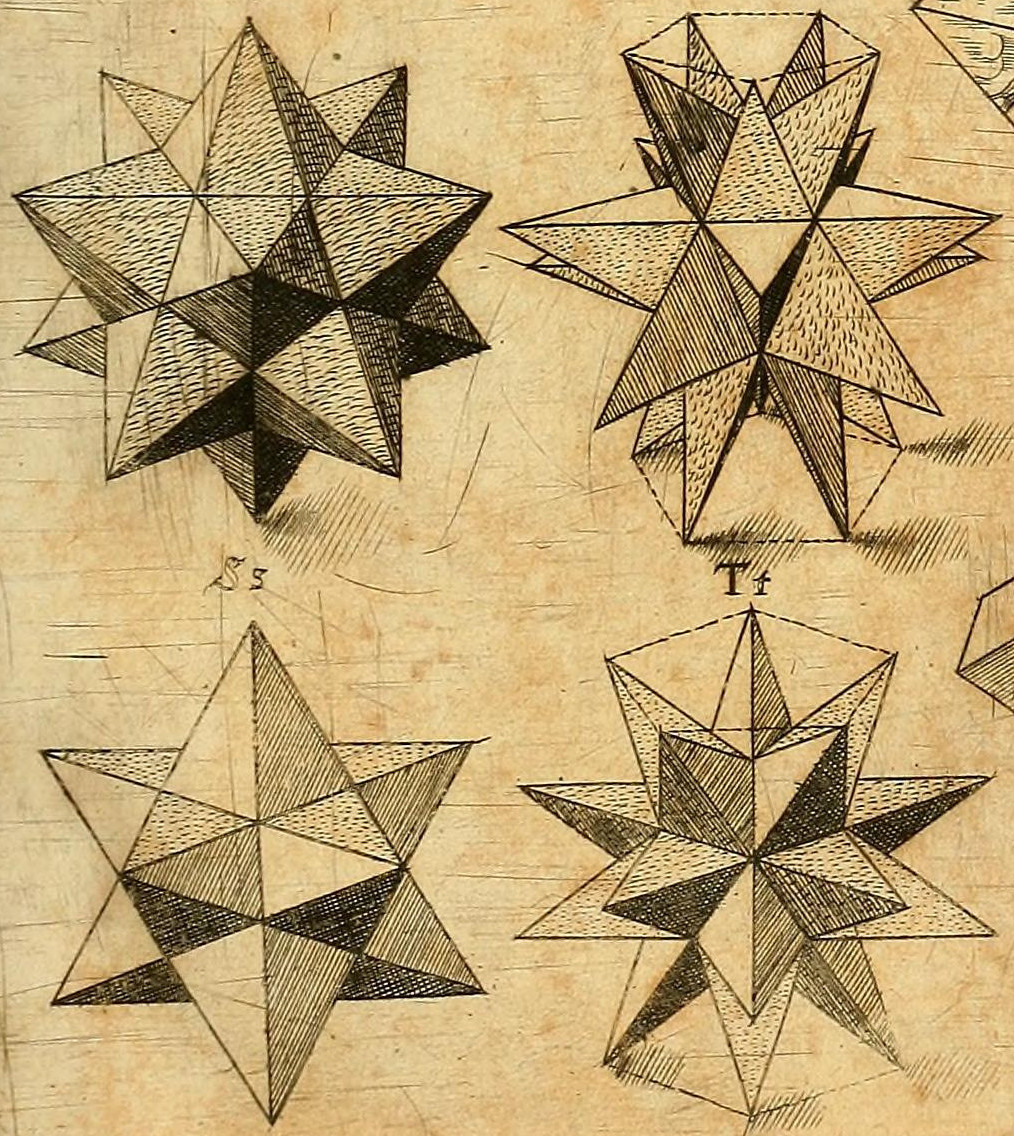
The four Kepler–Poinsot polyhedra. Each colour marks one face, which passes through the others.
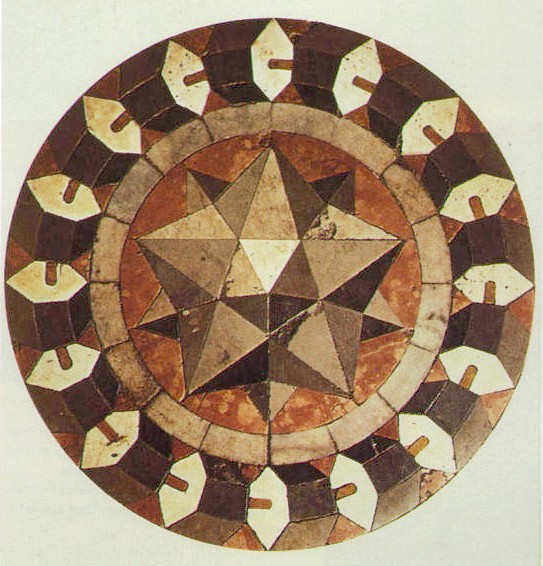
The first known depiction of a small stellated dodecahedron is, however, almost two hundred years older than Kepler’s book. It lies as a marble mosaic in the floor of the entrance of San Marco in Venice, after a design attributed to the painter Paolo Uccello.
Why there are only five
The question is old, and so is the answer. It is already in Euclid:
- At least three faces must meet at every vertex of a solid.
- The angles of these faces at a vertex must add up to less than 360°. At exactly 360° the faces would lie flat in a plane, with more no vertex could be folded.
With triangles (60°) three, four or five faces per vertex are possible, giving tetrahedron, octahedron and icosahedron. With squares (90°) only three, the cube. With pentagons (108°) also only three, the dodecahedron. Hexagons already have 120°, three of them make 360° and so a flat surface. The same bound of the full circle that fixes the number of solids here also governs the angle sums of the start figures (see Angle sums and full circles). Relating the two suggests itself.
Compounds: the dualities as a tetractys
With its four vertices the tetrahedron has the least a solid needs. It is the “tetractys of space”:
| Form | Vertices | ||
|---|---|---|---|
| 1 | point | 1 | one vertex |
| 2 | line | 2 | one edge |
| 3 | triangle | 3 | one face |
| 4 | tetrahedron | 4 | one solid |
Dividing a tetrahedron again and again produces a fractal that also plays a part in number theory (see Simplex – multidimensional tetrahedra). All Platonic solids can be built from tetrahedra, and the scheme of this tetrahedral fractal repeats in all the compounds. The triangular faces are true fractals, the squares and pentagons do not follow it.
Push two dual solids into each other so that their edges bisect one another, and three compounds arise. Where the two solids overlap an intersection remains, and a hull can be laid around both:
| Pair | Duality | Intersection | Hull |
|---|---|---|---|
| tetrahedron and tetrahedron | 3-fold, so 6 | octahedron | cube |
| octahedron and cube | 4-fold, so 8 | cuboctahedron | rhombic dodecahedron |
| icosahedron and dodecahedron | 5-fold, so 10 | icosidodecahedron | rhombic triacontahedron |
The three dual pairs as compounds. The edges of the two solids bisect each other.
The dualities concern only vertices and faces, so the essentials are already contained in the flat projection. And this corresponds to the simplexes of the 6-, 8- and 10-gon. The solids themselves are of course not identical with the simplexes. Put the single tetrahedron in front of the three pairs and you get the series 4, 6, 8, 10. Both systems thus begin with the four (square or tetrahedron) and close with the ten-gon.
Star polyhedra, compounds and space filling
The Platonic solids have the highest symmetry: all vertices, edges and faces are alike. The second highest belongs to the Kepler–Poinsot polyhedra and the stella octangula. They have two kinds of vertex, convex ones at the tips and concave ones at the base, and their edges differ in length.
Besides the dualities there is a second important distinction. Tetrahedron, octahedron and cube fill space without gaps, tetrahedron and octahedron together, the cube alone (see Space filling without gaps). The stella octangula belongs here too: it can be assembled from tetrahedra and octahedra, and its hull is the cube. The four star polyhedra of icosahedron and dodecahedron, by contrast, arise by extending the edges of the faces until they meet again. The result is nested triangles, pentagons and pentagrams, and anything fivefold can fill neither the plane nor space with copies of itself.
One could object that the stella octangula is not a true star polyhedron, since it arises as the interpenetration of two solids. But it arises just as well by extending the faces of the octahedron until they meet again, and so it is the only stellation of the octahedron. Among the compounds of two identical solids it is the simplest, and because both solids are alike it has a particularly high symmetry. The compound of octahedron and cube is already contained in it, as intersection and hull, only without this symmetry. The compound of icosahedron and dodecahedron consists of two different solids and so likewise has only a symmetry of the third rank.
Macrocosm and microcosm
Extend the edges of the Platonic solids and three things happen. For tetrahedron, octahedron and cube they continue in a gapless lattice. For icosahedron and dodecahedron they cross once more nearby, forming a fivefold star polyhedron, and then run apart and lose themselves in the infinite, in the “All”. The number of vertices a solid has thus decides whether its edges join into an infinite lattice, philosophically speaking an image of the whole, or scatter into the boundless.
In this difference lies the core of a hidden Platonic cosmology. The hexagram counts as the star of the macrocosm, the pentagram as the star of the microcosm. Philolaus spoke of the limiting and the unlimited (see The ancient sources).
Solid angles and full spheres
What the angle sum in full circles is in the plane, the solid-angle sum in full spheres is in space. Just as in the plane the square with its four right angles makes exactly one full circle, the eight right-angled vertices of the cube together make exactly one full sphere: the three axes x, y and z divide the sphere around a point into eight octants. The cube is also the only Platonic solid that fills space on its own.
| Solid | Vertices | Solid-angle sum in full spheres |
|---|---|---|
| Tetrahedron | 4 | ≈ 0.18 |
| Octahedron | 6 | ≈ 0.65 |
| Cube | 8 | 1 |
| Icosahedron | 12 | ≈ 2.52 |
| Dodecahedron | 20 | ≈ 4.71 |
Only the cube hits the full sphere exactly. The stella octangula, whose eight tips span a cube, thus also belongs to this order, as do the cubic crystal systems built from tetrahedra and octahedra. Icosahedron and dodecahedron, with their fivefoldness, cross this boundary of four. Since the angle sums of plane polygons and star polygons are so strikingly linked to the divisor properties of numbers, one may suppose that something similar holds in space.
Open questions
Still to be investigated:
- the solid-angle sums of the star polyhedra compared with the full circles of the star figures,
- the view of the simplexes as two-dimensional projections of higher-dimensional tetrahedra, and of the Platonic solids as a “distorted image” of our three-dimensional experience.