The octaves of light: the rainbow around the throne
Visible light spans almost exactly one octave, forty octaves above the tone F4. Newton's seven colours, the rainbow as a circle, the hexagram of colours, the colour cube as a stella octangula and why complementary colours are not an interval.
In the vision of John, the throne of God is surrounded by a rainbow, like an emerald to look upon (Rev 4:3). Ezekiel, too, sees around the throne-chariot a brightness like the bow in the clouds on a day of rain (Ezek 1:28), and already after the Flood the bow in the clouds is the sign of the covenant between God and the earth (Gen 9:13). The page Christmas, the throne of God and the number 24 suggests that the rainbow points to the octaves of electromagnetic waves. This page follows up that suggestion.
Physically, the rainbow is nothing but sunlight, sorted by its frequencies. The question is whether the law that orders tones also orders light.
A spectrum of octaves
Radio waves, thermal radiation, light, X-rays and gamma rays are the same phenomenon, electromagnetic waves. They differ only in their frequency and so in their wavelength, for the two multiplied together always give the speed of light. In music, doubling a frequency is called an octave, the ratio 2 : 1. Measured in octaves, the electromagnetic spectrum reaches from radio waves 100 kilometres long to gamma rays across about 58 octaves, and it is open at the top.
Our senses perceive only narrow slices of it. The ear hears sound from about 20 to 20,000 hertz, which is ten octaves. Sound is not an electromagnetic wave but a pressure wave in the air, yet octaves can be counted in any vibration. The eye sees light from about 380 to 780 nanometres in wavelength, that is, from 385 to 790 terahertz. That is a ratio of just over 2 : 1, almost exactly one octave.
The electromagnetic spectrum divided into octaves. Each tick stands for a doubling of frequency, the numbers below give the wavelength. Visible light is just one of these boxes, enlarged below.
Forty octaves above the tone
Doubling a frequency forty times multiplies it by , just over a trillion. The tone F4 has a frequency of 349.2 Hz in today’s tuning, with concert pitch A4 = 440 Hz. Forty octaves higher it lies at 384 terahertz, a wavelength of 781 nanometres, at the red edge of the visible. Its octave F5 becomes 768 terahertz or 390 nanometres, the violet edge. Reckoned this way, visible light is the octave from F4 to F5, forty octaves up.
Place the steps of the justly tuned major scale in this octave, that is, the ratios of the lambdoma between 1 and 2, and each step receives a colour. The whole tone 9 : 8 falls in the red, the major third 5 : 4 in the orange, the fourth 4 : 3 in the yellow, the fifth 3 : 2 in the green at the centre of the spectrum, the major sixth 5 : 3 in the blue and the major seventh 15 : 8 in the violet. The scale runs once through the rainbow.
The visible octave with the steps of the justly tuned major scale on F4. Clicking a step shows its frequency, wavelength and colour and plays the tone forty octaves lower. Below, the four visible lines of hydrogen.
A caution: the keynote F is not a property of light. It results from setting the octave at the edges of human sight, and those edges are blurred. The assignment of tones to colours therefore depends on a choice. It is a thought model, not a measurement. What is certain is only the finding that the eye sees one octave.
More than a choice is what hydrogen shows. Its four visible lines (see The Balmer lines) all lie in this octave, and the two outer ones, the red Hα and the violet Hδ, stand exactly in the ratio 8 : 5, that of a minor sixth. This follows directly from Balmer’s fractions: 9/5 divided by 9/8 gives 8/5.
Newton’s seven colours
That the rainbow has seven colours goes back to Isaac Newton. In his Opticks of 1704 he divided the spectrum into red, orange, yellow, green, blue, indigo and violet, explicitly on the model of the seven tones of the scale. He set the boundaries between the colours according to the divisions of a string in the Dorian mode. Orange and indigo can hardly be made out in the rainbow as colours of their own. They are there so that there are seven.
Newton's division of the spectrum as he gives it in the Opticks: the string lengths 1, 8/9, 5/6, 3/4, 2/3, 3/5, 9/16 and 1/2. The steps between them are whole tones and semitones of the Dorian mode, which reads the same from both ends, with green in the middle. Click a colour to see its step.
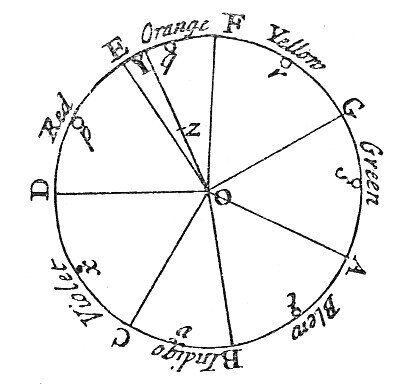
Newton was not only a physicist. He occupied himself all his life with alchemy and the interpretation of scripture, and his Observations upon the Prophecies of Daniel, and the Apocalypse of St. John appeared from his papers in 1733. The man who gave the rainbow seven colours also interpreted Revelation with its seven torches, seals and trumpets. This calls for a warning: whoever wants to see the seven colours of the rainbow in the seven torches before the throne is reading Newton into the Bible. The number seven lies not in the spectrum, which passes without boundaries from one colour into the next, but in the eye of the beholder. Many languages distinguish five or six colours in the rainbow.
Newton’s comparison has a long afterlife. The Jesuit Louis-Bertrand Castel proposed an ocular harpsichord in 1725, the clavecin oculaire, in which each key was to uncover a coloured glass, and later demonstrated such an instrument. Alexander Scriabin wrote a separate part for a colour-light keyboard in his Prometheus (1910). In harmonics, Hans Cousto developed in Die kosmische Oktave the idea of transferring frequencies across octaves into tones and colours, down to the orbital periods of the planets.
The rainbow is a circle
John describes the rainbow round about the throne, in the Greek text kyklothen, in a circle. That is more precise than it seems. Around 1300 Theodoric of Freiberg and Kamal al-Din al-Farisi already recognised that each raindrop refracts sunlight, reflects it at its back and refracts it once more on leaving. René Descartes calculated in 1637 that the light comes back concentrated at an angle of about 42 degrees to the point opposite the sun, and Newton explained why the colours are bent by different amounts. All drops at this angle lie on a cone around the line of sight. The rainbow is therefore really a circle around the shadow of one’s own head. We see only an arc because the ground cuts off the rest. From an aircraft or a mountain one sometimes sees it as a full ring.
Above, from the side: the sun's rays fall in parallel from behind. The dashed line from the eye in their direction meets the ground at the shadow of the head. The rainbow stands 42° from this line. Below, what you see yourself: a circle of 42° around the shadow of your head, of which the horizon leaves only the upper part. The higher the sun, the lower the shadow and the flatter the bow.
The comparison with the emerald is puzzling at first, for a rainbow is not green. Perhaps the colour of the centre is meant: green lies at the centre of the spectrum, where the fifth 3 : 2 lies in the octave of light, and at the centre of the rainbow stands the throne.
The colour circle closes like the octave
In music the octave returns to the beginning. C5 sounds like a higher C4. This is called octave equivalence, and it is why the tones can be arranged in a circle. It becomes a closed circle of fifths with twelve tones only in equal temperament, however (see The Tonnetz). With light it is different. Light of double the frequency does not look like the same colour. It is ultraviolet and invisible. The spectrum is a line from red to violet, not a circle.
And yet the eye closes this line into a circle. Red and violet, the two ends, seem related to us, and between them lies a colour that does not exist in the spectrum at all: purple or magenta, a mixture of both ends that arises only in the eye. This gives the colour circle, as Newton already drew it and as Goethe made it the foundation of his Theory of Colours (1810). The circle of tones is grounded in physics, in the ratio 2 : 1, the circle of colours in physiology, in our seeing. Circles they both are.
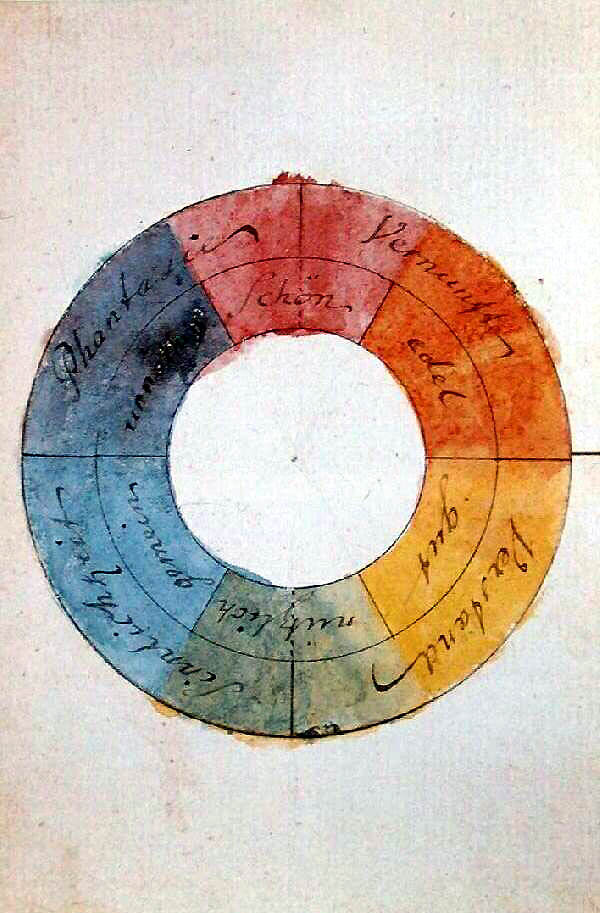
The hexagram of colours
The eye has three kinds of cones, most sensitive at about 420, 534 and 564 nanometres, in the violet-blue, the green and the yellow-green. That is why almost all colours can be mixed from three primaries. For light they are red, green and blue. Together they give white, which is how every screen works. For pigments they are cyan, magenta and yellow. Each pigment swallows part of the white light, and together they give black, which is how printing works. Each printing colour is white without one colour of light: cyan is white without red, magenta white without green and yellow white without blue.
Place the six colours in the colour circle, and the three colours of light form a triangle and the three printing colours a second one standing on its head. Together they form a hexagram, and opposite points are complementary colours. The hexagram, which in mysticism and Kabbalah stands for the interpenetration of above and below, is here quite soberly the order of colours: the triangle of light that adds up to white and the triangle of substances that leads to black.
The colour circle with the three primaries of light, red, green and blue, and the three primaries of printing, cyan, magenta and yellow. At the centre their sums, white and black.
The colour cube is a stella octangula
This becomes clearer still in space. Arrange each colour by its shares of red, green and blue, and you get the colour cube: black lies in one corner, white in the opposite one, the colours of light red, green and blue at the three corners next to black, and the printing colours cyan, magenta and yellow at the three corners next to white. The diagonal from black to white is the grey axis.
The eight corners of a cube fall into two groups of four, in which no two corners are joined by an edge of the cube. Each group forms a regular tetrahedron, and together they make the stella octangula, which appears on the page about the throne as the image of the Merkabah. In the colour cube this division follows the theory of colour exactly. One tetrahedron has the corners white, red, green and blue, the colours of light with their sum. The other has the corners black, cyan, magenta and yellow, the four colours of four-colour printing, CMYK.
The colour cube: each colour has its place according to its shares of red, green and blue. Its corners form two tetrahedra, that of light and that of print. The third view looks along the grey axis.
Looking at the cube along the grey axis, white hides black, and the remaining six corners form a regular hexagon, with red, yellow, green, cyan, blue and magenta in the order of the colour circle. This is the sixfold view of the stella octangula, and it is the hexagram of colours. Light and darkness stand on the axis, and the colours circle around it. This recalls the first day of creation, on which God divided the light from the darkness.
Goethe’s inverted spectrum
Newton let a narrow beam of sunlight fall onto the prism in a darkened room, a bright slit on a dark ground. Goethe turned the experiment around. He looked through the prism at a black stripe on white paper, a dark slit on a bright ground. Then too a spectrum appears, but a different one: cyan, blue, purple, red and yellow. At its centre shines exactly the colour that is missing from Newton’s spectrum and that the eye otherwise only infers from the two ends.
The experiment in a darkened room, calculated with real refraction in flint glass, the dispersion enlarged. Newton: a narrow bright slit becomes a spectrum with a green centre on the screen. Goethe: broad light with a dark stripe. On the screen the light stays white, only the edges of the shadow fringe with colour, and purple appears in its middle. Drag to turn the experiment.
Above, Newton's spectrum with its green core, below, Goethe's inverted spectrum with its purple core. The slider chooses a place: the two colours there are complementary.
Each colour of the inverted spectrum is the complement of the colour that lies at the same place in Newton’s. Where green stands there, purple stands here, where red stands there, cyan here, and together the two give white. Physically, Newton’s theory explains this completely, for the inverted spectrum is white light with Newton’s spectrum missing. Goethe, however, saw in it the proof that colours arise from the interplay of light and darkness and are not contained in light alone. The philosopher Olaf L. Müller has shown in his book Mehr Licht (2015) how far this symmetry reaches: for every experiment of Newton’s there is an inverted one in which light and darkness swap roles and the complementary colours appear. The polarity even bore fruit beyond the visible octave. After Herschel had found infrared beyond the red end in 1800, Johann Wilhelm Ritter, thinking in these polar terms, looked for the counterpart at the violet end and found ultraviolet in 1801.
The two spectra correspond to the two triangles of the hexagram and the two tetrahedra of the colour cube. Newton’s spectrum with its green core belongs to light and its primaries red, green and blue, Goethe’s spectrum with its purple core to darkness and the printing colours cyan, magenta and yellow. This is the polarity that stands behind the hexagram and the stella octangula on the page about the throne, here as an experiment anyone can repeat with a prism.
Goethe of all people, however, is also a witness against the idea of this page. He rejected Newton’s mathematics of colour and also his comparison of the colours with the musical scale. Colour and tone, he held, cannot be compared directly. At most both can be related to a common higher formula. The next section proves him right on one point.
Complementary colours are not an interval
Opposite colours in the hexagram combine to white. For the colours of the spectrum these pairs can be calculated exactly from the standard data of colorimetry (CIE 1931), with daylight as white. Do they stand in a fixed ratio, as two tones an octave apart do?
The answer is no. Blue at 480 nm and yellow at 578 nm stand in the ratio 1.20, quite exactly a minor third 6 : 5. Orange at 600 nm and cyan at 490 nm lie at 1.22, red at 650 nm and cyan at 493 nm already at 1.32. At the edges of the spectrum, deep red and violet, the ratio grows to 1.42, close to the tritone with . The greens between about 495 and 565 nm have no partner in the spectrum at all. Their opposite is purple, which exists only in the eye. And choose a different white, and the pairs shift.
For each spectral colour the ratio of the longer to the shorter wavelength of its pair, calculated from the CIE 1931 standard data with daylight D65 as white. For comparison the intervals minor third, major third, fourth and tritone. Grey: the greens, whose opposite is purple.
Complementary colours therefore follow the three cones of the eye, not a ratio of frequencies. Only the core of the colour circle, blue opposite yellow, lies roughly a minor third apart.
What remains open
The rainbow shows only one of almost sixty octaves. If in John’s image it stands for the whole spectrum, then of the light around the throne we see almost nothing, like the prisoners in Plato’s cave who see only shadows.
That the eye sees just this octave has a sober reason: sunlight is especially strong in this range, and air and water let it through well. Whether one wants to see more in this than the adaptation of life to the sun is a question of interpretation.
Sources and further reading
Sources
- René Descartes, Les Météores, Leiden 1637 (the rainbow)
- Isaac Newton, Opticks, London 1704
- Louis-Bertrand Castel, Clavecin pour les yeux, Mercure de France, 1725
- Wilhelm Herschel, Experiments on the Refrangibility of the Invisible Rays of the Sun, Philosophical Transactions 90, 1800
- Johann Wilhelm Ritter, note on the discovery of ultraviolet rays, Annalen der Physik 7, 1801
- Johann Wolfgang von Goethe, Zur Farbenlehre, Tübingen 1810
- Alexander Skrjabin, Prometheus. Le poème du feu, 1910
Further reading
- Hans Cousto, Die kosmische Oktave, Essen 1984