Christmas, the throne of God and the number 24
24 elders around the throne, four creatures with six wings each, the magic circle, the Advent wreath, St John's Day and the Ægishjálmur. The number 24 in mysticism and religion.
A reminder of what number theory says about 24 (see The number 24): the primes are arranged as twins in the rhythm of six. Up to the highly composite number 24, every twin position is occupied. There are exactly four rhythms of six. From 25 on, five destroys this order step by step. In the geometry of space, too, in sphere packings and their symmetries, 24 is of great importance, and again through the interplay of four and six.
This can be read as a parable: up to 24, paradise is in order. With 25 begins the fall, the fall into matter. Five counts as the number of the human being. According to tradition Jesus was born in the night before 25 December. The 24th is Christmas Eve, the 25th Christmas Day. God (7) comes as a human being (5) into matter (10), and through matter the ennobling of the human being takes place, the great alchemical work.
The same finding can also be read without judgement: the strict, crystalline, infinite order of the rhythm of six, static space, is filled with living combinatorics and irregularity, the principle of life. The trinity of space, length times breadth times height, carries life with all its constructive and destructive forces. The question behind this page is whether the authors of biblical texts were Gnostics who encoded Platonic knowledge, arithmetic and geometry, in seemingly naive images. Number theory deals with quantities and is thus pure geometry.
Four rhythms of six up to 24, every twin position occupied. 25 is the first empty place.
The throne of God in Revelation
In the fourth chapter of the Revelation of John, the seer is called up into heaven and sees a throne with one seated on it, surrounded by a rainbow. Around the throne stand 24 further thrones with 24 elders in white robes with golden crowns. From the throne come lightning and thunder. Before it burn seven torches, the seven spirits of God. Before the throne lies a sea like crystal, and around it stand four living creatures: like a lion, like an ox, with a human face, and like a flying eagle. Each has six wings, and they cry “Holy” without ceasing. The 24 elders fall down and lay their crowns before the throne.
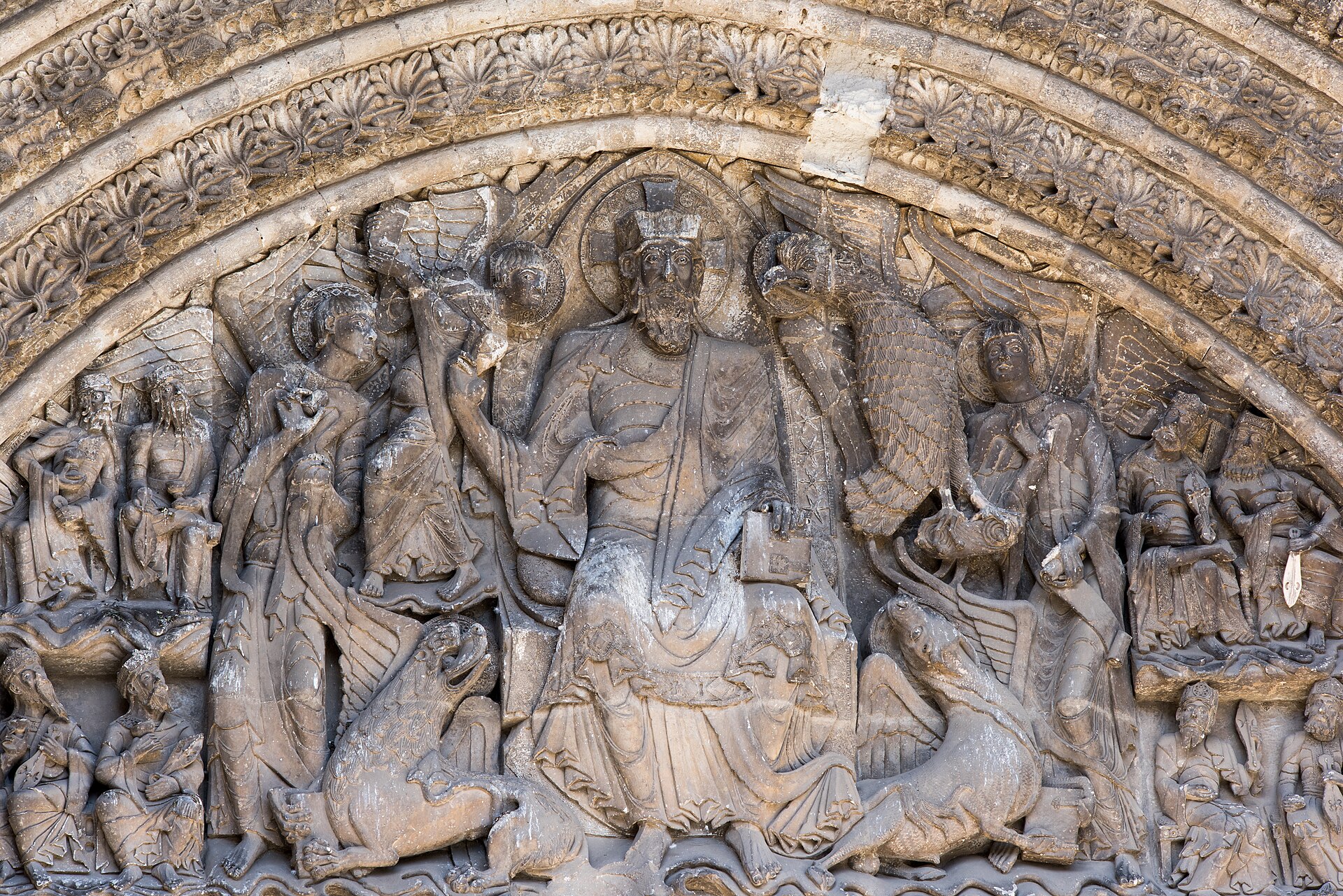
Several numbers of the rhythm of six reappear here:
- Seven: up to 24 exactly seven primes lie in the rhythm of six (5, 7, 11, 13, 17, 19, 23), matching the seven spirits of God. The one within the rhythm of six stands for the creator: six days of creation, and on the seventh he rested. Add 1, 2 and 3, and you have ten.
- 24: the 24 elders correspond to the order of primes up to 24.
- 4 × 6: the four creatures with six wings each point to the four rhythms of six up to 24. The four creatures have the same meaning as the four elements fire, air, water and earth, that is, as the tetractys, as mystics understood it from antiquity into the modern age.
- The rainbow around the throne points to the octaves of electromagnetic waves, a subject still awaiting elaboration.
The division of ten into three and seven recalls the kabbalistic Tree of Life, in which an abyss separates the three highest sefirot from the other seven. John had his vision on the Greek island of Patmos, and the New Testament was written in Greek, the language of the Platonic philosophers. Revelation ends with a threat against anyone who adds to or takes away from its words (Rev 22:18–19). Pythagoreans and Platonists alike saw number lore and religion as a unity, and in the end both come to the same. Is the last book of the Bible an encoded message from the Platonists to posterity?
Coincidence? Or did the seer glimpse truths that correspond to number theory and geometry? Did an early Christian philosophy of religion rest on knowledge of the Gnostics that has been lost to us? These questions are open for discussion.
Twelve disciples, 24 elders
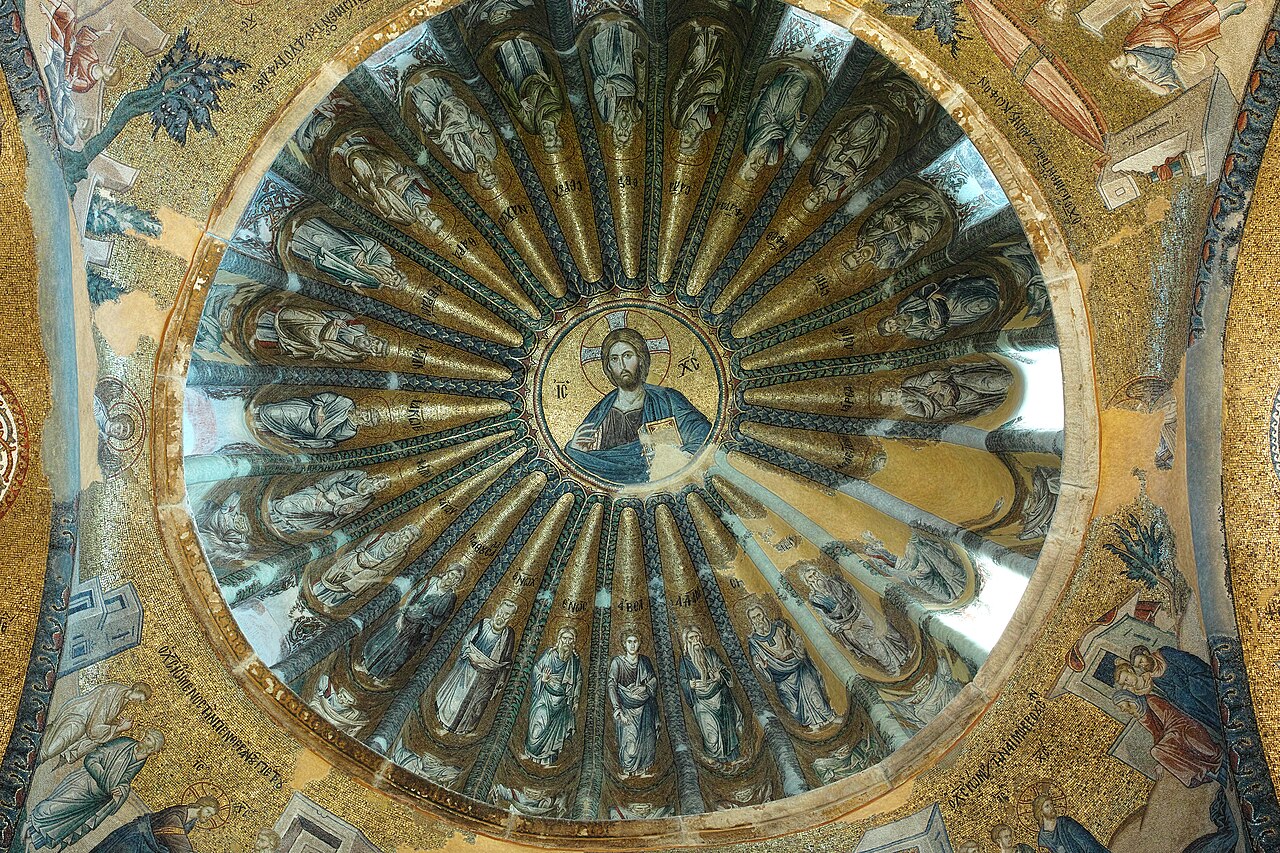
The twelve disciples around Jesus, God in the world, and the 24 elders around the throne relate like even and odd numbers. The very words “disciples” (the young) and “elders” suggest as much. Even and odd numbers are traditionally assigned the polarity of feminine and masculine, and the Gnostics, like the Eastern teachings, sought to overcome this polarity. That the twelve disciples symbolise the twelve signs of the zodiac is hardly open to doubt. The twelve signs in turn divide into the four elements, that is, into the four creatures with their six wings.
The Egyptians already had the 24-hour day, twelve hours of day and twelve of night, another polarity. Pythagoras is said to have studied long in Egypt. But it is also true that whoever invents a division of time will, for practical reasons, choose an even, highly composite number to avoid fractions. 24 would be a favourite even without deeper reasons. Yet 16 or 32 would also have been possible.
The magic circle
Particularly interesting is the magic circle as handed down in grimoires such as the Clavicula Salomonis (Key of Solomon). The description of the throne is mirrored in it with astonishing precision, and it contains the star polygons indispensable for the tetractys. The magician draws the circle as protection, stands at its centre, invokes the four elements and begins his work in trance. The symbolism is thus meant to act on the unconscious.
The structure of a magic circle, schematically: a square with four crosses, four hexagrams attached, four pentagrams outside the circle, twelve fields around the edge.
At the centre stands a square with four cross-shaped projections. Because the crosses attach directly to the square, there are 4 × 3 points, twelve in all. Each group of three points to a hexagram, four six-pointed stars in all: the four creatures with their six wings, and the four rhythms of six up to 24. Around the edge lie the twelve signs of the zodiac. Outside the circle, however, stand four pentagrams.
Magic circles appear in several grimoires up to the 18th century, one of the earliest being a French work, the Douze Anneaux, also called the Grimoire of Abognazar, for instance in the Ars Nova part of the Lemegeton and in manuscript versions of the Clavicula Salomonis, a jumble of cryptic signs with instructions for magical practice. In the circle the magician occupies, as it were, the throne of God, to act from the centre. One must remember that the magicians, Rosicrucians and Kabbalists of the Middle Ages and early modern period were mostly devout Christians who wanted to emulate Christ. They stood between fear of God and the longing for an inner vision of God, but also for miracles like those of Jesus, and the range reached from selfless improvement of the world to selfish fantasies of omnipotence.
On the outer rim of the circle, besides the four cardinal directions, the four elements, stand the names of the seven archangels and the signs of the seven planets, in the order Sun, Venus, Mercury, Moon, Saturn, Jupiter, Mars. The seven torches before the throne, seven archangels, seven planets: up to 24 there are exactly seven primes in the rhythm of six, 5 and 7, 11 and 13, 17 and 19, and 23, the first primes of creation in six days. With 1, 2 and 3 they make ten again.
Four quantities can be assigned to the four start figures: triangle = 3 = energy, pentagram = 5 = time, hexagram = 6 = space, double pentagram = 10 = matter. The message of the magic circle would then be: to connect with the macrocosm, time and matter must stay outside. And indeed the disorder of the primes begins after 24, with 25 = 5 × 5. Number-theoretically the pentagram is 2.5.
Tau and divisors
A T is drawn in each hexagram of the circle, the Greek tau. The two original languages of the Bible, Hebrew and Greek, share it. In Hebrew it is the last letter, completion. In Ezekiel (9:4) it is the mark on the foreheads of the saved, and some interpreters of Revelation (7:2–3) see in it the seal on the foreheads of God’s servants. It is the first letter of the Torah, and in the time of Francis of Assisi it was worn as an amulet against the plague. In the protective circle it is meant to protect the magician, perhaps from his own daring in wanting to be like God.
An attractive parallel: in number theory the small τ is the sign of the divisor-counting function, which counts how many divisors a number has. The hexagram stands in number theory for 6 : 2 = 3, four hexagrams give 12, the twelve disciples, tribes, signs of the zodiac and gates, and they stand inside the circle. The pentagram stands for 5 : 2 = 2.5, four pentagrams give 10, in the Kabbalah the number of matter, and they stand outside. Whether this is coincidence could only be settled if one knew when and why τ became the sign of the divisor function.
Other circles
Another, very similar circle does without the seven angel names and planets, but has a triangle outside at the top: the place where the summoned spirit is to appear. Other seals look quite different at first and are yet only the reversal of the magic circle: a hexagram in the centre and six crosses around it, 6 × 4 = 24. This leads straight to the spatial Star of David, which has a sixfold and a cross-shaped view.
The Advent wreath
The coming of Christ is awaited on four Sundays of Advent. From 1 to 24 there are exactly four rhythms of six. After that the disorder begins. Do the magic circle and the Advent wreath with its four candles have the same meaning? Is the Advent wreath a symbol of the magic circle of the best-known magician of the West? Behind such questions lurks an uncomfortable one: what came first, the intention to create a symbol or the person of Jesus? One can also ponder what the star polygons have to do with the star of Bethlehem.
The Merkabah
In exactly the same sense as the magic circle, as a link to the macrocosm, stands Jewish Merkabah mysticism. The Merkabah is the throne-chariot of God in the vision of Ezekiel, borne by the same four creatures as in Revelation. The Talmud describes beholding it as mortally dangerous: only one who is pure of heart and of mature age survives it unharmed. In this context the meaning of the pentagram as a protective amulet becomes clear, as do the four pentagrams around the magic circle.
The Merkabah is represented as the stella octangula, a three-dimensional hexagram of two interpenetrating tetrahedra with exactly 24 faces. It has two important views: a sixfold and a fourfold one. Join its outer vertices and you get a cube that contains a 24-faced solid within it. Here lies a parallel to the Masonic symbolism of working the rough stone into a cubic stone.
The stella octangula with its enclosing cube: 24 triangular faces, eight vertices.
The throne is space itself
Turn a model of the stella octangula in your hand from the hexagonal vertex view to the square edge view and back, and you see: the inside of the magic circle is a flat projection of exactly these two views. Indeed all hexagrams in the circle are turned so that their points aim at the corners of the square. Inside the circle there are only three-, four- and six-sided forms. The pentagrams are excluded for a reason: densely packed circles and spheres give only triangles, squares and hexagons (see Space filling without gaps).
For Platonists and Kabbalists, all-surrounding space itself was the first cause, the loving primordial God, and this principle is represented by the hexagram. Time-bound matter, by contrast, is the work of the demiurge, the creator god, and this principle is represented by the pentagram. This order of space is the misunderstood ancient cosmology, and it sheds light on the equally misunderstood number mysticism and magic. In it too, 12 and 24, from the combinatorics of 1, 2, 3, 4, 6 and 8, are central (see Kissing numbers and 24 and The Kabbalah). What makes the cube and its related solids seem divine, the full sphere of their solid angles and their 12- and 24-foldness, is set out under Sacred geometry. Cubes as a “House of God” are many, from the Kaaba to the Holy of Holies of the Temple.
A caution: the literature on the old Jewish traditions offers no evidence that the spatial six-pointed star was equated with the Merkabah. Even the flat hexagram is attested as the Shield of David among Kabbalists only from the 14th century, as protection against spirits and demons, although it occurs as a cultic sign in many ancient cultures. The link between Merkabah and stella octangula was spread only recently, on the internet, by Drunvalo Melchizedek. And the stella octangula is only one symmetry among many in this space lattice.
Lévi’s drawing of the cherub with four heads and six wings, which he calls the “pentacle of Pythagoras” (see Éliphas Lévi), shows an eightfold symmetry in its square view, like the Merkabah seen along an axis of the cube.
The 24-inch gauge and St John’s Day
Freemasonry descends from the stonemasons’ guilds of the cathedral builders, who supposedly traced their knowledge back to ancient Egypt. An important symbol in the ritual is the 24-inch gauge, a reminder to divide one’s time carefully. The ritual work symbolically takes place “from high noon to high midnight”, again 2 × 12.
On 24 June 1717, according to tradition, four existing London lodges joined to form the first Grand Lodge, 4 × 6 = 24. Since then Freemasons worldwide have celebrated 24 June, St John’s Day. But the feast of the birth of John the Baptist at the summer solstice existed long before, as the counterpart to Christmas at the winter solstice (by the Julian calendar then in use). Its occasion was the Baptist’s saying about Christ: he must increase, but I must decrease. John and Jesus thus stand for the longest and the shortest day, Christ as a solar symbol. In Christian Freemasonry the Worshipful Master, who sits in the east where the sun rises, embodies the person of Jesus.
In front of the temple of the United Grand Lodge of England there is an inlay with a hexagon and a star of 2 × 12 = 24 rays. This theme of 24 contains the tetractys: 1 + 2 + 3 + 4 = 10 and 1 × 2 × 3 × 4 = 24.
I Ching and Ægishjálmur
Order and rule are also symbolised by two systems from quite different cultures that are strikingly similar: the Chinese I Ching with its eight trigrams, and the Icelandic Ægishjálmur, the “helm of awe” from Icelandic grimoires such as the Galdrabók, a book of spells with runes, signs, protective charms and lists of unlucky days. Both have eight axes with three elements each: 8 × 3 = 24.
The Ægishjálmur, as an original construction: eight arms with three cross-bars each, 24 in all.
In the Nordic countries the Ægishjálmur was considered the most important amulet. It was meant to help its bearer create order out of chaos and complete every task, and was held to be powerful protection, and in the 17th century owning such magical signs could be prosecuted as witchcraft in Iceland. Who copied from whom cannot be told. Whether it is coincidence, inspiration or the application of mathematical knowledge remains more open in this example than in the Christian ones.