Éliphas Lévi – pentagram and hexagram
The 19th-century French Kabbalist made the pentagram and hexagram core symbols of modern esotericism.
Éliphas Lévi, born Alphonse Louis Constant (1810–1875), is regarded as one of the most influential occultists of the modern age. Hardly an esoteric current after him does without his images and terms, even if his name is rarely mentioned. His main work, Dogme et rituel de la haute magie (Dogma and Ritual of High Magic, 1854–1856), contains allegorical drawings that put the star polygons of the tetractys at the centre.
The pentagram
For Lévi the pentagram, which the Gnostics called the “blazing star”, is the sign of omnipotence and spiritual self-mastery, the star of the magi and the sign of the Word made flesh. Depending on the direction of its points it represents good or evil: with one point upwards the lamb, with two points upwards the goat. It is initiation and blasphemy, Lucifer or Vesper, morning or evening star, Mary or Lilith, victory or ruin, light or night. Lévi recalls Isaiah’s words about the shining star fallen from heaven, and the star of the Apocalypse that falls to earth, is called “Wormwood” and makes the waters bitter. Yet the pentagram profaned by humans still shines in the hand of truth, and the victor is promised that it will be set again in the place of the morning star. According to Lévi, all the mysteries of magic, all the symbols of Gnosis and all the Kabbalistic keys are summed up in the pentagram. Paracelsus, he says, already called it the greatest and most powerful sign.
Pentagram and hexagram are among the four start figures of the tetractys.
Baphomet
Lévi’s best-known drawing is Baphomet, a winged hybrid with a goat’s head, which he understood as a pantheistic image of the absolute. Between its horns it carries a torch, the light of revelation, and on its forehead an upright pentagram, the sign of human intelligence. Its hands point up and down towards two crescent moons, one light and one dark, as an image of the relation between good and evil, mercy and justice. The hands make the sign of esotericism, a reminder of secrecy.
Lévi explains every detail: the head combines dog, bull and ass and stands for the responsibility of matter and the atonement of bodily sins. The hands are human, to show the holiness of work. The lower body is veiled, an image of the mystery of universal generation, hinted at only by the staff of Hermes. The belly is scaled and to be imagined green, the semicircle above it blue. The female breasts bear of humanity only the signs of motherhood and work, that is, of redemption. The figure sits on a cube and rests on a sphere.
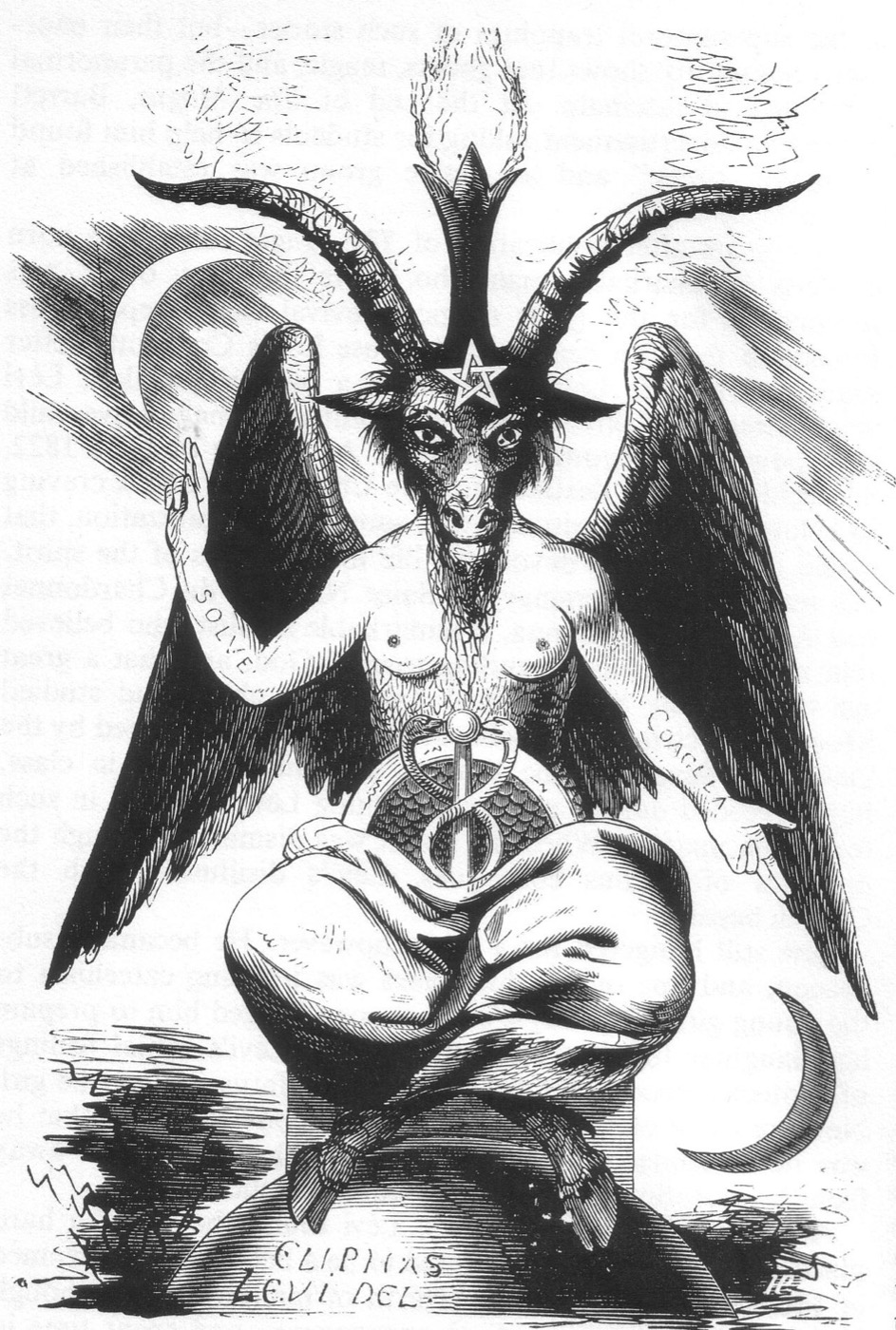
Elsewhere Lévi interpreted the figure differently and more negatively. One can see in it the angel fallen into matter, Lucifer, the “light-bearer” with the torch on his head. On this reading the alchemical process begins here: fall, purification, ascent. That is why the pentagram also carries the idea of redemption, as the star of Bethlehem.
The four creatures and the seal of Solomon
Another drawing by Lévi shows the cherub from the vision of Ezekiel with four heads and six wings. For Lévi the four heads are the fourness of the Merkabah, the six wings the sixness of the creation story. He calls the figure the key to all pentacles and the pentacle of Pythagoras. How Lévi arrived at the link with Pythagoras is open. That it exists is not in doubt.
The great seal of Solomon, the double triangle, Lévi depicts as two old men, the god of light and the god of reflections, the merciful and the avenging. The hexagram as a union of opposites is the same figure that in the rhythm of six stands for the interplay of even and odd numbers.
More on the cherub and the Merkabah under The throne of God and the number 24.