The Gnostics and the thirty aeons
Who the Gnostics were, how we know about them and why they thought in numbers: the Pleroma of Ogdoad, Decad and Dodecad, the Pythagorean tetrad in Irenaeus, Abraxas as 365 and the name Jesus as 888.
Several pages of this website mention the Gnostics: the Rosicrucians are said to have returned to the “Gnostic roots of Christianity”, the images of Revelation might encode Gnostic knowledge, Lévi calls the pentagram the “blazing star” of the Gnostics. This page explains who the Gnostics really were, how we know about them and what their teaching has to do with numbers and with the tetractys. It is more than one might expect.
What gnosis means
Gnosis is Greek for “knowledge”. What is meant is not knowledge gained by thinking or observing, but a knowing that saves: whoever recognises where he comes from and where he belongs is free. In the second century AD teachers appeared in Alexandria, Rome and Asia Minor who interpreted Christianity in this sense. The best known are Basilides in Alexandria around 130 and Valentinus, who came from Egypt and taught in Rome from about 140 to 160.
Their teachings differed widely, but some features recur:
- The true God is infinitely remote and unknown.
- The visible world was not made by him but by a lower maker, the Demiurge. The word comes from Plato’s Timaeus, where it names the divine craftsman.
- In man there is a spark from the upper world, imprisoned in body and matter.
- It is redeemed by knowledge, and after death the soul rises through the spheres of the planets, as in the Poimandres of the Hermeticists.
Whether “Gnosticism” ever existed as one movement is disputed among scholars. Only some groups called themselves Gnostics. The word Gnosticism was coined only in 1669 by the English philosopher Henry More, and scholars such as Michael Williams (1996) and Karen King (2003) consider the umbrella term misleading. Today one therefore often speaks more cautiously of Gnostic teachers and writings.
How we know about them
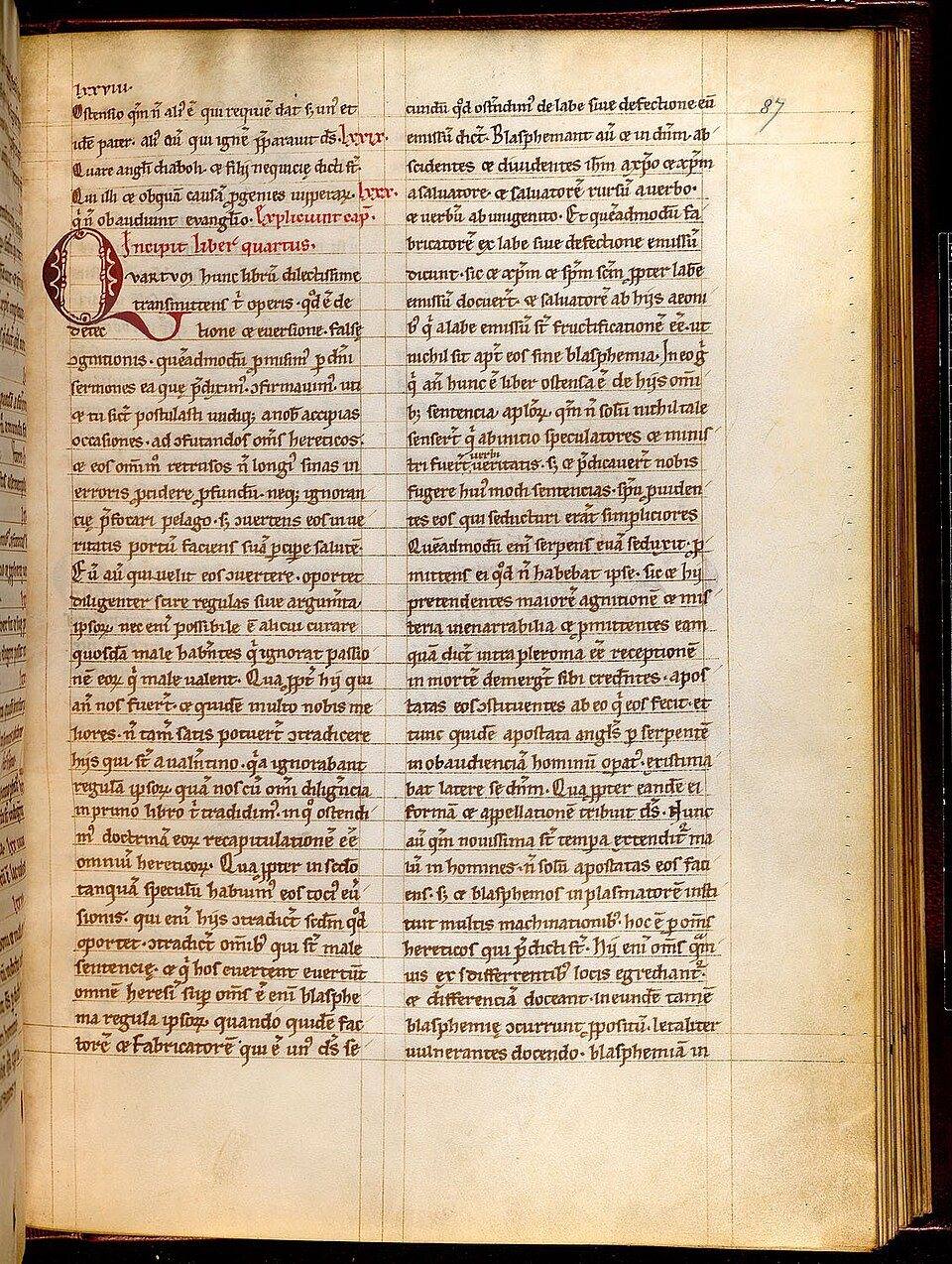
Until the twentieth century the Gnostics were known almost only from the books of their opponents. The most important is Irenaeus of Lyon, who around 180 wrote five books Against Heresies (Latin Adversus haereses). He had read Valentinian writings and knew followers in his own congregation in the Rhône valley. Around 230 Hippolytus of Rome followed with the Refutation of All Heresies, whose main part was rediscovered only in 1842 in a manuscript on Mount Athos.
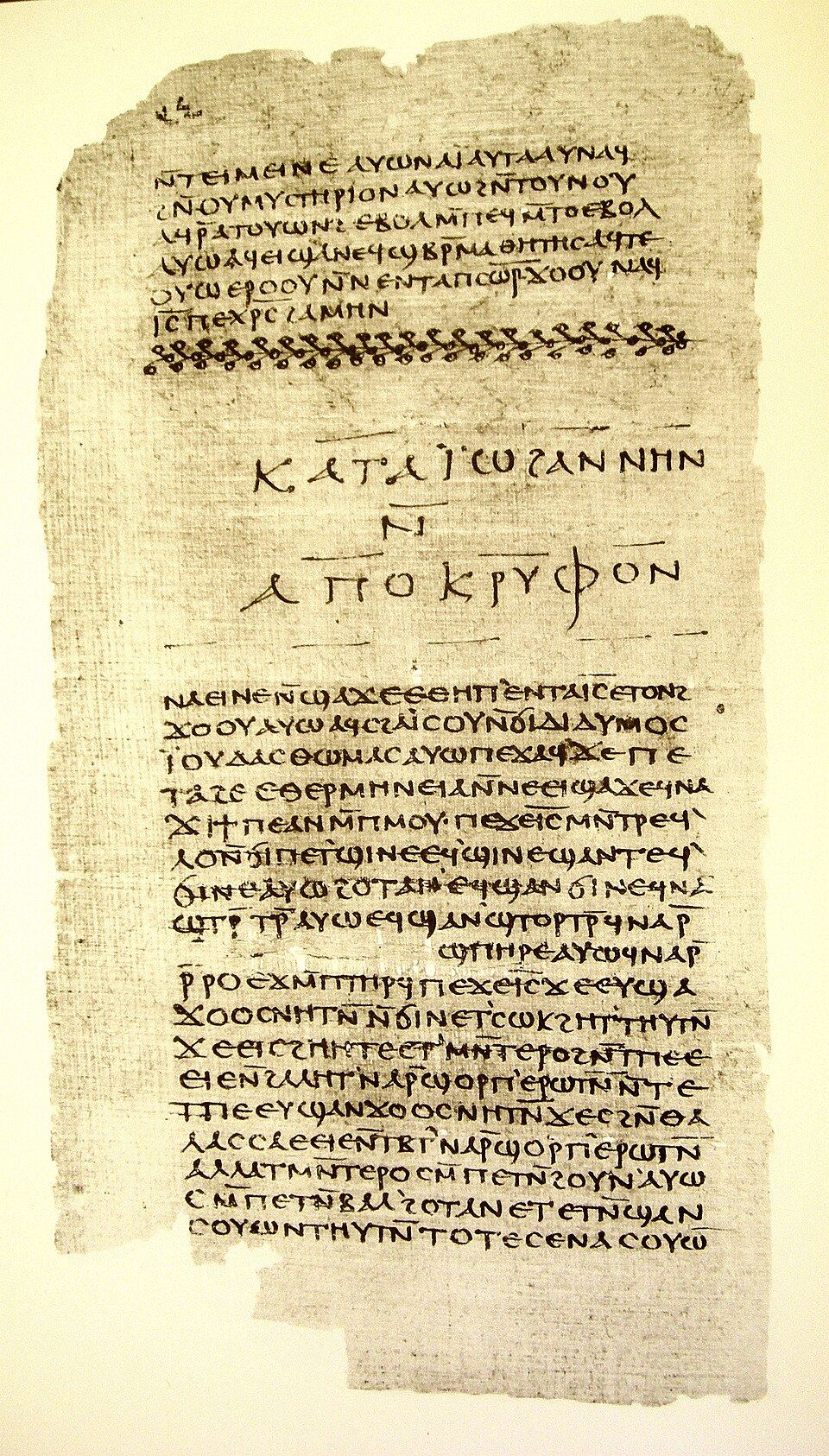
That changed in December 1945. Farmers near Nag Hammadi in Upper Egypt found an earthenware jar with thirteen papyrus books, most of them bound in leather, from the fourth century. They contain some fifty writings in Coptic, translated from Greek, among them the Gospel of Thomas, the Gospel of Truth from the circle of Valentinus and the Apocryphon of John. The same collection holds Hermetic texts and even a passage from Plato’s Republic. The books are kept today in the Coptic Museum in Cairo. For the first time the Gnostics spoke for themselves.
The Pleroma
The most detailed teaching that Irenaeus hands down is that of the pupils of Valentinus, above all Ptolemy. At the beginning stands an invisible, unbegotten ground, Bythos, the Depth, and with him Sige, Silence. From this pair further pairs go forth, each a male and a female power. They are called aeons. Together they form the Pleroma, the “fullness” of the divine world. Irenaeus lists the aeons exactly (Adversus haereses I 1.1–2):
The Pleroma according to Irenaeus. He calls the first four aeons the 'Pythagorean tetrad'. With Logos and Zoe, Anthropos and Ecclesia it becomes the Ogdoad. Logos and Zoe bring forth ten further aeons, Anthropos and Ecclesia twelve. The buttons show the names.
The very first step is remarkable. Irenaeus literally calls the four highest aeons “the first and first-begotten Pythagorean tetrad, which they also call the root of all things”. For the Pythagoreans the tetrad, the tetractys, is the “source of ever-flowing nature” (see What is the tetractys?). The Valentinians expressly took over this role.
The pairs are Pythagorean in conception too. Aristotle reports in the Metaphysics (I 5) a table of ten pairs of opposites of the Pythagoreans, among them odd and even, male and female, limit and unlimited. As there, in the Pleroma two always belong together, and only the pair brings forth something new.
At the end of the series stands Sophia, Wisdom, the youngest of the thirty aeons. She wants to grasp the unknowable Forefather, which is not hers to do, and is thrown into turmoil. A power called Horos, the Boundary, stops her and restores order. But from her suffering, outside the Pleroma, arises matter and with it the Demiurge, who builds the visible world without knowing of the upper one. This is how the Valentinians explain why the world is imperfect: it is the result of a false step at the edge of the fullness.
The numbers in the Bible
The Valentinians found their numbers again in the Gospels, and Irenaeus reproduces their reasons in detail in order to ridicule them (I 1.3 and I 3.2 to 3):
- Jesus lived thirty years in obscurity before appearing in public. That signifies the thirty aeons.
- In the parable of the labourers in the vineyard (Matthew 20) workers are hired at the first, third, sixth, ninth and eleventh hour, and 1 + 3 + 6 + 9 + 11 = 30.
- At twelve Jesus taught in the temple, and he chose twelve apostles. That is the Dodecad. That the twelfth apostle, Judas, fell away corresponds to the fall of Sophia, the twelfth aeon of the Dodecad.
- The Decad is shown by the letter iota with which the name Jesus begins, for iota has the numerical value 10. That is why the Sermon on the Mount says not one iota shall pass away (Matthew 5:18).
For Irenaeus this is arbitrary. But it shows how naturally these readers read the Bible as a text in which numbers mean something. The page Christmas, the throne of God and the number 24 asks exactly this question about the Revelation of John.
Pythagoras in Hippolytus
Hippolytus goes further than Irenaeus. He claims that Valentinus took his teaching not from Christ at all but from the philosophers: “The heresy of Valentinus is certainly, then, connected with the Pythagorean and Platonic theory” (Refutation VI 21, in the older English numbering VI 16). To show this, he first sets out the teaching of Pythagoras: unity as the unbegotten origin and the tetrad as the origin of bodies. He quotes the Pythagoreans’ oath by the tetractys and counts: “one, two, three, four, become ten, the perfect number” (VI 23).
This passage must be read with care. Hippolytus wanted to trace every heresy back to a pagan philosopher in order to expose it as un-Christian. But hardly anyone today disputes that Valentinus and his pupils thought in Platonic and Pythagorean terms. The Pythagorean tetrad in Irenaeus confirms it from within the teaching itself, and that a piece of Plato lay beside the Gnostic gospels at Nag Hammadi fits the picture.
Letters as numbers
The Greeks had no separate digits. They wrote numbers with letters: alpha is 1, beta 2, iota 10, rho 100 and so on. Every word therefore has a numerical value, the sum of its letters. This art is called isopsephy, and the Gnostics practised it eagerly, much like the Kabbalists with the Hebrew letters (see The Kabbalah).
A pupil of Valentinus named Marcus had followers as far as the Rhône valley, close to Irenaeus. The supreme tetrad itself, he related, had appeared to him in the form of a woman (I 14.1). She showed him the body of Truth, built from the 24 letters of the Greek alphabet, and taught him that the name Jesus has the number 888: 8 from the Ogdoad, then 80 and 800 when the Decad multiplies it tenfold and a hundredfold (I 15.2).
Basilides in turn taught that there are 365 heavens, as many as the days of the year. Their ruler is called Abraxas, and this name contains exactly the number 365 (I 24.3 and 24.7).
The name Jesus, Greek Iēsous, gives 888. Marcus reads it as 8 + 80 + 800, the Ogdoad multiplied once and twice by the Decad.
Abraxas gives 365, the days of the year and the number of heavens in Basilides.
The iota, with which the name Jesus begins, is on its own already 10, the Decad.
Units, tens and hundreds, nine letters each. Three of them (shown pale) had already fallen out of the alphabet and survived only as numerals.
Greek letters as numbers. The value of every word is the sum of its letters. 'All letters' shows the whole numerical alphabet.
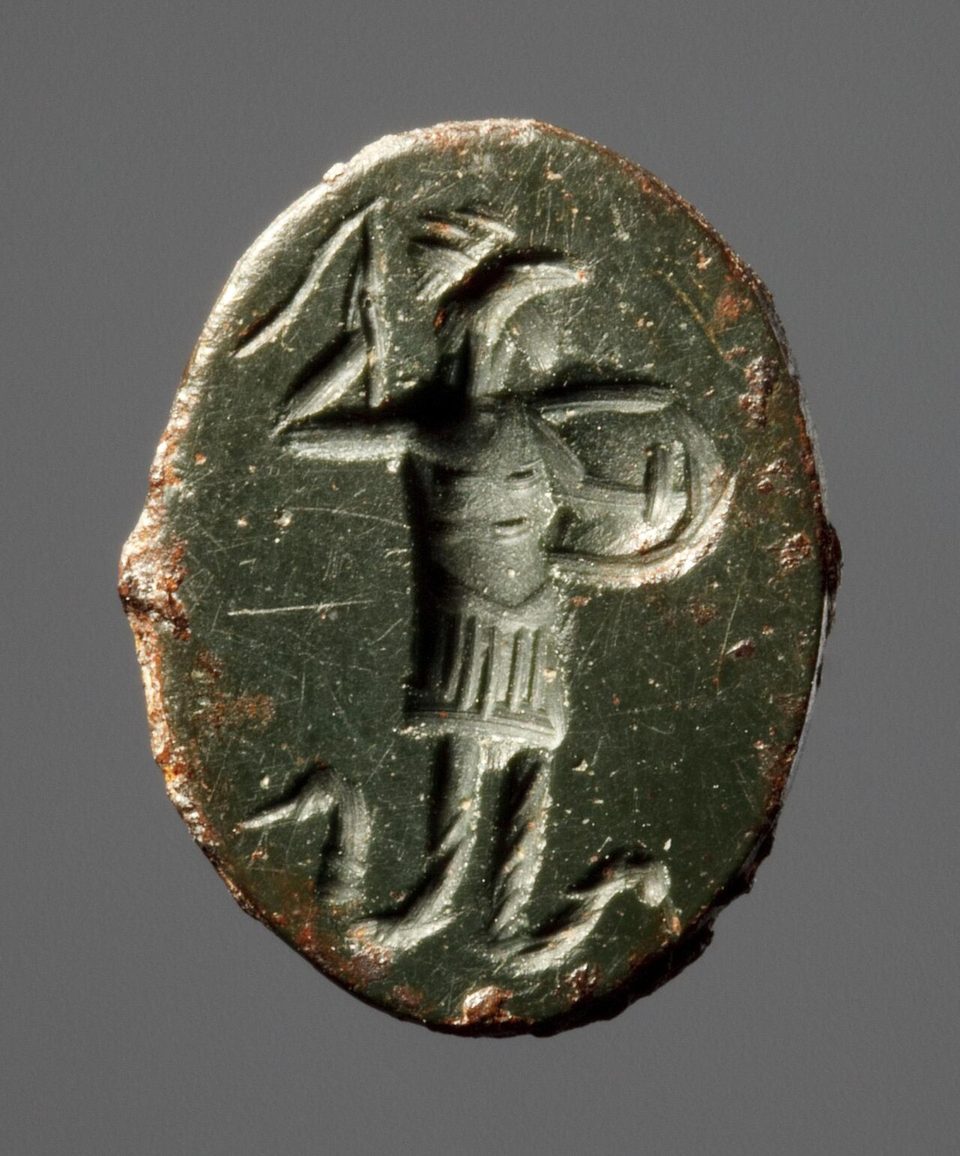
The name Abraxas, often also spelled Abrasax, is found on hundreds of engraved stones of the Roman imperial period, mostly together with a figure with a cock’s head and serpent legs. They were long called “Gnostic gems”. Most of them, however, belong to the general magic of Greco-Roman Egypt and share only the name with Basilides.
The soul’s way through the spheres
With the Gnostics the ascent of the soul is a path of numbers too. In the Apocryphon of John from Nag Hammadi the Demiurge Yaldabaoth creates twelve powers, seven of whom rule as kings over the seven heavens. The church father Origen, around 248 in his work Against Celsus (VI 24–38), describes a diagram of the Ophites, a Gnostic group that venerated the serpent of Paradise. It showed ten circles, enclosed by a single one, and seven rulers past whom the soul must go. Before each one it speaks a formula that opens the way, before Yaldabaoth, Iao, Sabaoth and the rest.
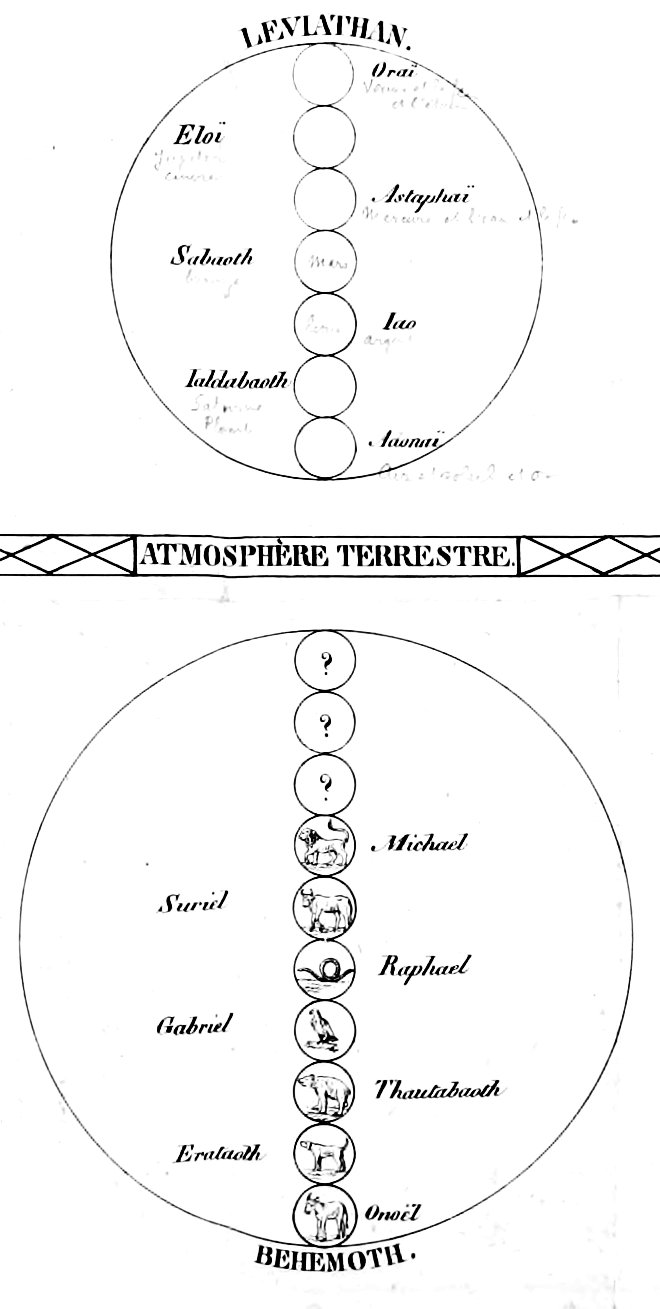
The seven rulers are the seven planets of antiquity, the same through which the soul ascends in the Poimandres of the Hermeticists. And as there, the goal is the Eighth, the Ogdoad, above all the planets. Among the Nag Hammadi finds there is even a Hermetic writing called The Discourse on the Eighth and Ninth.
What became of it
After the fourth century the Gnostic groups disappeared almost entirely. Later currents such as the Cathars in the Middle Ages taught something similar, two worlds, a spiritual and a material one, but a direct line to the ancient Gnostics cannot be shown.
The Rosicrucians and Freemasons of the seventeenth and eighteenth centuries knew the Gnostics only from their opponents, above all from Irenaeus, Tertullian, Clement of Alexandria and Epiphanius. The main part of Hippolytus was still unknown to them. Their image of a hidden, original Christianity drew above all on Hermeticism and the Kabbalah. When this website speaks of a “return to the Gnostic roots of Christianity”, it describes their own self-understanding, not a historical descent. Historically, gnosis was not a root from which the Church grew but a branch beside it, which the Church cut off.
The Gnostics were rediscovered in the nineteenth century. Jacques Matter’s Histoire critique du gnosticisme of 1828 was one of the first accounts. Eliphas Lévi made them forerunners of magic, but the pentagram he attributes to them plays no recognisable part in the surviving Gnostic writings of antiquity. In 1916 the psychologist C. G. Jung wrote the Seven Sermons to the Dead in the name of Basilides, in which Abraxas appears as a god beyond good and evil. Hermann Hesse took over the figure in 1919 in his Demian: “The god’s name is Abraxas.” One of the Nag Hammadi books was bought in 1952 for the Jung Institute in Zurich and is still called the Jung Codex, although it returned to Cairo long ago.
What remains
The Gnostics were not keepers of a secret geometry. But they built the divine world out of numbers, and out of exactly the building blocks this website is about: a tetrad as root, which they themselves call Pythagorean, pairs like the opposites of the Pythagoreans, the ten, the twelve and the eight, seven planetary spheres and an alphabet in which every word is a number. To the question whether numbers say something about God and the world, they answered yes. Their opponents, who denied it, handed their numbers down to us.
Sources and further reading
Sources
- Irenaeus of Lyon, Against Heresies, around 180 AD
- Hippolytus of Rome, Refutation of All Heresies, around 230 AD
- Origen, Against Celsus VI 24 to 38 (the Ophite diagram)
- The Nag Hammadi writings, found 1945
- Jacques Matter, Histoire critique du gnosticisme, Paris 1828
- Carl Gustav Jung, Septem Sermones ad Mortuos, 1916
- Hermann Hesse, Demian, Berlin 1919
Further reading
- Kurt Rudolph, Die Gnosis. Wesen und Geschichte einer spätantiken Religion, Göttingen 1977
- Christoph Markschies, Die Gnosis, Munich 2001