Pythagoras – the man
Origins, years of study, travels and the end in Metapontum: what the ancient accounts say about the life of Pythagoras and how much of it is certain.
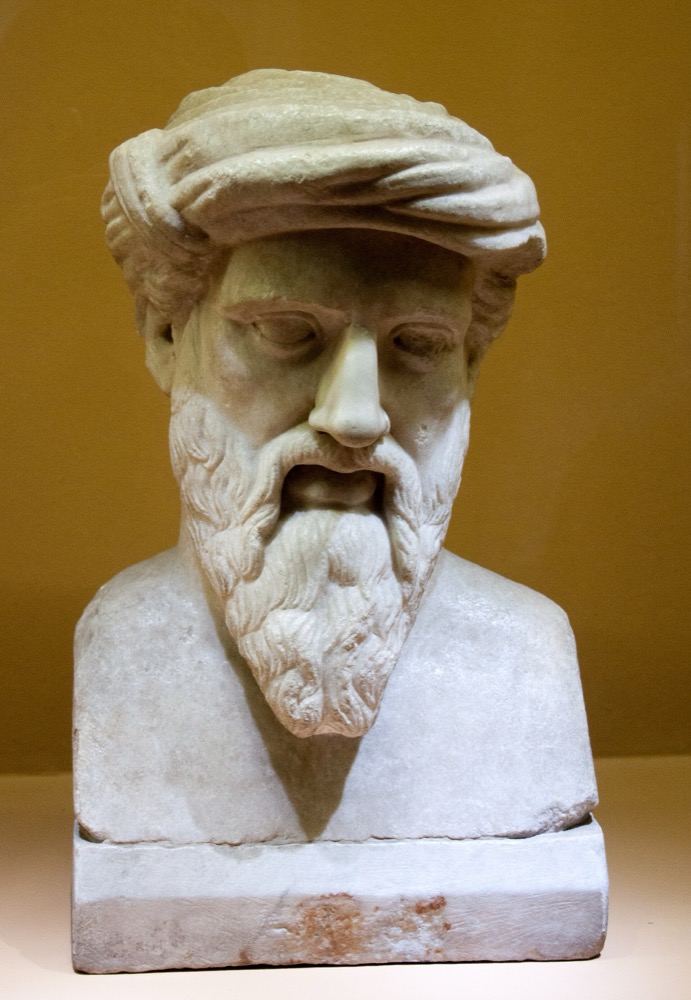
We know very little about Pythagoras himself, because he left nothing in writing. What counts as reasonably certain comes from a few fragments of some Presocratics and from scattered reports in Herodotus (c. 490 to 420 BC) and Plato (427 to 347 BC). Fairly reliable too are statements by Aristotle and his pupils Eudemus and Aristoxenus. Aristoxenus still knew the last Pythagoreans, pupils of Philolaus and Eurytus.
The most detailed ancient work on Pythagoras and his school was written by the Neoplatonist Iamblichus (c. 250 to 330 AD), some eight hundred years after Pythagoras. He cared less about a biography than about a picture of the Pythagorean way of life. The stations below and many of the sayings are therefore not historically certain. But the content of the teaching that has come down to us allows conclusions about the personality and about the basic structure of its thought.
This eight-part series follows in its themes an essay by Alfried Lehner in the German magazine TAU (1988). Like him, it relies above all on Iamblichus.
Origins and the legend of his birth
Pythagoras was born around 570 BC, probably on the Ionian island of Samos. His father Mnesarchus was a goldsmith and merchant there. Legends grew up around the birth itself. A Samian poet even called Pythagoras a son of Apollo.
Iamblichus tells the background like this: Mnesarchus came to Delphi with his wife on a trading journey and consulted the oracle about a voyage to Syria. The Pythia foretold a profitable journey and added that his wife was pregnant. She would bear a son who would surpass all people in beauty and wisdom and be a great helper to the whole human race. Mnesarchus concluded that the god would not have told him this unasked if the child were not truly exceptional. He renamed his wife Parthenis Pythaïs and the son Pythagoras, after Pythian Apollo who had announced him. Iamblichus explicitly rejects the suspicion of some authors that Apollo himself was the father.
Childhood and youth
The father gave his son the best education. After his death the young Pythagoras is said to have stood out for his seriousness and self-possession, so that even his elders treated him with awe. Wherever he appeared or spoke he drew every eye, and many took him for a son of the gods. Iamblichus portrays him as someone who ordered his nature through worship, learning and a carefully chosen way of life: steady in soul, moderate in the body, cheerful in word and deed, never overcome by anger.
This description seems exaggerated, and it betrays the purpose of the work. In the young Pythagoras Iamblichus already draws the goal of the Pythagorean way of life, the perfected human being. Still, we depend on this source if we want to trace his life.
Teachers and travels
At eighteen Pythagoras is said to have gone to his uncle on Lesbos to study with the philosopher Pherecydes of Syros. Old texts make it likely that he was his pupil. Pherecydes taught that the soul is immortal and returns again and again into a body. This belief had reached Greece through Orphism and strongly shaped Pythagoras.
Two years later he is said to have visited Thales of Miletus, the first Greek natural philosopher. On his advice he probably travelled on to Sidon in Phoenicia and was initiated into the mysteries celebrated in Syria.
After that he is said to have gone to Egypt, spending twenty-two years in close contact with the priests of Thebes and being initiated step by step into their wisdom. When the Persian king Cambyses conquered Egypt in 525 BC, he supposedly was taken captive to Babylon together with the country’s intellectual elite. There too he quickly won the priests’ trust and was initiated into all the mysteries. Aristoxenus, two hundred years later, even reports a meeting with Zoroaster. Iamblichus speaks of twelve years of study in Babylon.
Perhaps in Egypt and Babylon Pythagoras acquired the knowledge that later became the four sciences of the Pythagoreans: astronomy, geometry, arithmetic and music. This cannot be proved. It is plausible, though, since the theorem of the right triangle, for example, was known in Babylon more than a thousand years earlier.
Croton
Back on Samos he did not stay long. According to Iamblichus he avoided political offices that people tried to press on him and complained of the Samians’ indifference to learning. The city had asked him to share his knowledge. He did so in symbolic form, as he himself had been taught in Egypt, and found few serious listeners.
When he left Samos is disputed. Reports range from about 532 to 510 BC. Aristoxenus, the oldest reporter, has him leave at the age of forty, when the tyranny of Polycrates became unbearable, that is around 530.
Pythagoras settled in Croton in southern Italy and at once won many followers. After his first speech more than two thousand people are said to have joined him. Here he founded his religious and ethical brotherhood.
Persecution and death
The brotherhood quickly spread beyond Croton, and the more it flourished, the more suspiciously it was watched. Its aristocratic outlook roused political opponents. Once, it is said, an angry crowd set fire to the house where the Pythagoreans were gathered. All but two died in the flames. According to Iamblichus Pythagoras was not present and escaped.
The Pythagoreans scattered across Greece and tried to live there by the principles of the brotherhood. Slanders, that they led the young towards tyranny and conspired against the people, soon brought general persecution. Pythagoras moved to Metapontum on the Gulf of Taranto, where he is said to have died and been buried. Reports of his age range from about 75 to over 100 years.
An exceptional man
However reliable this account may be, Pythagoras was surely an exceptional man. Wherever he went, people gathered round him, were carried away by his words and revered him. Again and again his self-control is stressed. It reveals his goal, the ennobling of the whole human being, in body, mind and soul. This goal runs through everything we know of his teaching.