Pythagoras – the Pythagorean brotherhood
Admission tests and five years of silence, the oath on the sacred four, listeners and learners, the day in the order, Damon and Phintias and the end in persecution.
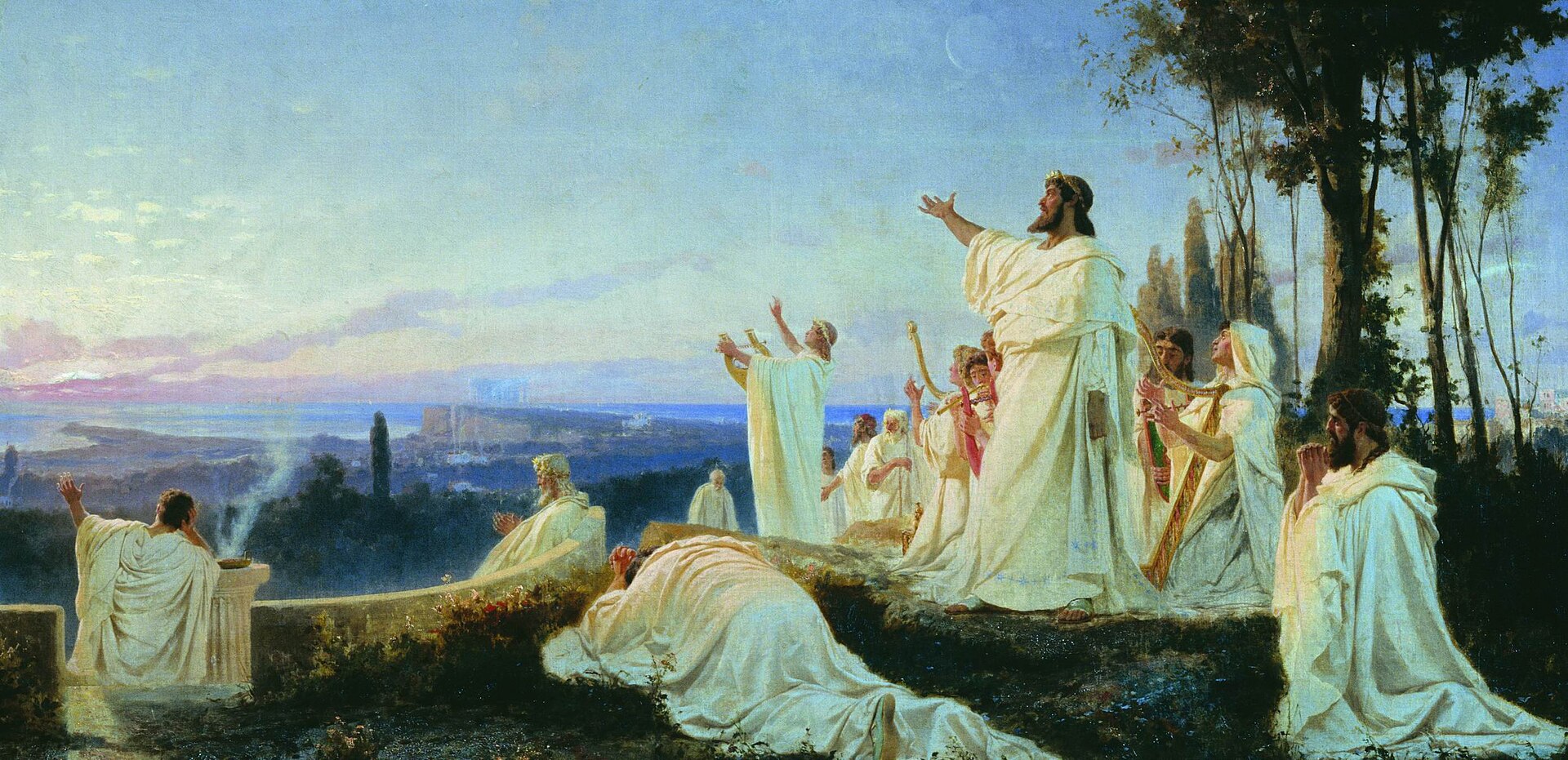
The Pythagoreans lived out their way of life in a brotherhood. It held property in common and admitted new members, explicitly including women, only after a long probation and strict tests. Theano is named as an important Pythagorean woman. Members recognised one another by the pentagram.
Admission
According to Iamblichus, Pythagoras tested candidates thoroughly. He asked how they stood with their parents and household. He watched when they laughed at the wrong moment, when they kept silent and when they spoke out of turn, what desires they had, which friends they kept and how, what they spent the day on and what pleased or grieved them. He also judged their build, gait and movements, for the visible was to him a sign of the invisible dispositions of the soul.
Those who passed were deliberately ignored for three years. This showed whether they were steadfast and eager to learn and whether outward honour meant nothing to them. Then came five years of silence as a test of self-control. During this time each person’s property passed to the community and was entrusted to members appointed for the purpose.
During the probation candidates heard the lectures only from behind a curtain, without ever seeing Pythagoras. Those whom the master judged worthy then became esoterikoi, those “from within”, for life. They could now hear and see Pythagoras inside the curtain. Those who were rejected got their property back twofold. The community then raised a burial mound for them as for the dead, and if one met them later, they were treated as different people.
This method did not win the brotherhood only friends. Iamblichus probably rightly suspects that among the later persecutors were rejected candidates as well as political opponents.
The oath on the four
At their initiation newcomers swore a sacred oath. It is said that they were made to count to four. As soon as they had said “four”, they were stopped: now they had spoken the oath. Whoever knows what one, two, three and four contain can open the door to the secret.
Iamblichus hands down an oath formula that runs in essence: By him who gave our race the sacred four, the source and root of ever-flowing nature. More on the page What is the tetractys?.
Listeners and learners
Those admitted were divided into two groups, each receiving the part of the teaching suited to its disposition. The akousmatikoi were, as the name says, listeners. They followed rules but did not philosophise themselves. The mathematikoi probably formed the inner circle.
From their circle a catechism is handed down. Its sayings answer three kinds of question: What is …?, What is most …? and What should one do or avoid? Iamblichus gives examples:
| Question | Answer |
|---|---|
| What are the Isles of the Blessed? | Sun and moon |
| What is the oracle of Delphi? | The tetractys. It is also the harmony of the Sirens. |
| What is most just? | To sacrifice |
| What is wisest? | Number, and after it, that which gives things their names |
| What is most beautiful? | Harmony |
| What is most powerful? | Insight |
Iamblichus even sees a link to the sayings of the Seven Sages, who lived before Pythagoras. The questions about doing and avoiding contain instructions for daily life and for sacrifice and burial. Everywhere the pictorial, symbolic language of the Pythagorean teaching shows.
The order also had officials called “politicians”, “administrators” and “legislators”.
A day in the order
Iamblichus describes the daily routine like this:
- In the morning they walked alone to quiet places with groves and shrines to prepare the soul for the day and order their thoughts.
- Then they gathered in the sanctuaries for teaching, learning and “the building of character”.
- Exercise followed: running, wrestling, work with jumping weights and shadow boxing against an invisible opponent.
- At midday there was bread with honey or a honeycomb, and no wine during the day.
- In the afternoon they attended to public affairs, foreign policy and dealings with strangers.
- In the late afternoon they walked in twos or threes, went over what they had learned and practised the noble studies.
- After a bath they met for the common meal, at tables of at most ten people. First they offered wine and incense. The meal ended before sunset and consisted of wine, barley cakes, bread, side dishes, cooked and raw vegetables and the meat of sacrificial animals.
- After libations there was reading together. The youngest read aloud, the eldest chose the text.
- Finally the eldest at the table spoke an admonition that ran in essence: harm no useful, fruit-bearing plant and no animal that does not harm people. Think reverently of gods, daimons and heroes, and likewise of parents and benefactors. Support the law and fight lawlessness. Then everyone went to rest.
Bedding and clothes were of white linen, and they used no furs.
Measure and equanimity
The advanced abstained from all that has a soul, that is, they lived as vegetarians, and drank no wine. Killing animals was to be felt as sacrilege, so that the horror of killing humans would grow all the greater and no more wars would be fought. Abstaining from wine was to prevent licentiousness and keep thinking clear.
The strict discipline required limiting sleep and food too. As an exercise they supposedly had choice dishes set before them and sent them back untouched. They despised fame and wealth and cultivated unaffected respect for their elders, sincere comradeship with their peers and unenvious encouragement of the young. Everything culminated in the principle: friendship of all with all.
Just as they kept their bodies always in the same condition, down to their weight, they also kept their temper in balance: not now merry and now downcast, but evenly gentle and cheerful. They were to be prepared for everything not in their power. If they did lose their balance through grief or anger, they withdrew to “digest and heal” the emotion. No punishment and no reproof, which they called “rearrangement”, could be given in anger.
Wise arbiters
In this way the Pythagoreans acquired a wisdom and practical skill that Iamblichus praises with many examples. They were often called in as arbiters:
- In a dispute over a large sum, a Pythagorean persuaded one party to pay four talents and the other to accept only two. Then he fixed the amount at three. So he seemed to have given each of them a talent.
- A stranger had lost a belt with money in the sanctuary of Asclepius. The law forbade picking up what had fallen to the ground. A Pythagorean advised him to take out the money, since that had not fallen on the ground, but to leave the belt.
- When cranes flew over the audience during a play, a stranger said to his neighbour: “Do you see the witnesses?” A Pythagorean heard it and brought the two before the council. It turned out that they had thrown people into the sea, who as they died had called the cranes flying over the ship as witnesses. Schiller used this motif in his ballad The Cranes of Ibycus.
Damon and Phintias
Iamblichus also tells how Pythagoreans stood by one another in need. This includes the story of the surety on life and death that Schiller, drawing on another source, shaped into his ballad Die Bürgschaft (The Pledge).
In the circle of the tyrant Dionysius of Syracuse people mocked the Pythagoreans, accusing them of arrogance, feigned loyalty and pretended calm. Others thought their attitude genuine. To find out, a trap was set for Phintias: he was accused of plotting against the tyrant’s life. All present testified to his guilt, and Dionysius, feigning outrage, sentenced him to death.
Phintias accepted the sentence but asked for the rest of the day to settle his affairs and those of his friend Damon, with whom he shared property. Damon was to stand surety for him. Dionysius and his people were astonished that Damon came at all. They were utterly dumbfounded when Phintias returned before the deadline to be executed. Dionysius embraced the friends and asked to be taken into their bond as a third. They refused, however hard the tyrant pressed. Iamblichus cites Aristoxenus, who claims to have heard the story from Dionysius himself.
Iamblichus also stresses how capable some Pythagoreans were as statesmen and rulers. In their time, he says, the best constitutions were found in Italy and Sicily.
Persecution
Once more: Iamblichus does not write history in our sense. But his high opinion deserves attention, and surely the brotherhood and its founder were people with high ethical aims.
Why such a community was so relentlessly persecuted is disputed. Political rivalry towards an aristocratic group, the hatred of powerful rejected candidates, petty intrigues and above all the jealousy of those who felt unequal to such aims probably worked together.
Rudolf Steiner saw the reason in this: Pythagoras and his pupils wanted to serve other gods than the people did. The people were content with their gods, but Pythagoras had to consign them to the realm of the imperfect. Therein lay the secret that must not be revealed to the uninitiated: his thinking gave the human soul a different origin from the gods of popular religion. Only to those carefully prepared could he convey that as souls they might in a certain sense regard themselves as higher than the popular gods. Steiner traced the many attacks back to this secret.
In every age the power of the mind has been uncanny to some people. The charge that something harmful to all is going on behind closed doors was usually only a pretext. The persecution of Freemasons in totalitarian states, or at least the banning of their meetings, is a striking parallel (see Freemasonry).
Harrowing is what Iamblichus reports about the end: the expelled, for whom burial mounds had been raised, attacked the Pythagoreans and tried to burn them all. Italians stoned them and threw them out unburied. With the knowers their knowledge perished too, for they had kept it only in their hearts. Only the obscure and unexplained reached outsiders, apart from a few faint sparks preserved by those who happened to be abroad. Such reports recall the downfall of the Templars and of some ancient mysteries.
What remains
The teaching lived on in smaller circles: with Philolaus, with Archytas of Tarentum, with Plato, who took Pythagorean ideas into the Timaeus, and later with the Neopythagoreans of Roman times (see The ancient sources).
For thousands of years people have come together to trace the mystery of creation and life. They listen inwardly and in this sense become esoterics. In the phenomena of the world they see signs of divine working and find in the tangible the symbolon, the token of a spiritual truth. For just as long there have been those to whom such a nature is a silent reproach.
So the path of human beings resembles a struggle for light, as in a forest in which every tree grows towards the light. Darkness is real and belongs to the nature of the world. But just as the world arose from polar forces and endures through them, as higher life reproduces through the polarity of the sexes and new knowledge grows from the clash of opinions, so the path of the spirit towards the light cannot be stopped. Much that was once guarded as mystery knowledge, such as the law of polarity, is common property today. So the seed of the old wisdom schools lives on. Here and there a mustard seed sprouts, blossoms and perishes again in the storm, but not without passing on something of its secret: the knowledge of the goal of creation, to develop upwards into the sphere of the spirit.