Arithmetic: number in itself
The first art of the quadrivium: why Plato thought counting a school for the soul, what the pebbles of the Pythagoreans teach and a path through the pages on numbers, divisors and primes.
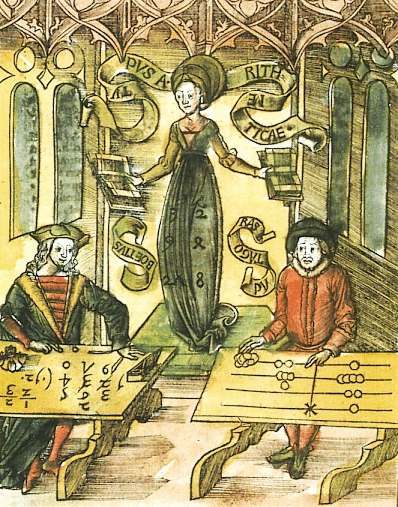
For Nicomachus arithmetic is the study of multitude in itself, of numbers as they stand on their own: even and odd, divisors and multiples, primes and figures. It stands at the start of the quadrivium because all the other arts presuppose it. Music needs the ratios, geometry the measures and astronomy the periods.
What counting trains
In the seventh book of the Republic Plato explains why counting of all things trains the mind. Show someone three fingers and his eyes tell him at once that they are fingers. But ask whether a finger is large or small and the senses are at a loss, for the same finger is large beside the small one and small beside the large one. Here the understanding must step in and ask what “one”, what “large”, what “number” really is. Arithmetic, says Plato, draws the soul from becoming to being.
One need not share Plato’s philosophy to see the core: in arithmetic one cannot talk one’s way out. A number is even or odd, a calculation is right or not. Whoever has learned that 1 + 3 + 5 + 7 always fits together into a square, and then understands why it must always be so, has learned something no opinion can shake. That is the experience of certainty, and whoever has had it once also recognises when it is missing.
The path through this website
- What is the tetractys? and The triangle of points: number as a figure of pebbles.
- The masculine and the feminine: even and odd, and why the Pythagoreans made a world order of them.
- Counting and Dividing: the numbers built from a few basic assumptions, with proofs to follow.
- Prime numbers and The sieve of Eratosthenes: the building blocks of all numbers.
- The order of the primes and Arithmetic with remainders: what is proven about the order and what remains open.
Exercise
Take twenty small stones, beans or coins. Lay out the first triangular numbers, 1, 3, 6 and 10, as triangles, and the first square numbers, 1, 4, 9 and 16, as squares. Then put two equal triangles together so that they form a rectangle, and count its sides. You will find the formula for the triangular numbers without having learned it. This, as far as we can tell, is probably how the Pythagoreans already did mathematics. The proof that it always holds is in What is a proof?.
Sources and further reading
Sources
- Plato, Republic VII 522c to 526c
- Nicomachus of Gerasa, Introduction to Arithmetic, around 100 AD
- Gregor Reisch, Margarita philosophica, Freiburg 1503