The masculine and the feminine
Why the Pythagoreans called the odd male and the even female, what Yin and Yang, the alchemists with sun and moon and the Gnostics with their pairs meant, what Eros has to do with it all and what of it still holds today.
Many pages of this website speak of the masculine and the feminine: odd numbers count as male, even ones as female. The triangle and the compass stand for the male principle, the four-sided figure and the square for the female. Sun and moon unite in the hermaphrodite of the alchemists, the aeons of the Gnostics appear in pairs, and in the hexagram two triangles interpenetrate. This page asks what these words actually mean, where the assignments come from and what one can still make of them today.
The most important point first: in all these teachings what is meant is not men and women but two principles that bring something forth together. The sexes served only as the most vivid image for the fact that from two different things a third arises.
Odd and even among the Pythagoreans
The oldest source is a table of ten pairs of opposites that Aristotle hands down in the Metaphysics (I 5) as the teaching of “other members of this school”, that is, of the Pythagoreans:
| limit | unlimited |
|---|---|
| odd | even |
| one | many |
| right | left |
| male | female |
| resting | moving |
| straight line | curved line |
| light | darkness |
| good | bad |
| square | oblong |
Ten pairs, and that is no accident, for ten was the perfect number to the Pythagoreans (see Pythagoras: the philosopher). The table is not a list of claims about the world but two columns of kindred things. What stands on the left belongs to limit, to form, to the determined, what stands on the right to the unlimited, to matter, to the open. Male and female are only one pair among ten.
But why does the odd stand on the side of the male? Ancient authors give two answers, and both are pictures made of the pebbles the Pythagoreans calculated with.
The first picture is halving. Plutarch explains in his essay On the E at Delphi (8): if you divide an even number into two equal halves, a receptive empty space is left in the middle. If you divide an odd number, a generative middle part is always left over. Therefore the even number resembles the female and the odd the male.
The second picture is the angle. If you lay angles of 3, 5, 7 … pebbles one after another around a single pebble, that is, the odd numbers, the result is always a square, whatever its size. The shape stays the same. If you lay angles of 2, 4, 6 … pebbles, the even numbers, you get oblongs, and each has a different ratio of sides: 2 : 1, 3 : 2, 4 : 3, 5 : 4 and so on, without end. Aristotle mentions this laying of angles in the Physics (III 4) as the Pythagoreans’ reason for saying that the even is the unlimited. This explains three lines of the table at once: odd, limit and square on one side, even, unlimited and oblong on the other.
The two ancient pictures to try out. Under 'Laying angles' the odd angles grow into squares, the even ones into oblongs with an ever new ratio. Under 'Halving' odd numbers leave a middle, even ones a gap.
It is remarkable which ratios the even angles yield in turn: 2 : 1, 3 : 2 and 4 : 3, octave, fifth and fourth, the three consonances of the tetractys. The unlimited, tamed by number, brings forth harmony. That is exactly the basic idea of the Pythagorean Philolaus: the world is fitted together from limiters and unlimiteds, and what joins them is harmony.
One is both
And where does one belong? According to Aristotle the Pythagoreans said it is both even and odd, and number proceeds from it. The reason is simple: add one to an even number and it becomes odd, add it to an odd number and it becomes even. One contains both possibilities. The origin is therefore neither male nor female but both in one. This image returns among the alchemists as the hermaphrodite.
Five is marriage
The first female number is two, the first male three, since one is both. Their sum, five, the Pythagoreans called marriage, as Plutarch reports in the same passage. The pentagram, the badge of the Pythagoreans and later the sign of man, has five points (see Pentagram and golden section).
How this website reads it
This website gives the old assignment a further geometric reason that is not found in this form in the ancient sources: the angle sum of a polygon with an odd number of vertices always comes to an odd number of half circles, that is, never to whole circles. Only two points close a circle, and only in even polygons do vertices lie exactly opposite each other (see Angle sums and full circles). The odd presses beyond itself, the even completes. Understood this way, “male” is what initiates and is incomplete, and “female” what receives and completes. This is an interpretation, but it matches Plutarch’s picture exactly: the middle that cannot be divided, and the space that can take something in.
The page on the Kabbalah looks for the same polarity in the spatial lattice, with faces as female and vertices as male, and in the rhythm of six of the primes the hexagram stands for the interplay of even and odd numbers.
Yin and Yang
Quite independently of Greece, China arrived at an astonishingly similar order. In the Book of Changes, the Yijing, the light, firm, active is called yang and the dark, yielding, receptive yin. A yang line is an unbroken stroke, a yin line a broken one, one part against two.
A commentary on the Yijing, the Great Treatise (Xici, probably from the third or second century BC), also assigns the numbers: “heaven one, earth two, heaven three, earth four” and so on up to ten. The odd numbers belong to heaven, yang, the even ones to earth, yin. The text even does the sums: the heaven numbers add up to 25, the earth numbers to 30 and all together 55. One can read this with the angles from above: 1 + 3 + 5 + 7 + 9 = 25 is the square 5 × 5, 2 + 4 + 6 + 8 + 10 = 30 the oblong 5 × 6, and 55 is the triangular number of ten.
The oldest magic square, the Chinese Luoshu, follows this order too. It is the same square that Agrippa later assigned to Saturn: the odd numbers stand in the cross through the centre, the even ones in the corners (see Magic squares).
No connection between the Pythagoreans and ancient China is known. All the more remarkable that both cultures linked the odd with the bright and active and the even with the dark and receptive. There is one important difference, though: in Chinese thought neither side is the better one. Yin and yang pass into each other, and each carries the seed of the other.
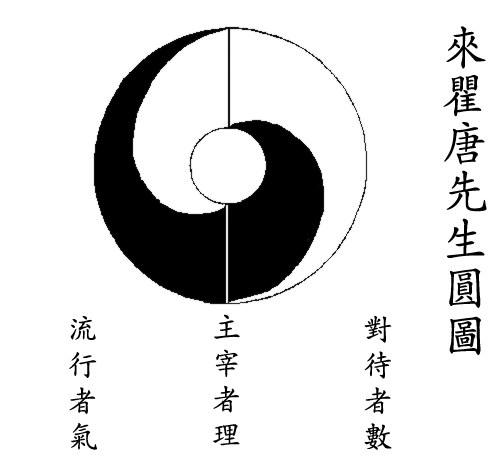
Form and matter
Aristotle carried the pair of concepts into his natural philosophy. In On the Generation of Animals (I 20) he writes that in generation the male provides the form and the principle of movement, the female the matter. That is biologically wrong, but it shaped thought for two thousand years: since then male means what forms, female what is formed, receives and nourishes.
In Hermeticism and alchemy this becomes a whole system of correspondences:
| male | female |
|---|---|
| sun | moon |
| gold | silver |
| sulphur, the burning | mercury, the volatile |
| fire, triangle pointing up | water, triangle pointing down |
| spirit, triangle, compass | matter, four-sided figure, square |
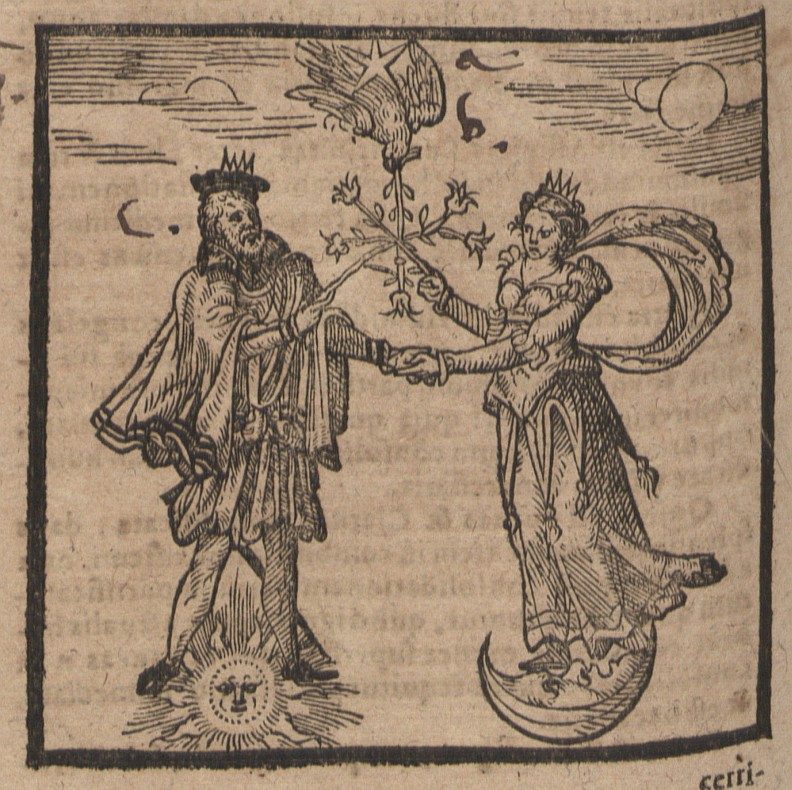
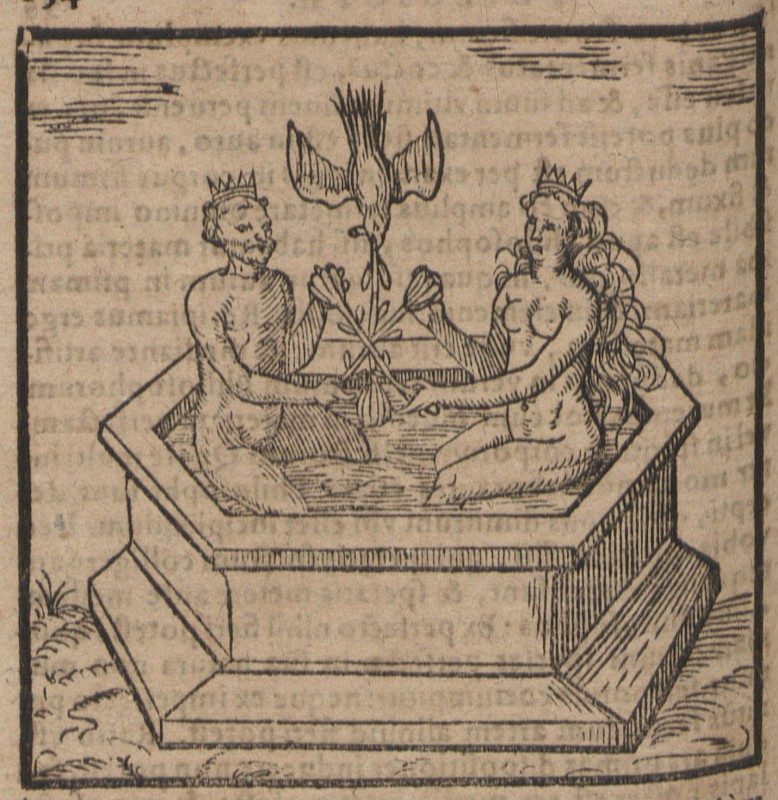
The aim of the alchemists was never the victory of one side but their union, the coniunctio or “chymical wedding”. The Rosarium philosophorum tells it in a series of twenty woodcuts: king and queen meet, lay aside their clothes, step into the bath together and merge into one body.
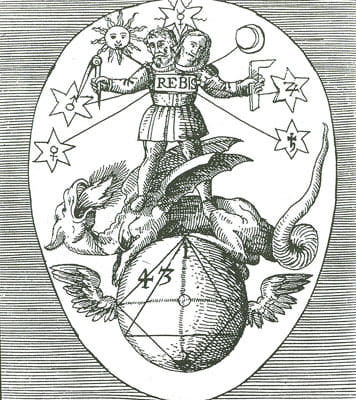
Its result is the Rebis, the “double thing”, a being with a male and a female head that, like the Pythagorean one, carries both within it. In the woodcut of 1617 it holds compass and square (see Polygons and star polygons in Freemasonry).
Laid over each other, the two triangles for fire and water make the hexagram. That is why in alchemy it stands for the union of opposites, and Eliphas Lévi called it the sign of light and reflection (see Eliphas Lévi).
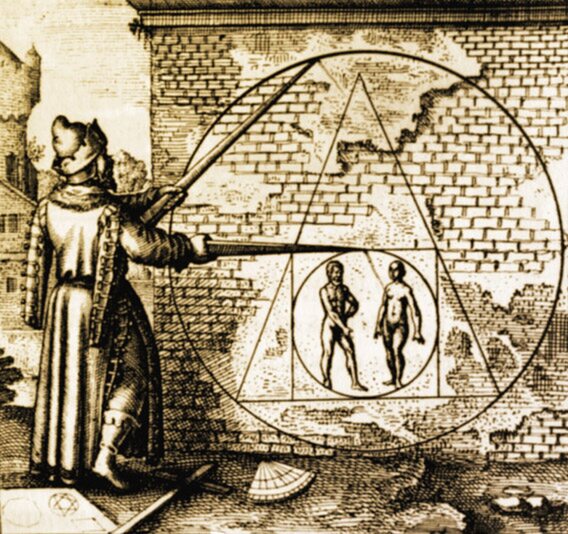
In 1617 Michael Maier described the transformation geometrically in his emblem book Atalanta fugiens. The motto of Emblem XXI reads: “Make of man and woman a circle, from that a square, from that a triangle, from that a circle, and you will have the philosophers’ stone.”
Pairs among the Gnostics
For the Valentinians, a school of the Gnostics, the whole divine world consists of pairs, the syzygies: Depth and Silence, Mind and Truth, Word and Life, as well as Man and Church. No aeon acts alone. Disaster begins when one does: in the Apocryphon of John, Sophia, Wisdom, wants to bring something forth without her partner, and the result is the imperfect maker of this world. Redemption is then the return to the pair and finally to unity. In the Gospel of Thomas (saying 22) Jesus says that whoever “makes the male and the female one and the same, so that the male not be male nor the female female” will enter the kingdom.
The spherical humans in Plato
The most beautiful image for this longing comes from Plato’s Symposium. The comic poet Aristophanes tells there that the first humans were round as balls, with four arms, four legs and two faces. There were three kinds: wholly male, descended from the sun, wholly female from the earth, and male-female from the moon, “because the moon too partakes of both” (190b). Because they grew overbearing, Zeus cut them in two, and ever since each half has sought the other. This seeking, says Aristophanes, is called Eros.
Again at the beginning stands a whole that contains both, again it is round, and again twoness arises only through a division.
Eros, the force in between
So far the subject has been what the two principles are. Still open is what drives them together. The Greeks had a name for it: Eros. What was meant was not only love between people but every force that brings what is separate together.
Empedocles (around 450 BC) made a doctrine of the cosmos out of it. For him the world consists of four “roots”, fire, air, water and earth, and two forces that move them: Love and Strife. Love unites the elements, Strife separates them again, and all becoming happens in the alternation of the two. This is the thought that alchemy called solve et coagula, dissolve and bind, two thousand years later.
Aristophanes described the longing of the separated halves in the Symposium. Later Socrates speaks, and he recounts a speech he claims to have heard from a seer named Diotima. Whether she existed we do not know. Her answer to the question of what Eros is belongs to the deepest things antiquity said about opposites.
Eros, says Diotima, is not a god but a being in between, between gods and humans. He was begotten on Aphrodite’s birthday by Poros, resource and way out, and Penia, poverty. That is why he is both at once: always in need like his mother, always resourceful like his father. He is neither wise nor ignorant, for whoever is wise no longer strives for wisdom, and whoever is ignorant does not know that he lacks anything. Eros loves wisdom because he does not have it. He is therefore himself a philosophos, a friend of wisdom (203b to 204b). So Eros is not only the force that joins opposites. He is himself born of opposites, and he lives in the tension between them.
Diotima also says what Eros is for: begetting in beauty. Something new is to come forth from the union, children of the body, and of the soul poems, laws and knowledge. The third that arises from twoness is therefore the real goal.
And she describes a path, the famous ladder of love (210a to 211c). One begins by loving one beautiful body. Then one recognises that the beauty of all bodies is akin, and loves them all. Then one learns to value the beauty of the soul above that of the body, then the beauty of customs and laws, then that of the sciences. At the very top one beholds the beautiful itself, which neither comes to be nor passes away.
This ladder is a path of education. Love that begins with one person leads through the order of the world to the sciences and beyond. Plato thereby described what the seven liberal arts later ordered as a curriculum: learning is a form of longing. Whoever does not love what he does not yet have learns nothing.
What is meant and what is not
The old assignments must be read with open eyes. In the Pythagorean table the female stands on the same side as darkness and the bad, and Aristotle held the female to be the less perfect. These are the valuations of a society in which women had hardly any rights. They have nothing to do with the mathematics behind them. That odd angles form squares and even ones oblongs is true whatever one calls the two sides.
The “law of polarity” one reads about in esoteric books is also younger than it sounds. The well-known version with seven “Hermetic principles”, among them polarity and gender, comes from the Kybalion, an American book of 1908. It is not found in this form in the ancient Hermetic writings.
What remains when the valuations are taken away is an idea that runs through all these teachings:
- Two different principles together bring forth a third. One gives form and impulse, the other space and matter. Neither can do it alone.
- The origin contains both. One is even and odd, the Rebis man and woman, the spherical human round.
- The aim is union, not the victory of one side. Whether one calls it coniunctio, syzygy, yin and yang or marriage, what is meant is always union.
In the language of numbers this is the tetractys itself: one as origin, two as the first division, three as what joins them, and four as the whole that results. Johann Gottfried Herder drew exactly this scheme as a cross, with one origin, two opposites and their union (see Herder’s Metacritique).
Sources and further reading
Sources
- Aristotle, Metaphysics A 5, 985b to 986b
- Plutarch, On the E at Delphi 8
- Aristotle, Physics III 4
- Empedocles, fragment B 17
- Plato, Symposium 189c to 193d and 201d to 212a
- Xici zhuan (Great Treatise on the Book of Changes)
- Apocryphon of John and Gospel of Thomas 22 (Nag Hammadi)
- Rosarium philosophorum, Frankfurt 1550
- Michael Maier, Atalanta fugiens, Oppenheim 1617
- Three Initiates, The Kybalion, Chicago 1908
Further reading
- Richard Wilhelm (trans.), The I Ching or Book of Changes, English by Cary F. Baynes, Princeton 1950