Music: number in relation
The second art of the quadrivium was no teaching of music-making but the study of ratios. What the ear knows about numbers, why the legend of the blacksmiths' hammers cannot be true and a path through the pages on sound and harmony.
The music of the seven liberal arts was not a teaching of singing or playing but of numbers in relation to one another. Nicomachus calls it the study of relative multitude: not three in itself but three to two. Its discovery is one of the most consequential in the history of thought. The intervals the ear hears as consonant correspond to simple ratios of numbers. The octave is 1 : 2, the fifth 2 : 3, the fourth 3 : 4, and all four numbers stand in the tetractys.
What hearing trains
Music trains something no other art trains in the same way: judgement of ratios. A single tone is neither beautiful nor ugly. Only two tones together sound pure or rough, and whether they do depends solely on their ratio. Whoever has heard this once and then measured it on a string understands the core of the Pythagorean view of the world: harmony is not a property of things but of their relations. That holds in music, in architecture and, as the old teachings held, in the soul and in living together too.
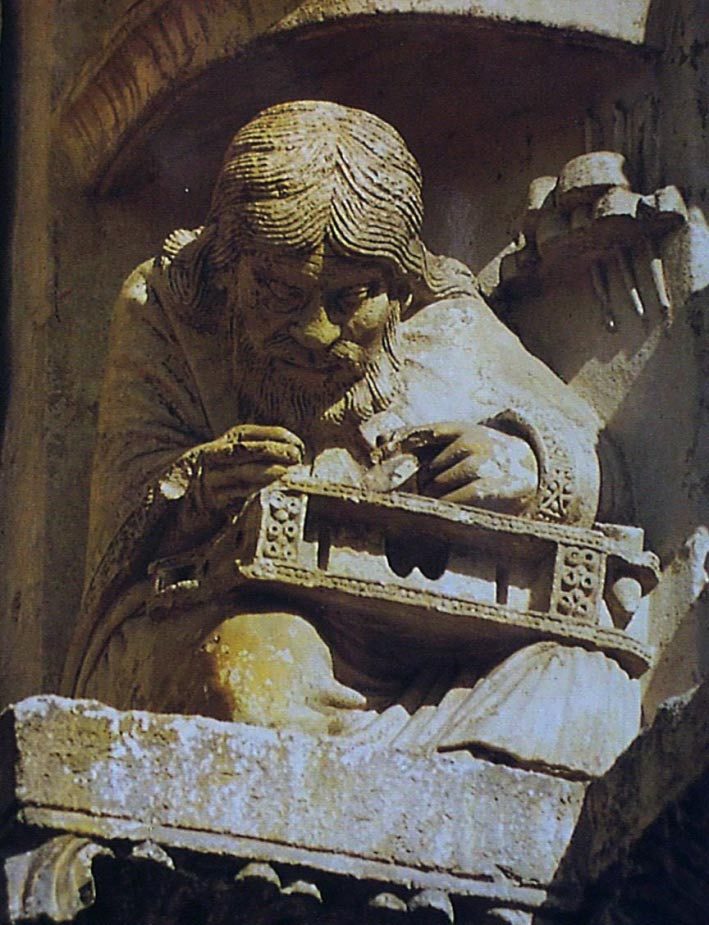
A legend to test
Nicomachus tells that Pythagoras passed a smithy and heard the hammers sounding together in octave, fifth and fourth. He weighed the hammers and found that their weights stood as 6, 8, 9 and 12. It is a beautiful story, but it cannot be true as told. The pitch of a hammer on the anvil hardly depends on the weight of the hammer, and with strings stretched by weights the pitch grows not with the weight but with its square root. Whoever really finds the ratios finds them in the length of a string. This is a good exercise in all three arts of the trivium at once: read closely, reason soundly, and do not mistake a beautiful tale for a fact (see Number and sound).
The path through this website
- Number and sound: the discovery of the intervals and the tetractys of tones.
- The monochord: the instrument on which ratios are heard and measured.
- Ratios: what a ratio is mathematically, with the Pythagorean comma.
- The lambdoma and The Tonnetz: orders of all ratios.
- The harmony of the spheres: the step from music to astronomy.
Exercise
Take a guitar, a violin or simply a tightly stretched rubber band over a box. Pluck the string open. Then press it down exactly in the middle and pluck one half: you hear the octave. Press it at a third of its length and pluck the longer two thirds: the fifth. At a quarter: the fourth. Measure the lengths with a ruler. In five minutes you have repeated what the Pythagoreans took for one of the basic laws of the world.
Sources and further reading
Sources
- Nicomachus of Gerasa, Manual of Harmonics 6 (the smithy)
- Marin Mersenne, Harmonie universelle, Paris 1636
- Royal Portal of Chartres Cathedral, around 1150
Further reading
- Hans Kayser, Lehrbuch der Harmonik, Zurich 1950