Know thyself
Where all the old schools ended: the inscription at Delphi, Socrates' self-examination, the three evening questions of the Pythagoreans and of Seneca, the rough stone. Why thinking becomes an attitude only when it turns inward, and what makes a master.
The seven arts train the outward gaze: on texts, reasons, speeches, numbers, forms, sounds and stars. But all the old schools agreed that the path does not end there. At the end stands the inward gaze, and only it makes what has been learned into something that holds.
The inscription at Delphi
In the forecourt of the temple of Apollo at Delphi, Pausanias reports, stood two sayings: “Know thyself” and “Nothing in excess”. Today the first is mostly read as a call to explore one’s inner life. Originally it probably meant something more sober: know that you are a human being and not a god. Know your limits.
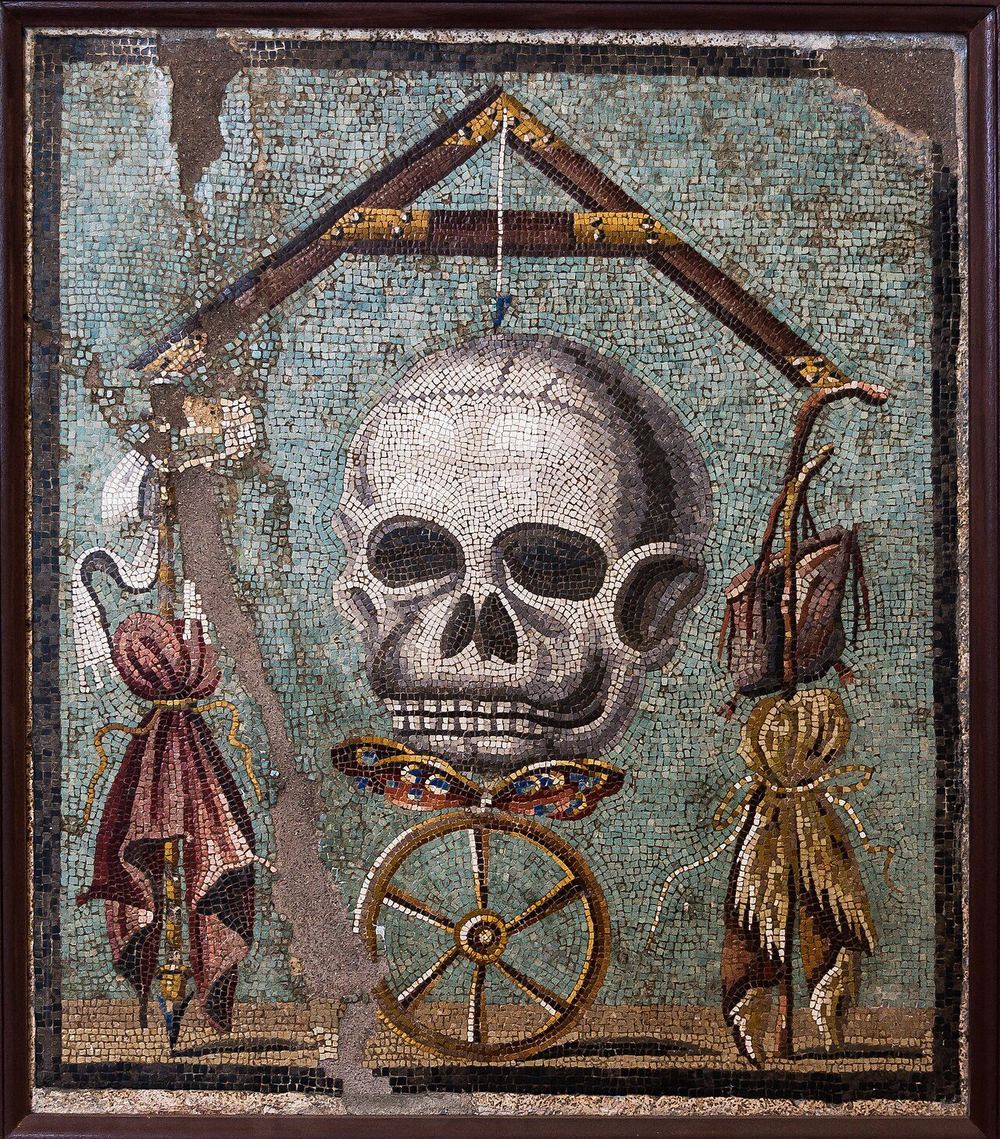
Both meanings belong together. To know oneself also means to know the limits of one’s own knowledge, and the second saying names the virtue that follows from it, measure. Measure appears again and again on this website: in the ratios of tones, in the proportions of figures and in the parable of the true master, who teaches his journeymen that strife follows where measure is lacking.
The examined life
Socrates made the Delphic call his life’s task. In court, when his life was at stake, he said according to Plato’s Apology (38a) that the unexamined life is not worth living for a human being. Examination meant for him: asking oneself and others again and again what one really knows, what one holds to be good and whether one lives by it.
The Pythagoreans made a daily exercise of it. The Golden Verses, a collection of Pythagorean rules of life, say (40 to 42):
Do not let sleep come upon your soft eyes before you have gone over each deed of the day three times: Where did I go wrong? What did I do? What did I leave undone that I ought to have done?
In the first century AD Seneca describes the same exercise. The philosopher Sextius, whose school Seneca had come to know through his teacher Sotion, asked himself, he says, every evening: Which of your ills have you healed today? Which fault have you resisted? In what respect are you better? Seneca did the same himself, once the light had been put out and his wife had fallen silent (On Anger III 36).
The philosopher Pierre Hadot showed that ancient philosophy was above all such a way of life, a series of exercises and not merely a doctrine. One learned not only what the world is but how one should live in it.
The rough stone
The Freemasons made an image for this work out of the builders’ material: the rough stone that must be dressed until it fits into the building. The image says three things. The work is done on one’s own stone, not on that of others. It is done with tools, that is, with practice and method, not with good will alone. And it never quite stops, for even the best stone is meant for a building larger than itself.
The Gnostics too sought salvation in knowledge of one’s own origin. The Gospel of Thomas, often counted among the Gnostic writings, says (saying 3): “When you know yourselves, then you will be known.” However different the paths, Delphi, Socrates, the Pythagoreans, the Stoics, the Gnostics and the Freemasons meet at this point: whoever wants to understand the world must begin with himself.
What makes a master
This closes the circle back to the start of this section. A master, magister, was at the medieval universities someone who commanded the arts so well that he was allowed to teach them. Seneca writes that people learn while they teach (Letters 7.8). To teach means to understand what one has learned well enough to pass it on, and in doing so to notice where one has not yet understood it.
By all that the old teachings suggest, then, a master is not someone who possesses the truth. He has made the tools so much his own that he can test for himself, he knows the limits of his knowledge, he keeps measure, and he can guide others without making them dependent. Whether and when someone has come that far cannot be answered from outside. That question remains put to each person himself.
Exercise
Resolve for thirty days to go through the three questions of the Golden Verses every evening before you fall asleep: Where did I go wrong? What did I do? What did I leave undone? Write a single sentence for each question in a notebook. No more, and without condemning yourself. This is not about guilt but about attention.
After thirty days read everything in one go. You will find patterns, and this time they are not coincidences.
Sources and further reading
Sources
- Plato, Apology and Charmides 164d
- Golden Verses of the Pythagoreans, verse 40 to 44
- Seneca, On Anger III 36
- Gospel of Thomas, saying 3
Further reading
- Pierre Hadot, Philosophy as a Way of Life, Oxford 1995