Astronomy: magnitude in motion
The fourth art of the quadrivium joins number, form and time. Why Plato did not mean stargazing, how observation decides about beautiful theories and a path through the pages on the heavens.
For Nicomachus astronomy is the study of magnitude in motion. It is the last and highest art of the quadrivium, for it needs all the others: arithmetic for the periods, geometry for the orbits and music for the ratios the Pythagoreans already sought in the sky.
What observing trains
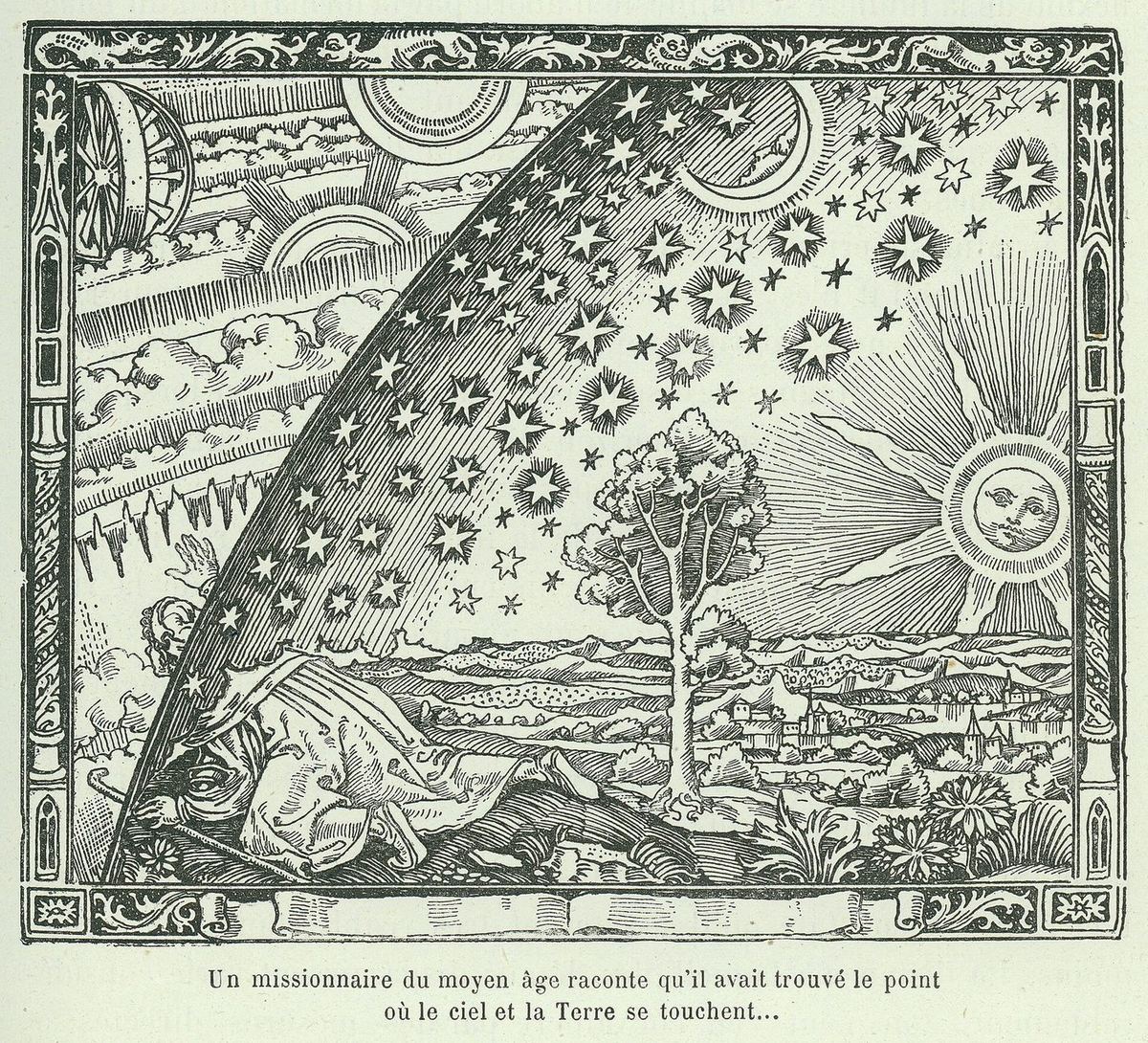
In the Republic Plato did not want to train stargazers. The stars, he says, are indeed the most beautiful thing one can see, but whoever merely stares upward learns nothing. The point is to understand the order behind the motions. That is the core of every natural science to this day.
But astronomy also trains something else that Plato did not have in view in this way: humility before observation. The sky is the place where humanity’s most beautiful theories have failed. The perfect circular orbits of the Greeks lasted almost two thousand years, until Kepler saw them fail over eight minutes of arc. Kepler’s own model of the planetary distances from the five Platonic solids was beautiful and wrong. His laws of planetary motion, found while seeking the harmony of the world, hold to this day (see Dialectic). Astronomy teaches one to love an idea and still let it go when the sky disagrees.
Number in the sky
There are real numerical relations in the sky that do not rest on interpretation. Venus, for instance, returns to the same place in the sky after almost exactly eight years. In this time it overtakes the earth five times, and the five places where this happens form a nearly regular pentagram on the zodiac. Five meetings in eight years, and 5 and 8 are consecutive Fibonacci numbers. This is no proof of a world harmony, but a fact anyone can check, and it shows why the sky has always made people calculate.
The path through this website
- The harmony of the spheres: the old idea that the planets sound.
- Resonances: where heavenly bodies really orbit in whole-number ratios.
- Trojans: the points where sun, planet and asteroid form an equilateral triangle.
- The dodecahedral universe: a geometric idea about the shape of all of space.
- The Balmer lines: how whole numbers are hidden in the light of hydrogen.
Exercise
For one month, observe the moon every clear evening. Draw its shape, note the time and where it stands in the sky, say above which house or tree. After four weeks you will have found out for yourself how long a lunar month is, why the moon rises later every evening and why its bright side always faces the sun. This is humanity’s oldest science, and you need nothing for it but your eyes and a notebook.
Sources and further reading
Sources
- Plato, Republic VII 528e to 530c
- Johannes Kepler, Mysterium cosmographicum, Tübingen 1596, and Astronomia nova, Heidelberg 1609
- Camille Flammarion, L’atmosphère. Météorologie populaire, Paris 1888