Geometry: magnitude at rest
The third art of the quadrivium, after which the Freemasons interpret their letter G: what compass and straightedge teach about thinking, what is true of the inscription over Plato's Academy and a path through the pages on figures and solids.
For Nicomachus geometry is the study of magnitude at rest: lines, surfaces, solids, their measures and ratios. It is the art closest to Freemasonry. Prichard’s catechism interprets the letter G as “Geometry, or the fifth Science”, and square and compasses, the tools of the geometer, are its emblem (see Polygons and star polygons in Freemasonry).
What constructing trains
Over the entrance to Plato’s Academy there is said to have stood: “Let no one ignorant of geometry enter.” The sentence is attested, however, only in authors of late antiquity, many centuries after Plato. Whether it ever stood there we do not know. That it fits Plato is certain, for in the Republic he demands geometry as a preparatory school for philosophy.
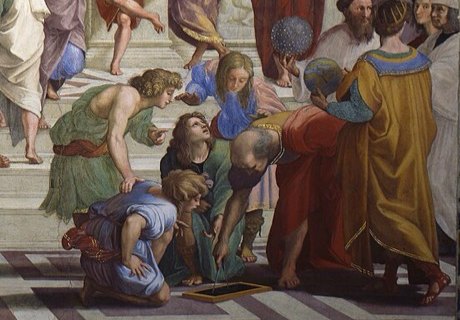
Greek geometry trains two things. The first is precision. Euclid constructs with compass and straightedge alone, and every step must follow from the ones before. A figure that is only roughly right does not count. The second is the union of seeing and justifying. A drawing shows something, but only the proof says whether it is always so. Many figures on this website are built this way: one sees something, and then it is proven.
Ptolemy I, king of Egypt, is said to have asked Euclid whether there was no easier way to geometry than his Elements. Euclid is said to have answered: “There is no royal road to geometry.” This anecdote too is handed down late, by Proclus in the fifth century. But it is true in a deeper sense: understanding cannot be shortened, not even for kings.
The path through this website
- Circle, triangle and square: the basic forms with which the plane can be filled.
- Simplex, the fixed form of number and Angle sums and full circles: the figures of the tetractys.
- Angles: why a triangle has 180 degrees, with proof.
- Pentagram and golden section and The incommensurable: the discovery that shook the Pythagoreans.
- The Platonic solids: the step into space.
Exercise
Take a pair of compasses, a straightedge without markings and a sheet of paper. Draw a circle. Without changing the opening of the compasses, set it on a point of the circle and strike an arc that cuts the circle. From the point of intersection again, and so on. After six steps you are back at the start. Join the six points: a regular hexagon. Join every second one: a hexagram. Then ask yourself why the compasses fit exactly six times. The answer lies in six equilateral triangles around the centre, and when you have found it, you have carried out a proof.
Sources and further reading
Sources
- Plato, Republic VII 526c to 527c
- John Philoponus, commentary on Aristotle’s On the Soul, 6th century (the inscription of the Academy)
- Proclus, Commentary on the First Book of Euclid’s Elements 68 (the royal road)
- Samuel Prichard, Masonry Dissected, London 1730