Islamic ornament: stars from compass and straightedge
Eight-pointed stars, decagons and endless bands: how the builders of the Islamic world designed with compass and straightedge patterns that have no beginning and no end. A tenth-century mathematician wrote for craftsmen, and in Isfahan a pattern has stood since 1453 that comes very close to the order of quasicrystals.
Whoever enters a mosque in Isfahan, the Alhambra in Granada or a madrasa in Samarkand sees walls, ceilings and floors covered with geometric patterns. Stars with eight, ten or twelve points, interlaced bands that begin nowhere and end nowhere, surfaces that seem to continue to infinity. This art is one of the great achievements of geometry, and it was created not by mathematicians but by craftsmen.
Why geometry
In mosques and in the Quran no people or animals are depicted. This is not an explicit command of the Quran but a tradition that prevailed early in religious art, while palaces and books certainly knew pictures of people. Where the figure was absent, three other arts took its place: script, the plant scroll and geometry.
Geometry was especially suited to this, for it shows an order without depicting anything. A pattern that continues in all directions has no centre more important than other places and no edge where it ends. Many have seen in it an image of the infinity and unity of God. Whether the craftsmen themselves thought so we do not know. They seldom wrote down their intentions.
With compass and straightedge
The patterns arise with the same tools Euclid constructed with. One begins with a circle, divides it into equal parts, joins the points of division and obtains stars. Divide it into six and the Star of David appears, divide it into eight and the eight-pointed star appears, so frequent in Islamic art that it has a name of its own, khatam, the seal. The stars are then set in a grid, and the gaps between them are filled with further shapes (see Simplexes and star polygons).
In the tenth century the mathematician Abu l-Wafa in Baghdad wrote a book titled On the Geometric Constructions Needed by the Craftsman. In it he reports meeting craftsmen who assembled their patterns, and he gives procedures for constructing regular polygons exactly, some with a compass of fixed opening only. From the late fifteenth or the sixteenth century a pattern scroll almost thirty metres long survives, the Topkapı Scroll in Istanbul. It shows designs with fine construction lines, and from it one sees how the builders worked: beneath the visible pattern lies an invisible framework of circles and lines.
The difficult five
Six- and eight-pointed stars are easily joined into surfaces, for triangle, square and hexagon fill the plane without gaps (see Circle, triangle and square). With the pentagon this does not work. Yet the Islamic builders particularly loved five- and ten-pointed stars, and they found ways to join them into large surfaces all the same, by combining stars with other shapes.
From the thirteenth century at the latest they used for this a set of five basic shapes now called girih tiles, after the Persian word for knot: a decagon, a pentagon, a rhombus, an elongated hexagon and a shape like a bow tie. All edges are equally long, all angles are multiples of 36 degrees, and on each tile a piece of band is drawn. Laid side by side, the pieces of band join into a continuous interlace, and the tiles themselves disappear.
Isfahan and the quasicrystals
In 2007 the physicist Peter Lu and his colleague Paul Steinhardt made a surprising observation in the journal Science. On the portal of the Darb-e Imam shrine in Isfahan, built in 1453, they found a girih pattern laid out on two scales at once. Large tiles are divided into smaller ones, and this subdivision follows a rule that could be repeated any number of times. Such a rule produces a pattern that is ordered but never repeats periodically, just like the tiling Roger Penrose discovered in 1974 and that was found again in 1982 in quasicrystals.
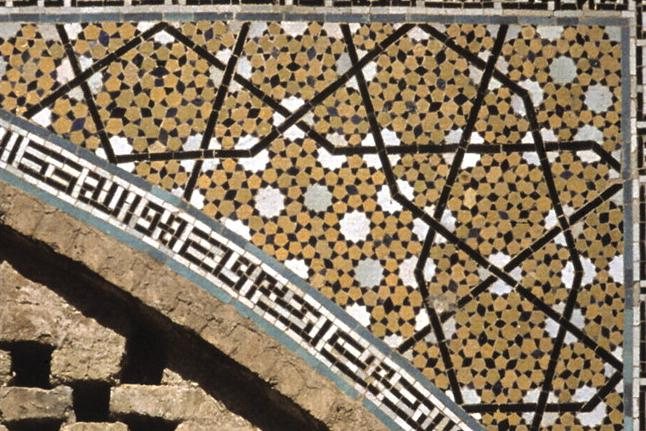
The pattern in Isfahan is not perfect. It contains some errors, and a wall is finite, so one cannot prove that it would really continue to infinity without repetition. Whether the builders knew that their rule produces a non-periodic pattern, or whether they had simply found a beautiful procedure, is disputed. What is certain is that they mastered patterns of this kind, which Western mathematics understood only five hundred years later. Whether their tool was the girih tiles, as Peter Lu and Paul Steinhardt suppose, or compass and straightedge is likewise disputed (see The pentagram and the golden ratio).
A Penrose tiling of thick and thin rhombi. It is strictly ordered and full of fivefold stars, but never repeats. With each step of subdivision the ratio of the two kinds of rhombus approaches the golden ratio.
Kepler and the pentagons
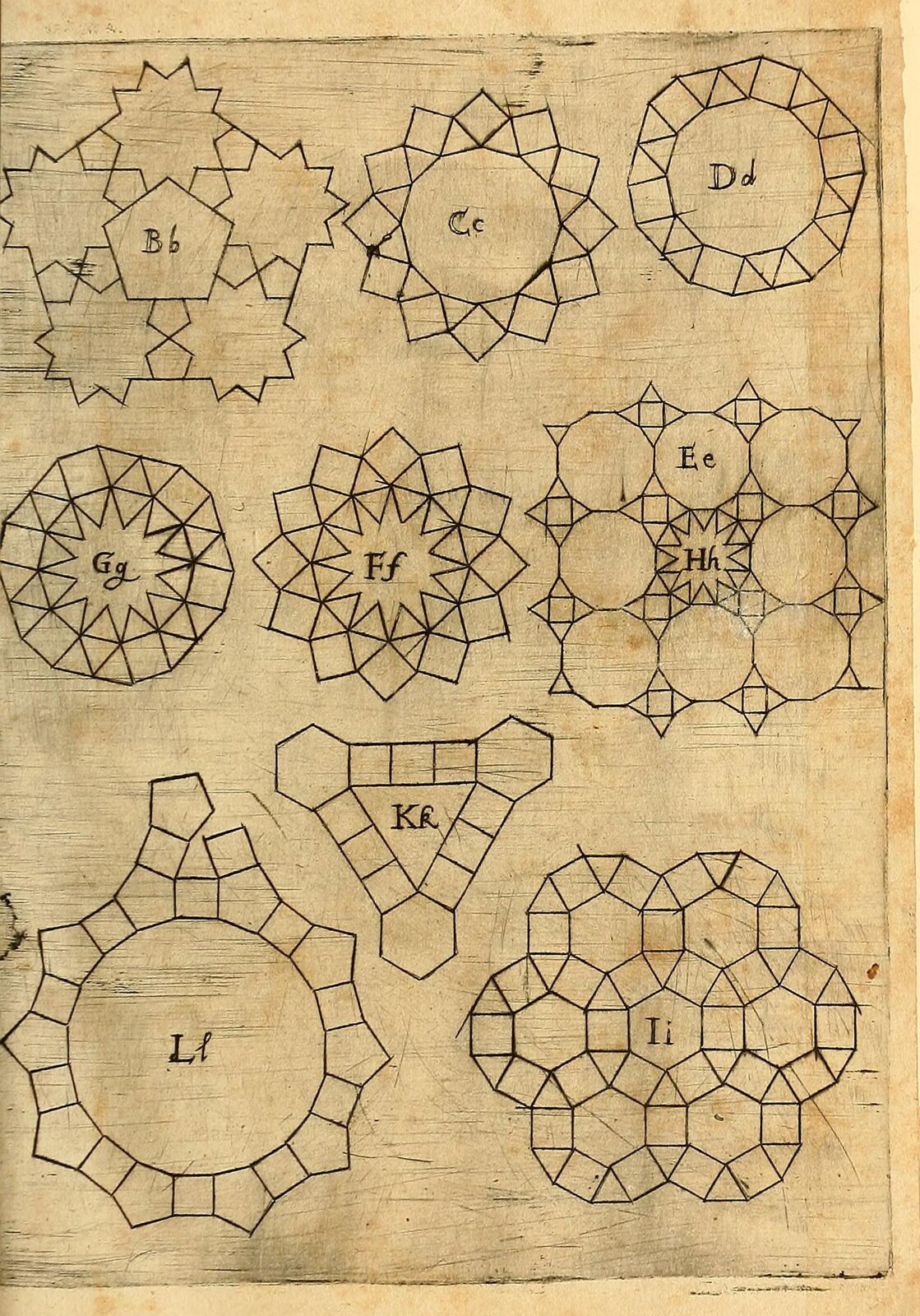
In Europe too someone tried his hand at five. In 1619, in his Harmony of the World, Johannes Kepler drew all the ways of filling the plane with regular polygons, and in doing so he found a figure of pentagons, pentagrams and decagons that he labelled with the letters “Aa”. It can be continued, as he noted, only with growing irregularities. Today one recognises in it a forerunner of the Penrose tiling (see Johannes Kepler).
Exercise
With the compass draw a circle and divide it into six parts with the same opening, as every craftsman could. Join every second point, and you have a hexagram. Then draw a circle with the same opening around each of the six points. You get the beginning of the so-called Flower of Life, and countless star patterns can be developed from this grid (see Sacred geometry). Try to find a pattern that could be continued in all directions.
Sources and further reading
Sources
- Abu l-Wafa al-Buzjani, Book on the Geometric Constructions Needed by the Craftsman, Baghdad, 10th century
- Gülru Necipoğlu, The Topkapı Scroll. Geometry and Ornament in Islamic Architecture, Santa Monica 1995
- Peter J. Lu and Paul J. Steinhardt, Decagonal and Quasi-Crystalline Tilings in Medieval Islamic Architecture, Science 315, 2007, pp. 1106 to 1110
- Roger Penrose, The role of aesthetics in pure and applied mathematical research, Bulletin of the Institute of Mathematics and its Applications 10, 1974
- Johannes Kepler, Harmonices mundi, Linz 1619, book II
Further reading
- Eric Broug, Islamic Geometric Patterns, London 2008
- Keith Critchlow, Islamic Patterns. An Analytical and Cosmological Approach, London 1976