Johannes Kepler: the most beautiful error and the harmony of the world
Five Platonic solids between six planets: Kepler's first great idea was beautiful and wrong. How he let it fail over eight minutes of arc, found the ellipses along the way, discovered the third law in the Harmony of the World and why it was precisely his error that led him to the truth.
Johannes Kepler (1571 to 1630) is the man in whom one can best see how mysticism and science go together and where they part. He was convinced that God created the world according to geometric archetypes, and he searched for these archetypes all his life. In doing so he found the laws by which the planets move, and he found them precisely because he was willing to give up his most beautiful idea.
The inspiration of Graz
Kepler came from the imperial city of Weil der Stadt in Swabia and studied theology in Tübingen. His teacher Michael Maestlin acquainted him with the teaching of Copernicus, by which the sun stands at the centre and the earth is one of six planets. In 1594 Kepler became a mathematics teacher in Graz.
There, in the summer of 1595, during a lesson, a thought came to him that he took for a revelation. Why are there exactly six planets, and why do they have just these distances? Because there are exactly five regular solids (see The Platonic solids). Nest them inside one another, each with a sphere inside and outside, and six spherical shells arise, one for each planet. Outermost the cube between Saturn and Jupiter, then the tetrahedron to Mars, the dodecahedron to Earth, the icosahedron to Venus and the octahedron to Mercury. In 1596 he published the idea in the Cosmographic Mystery, the Mysterium cosmographicum.
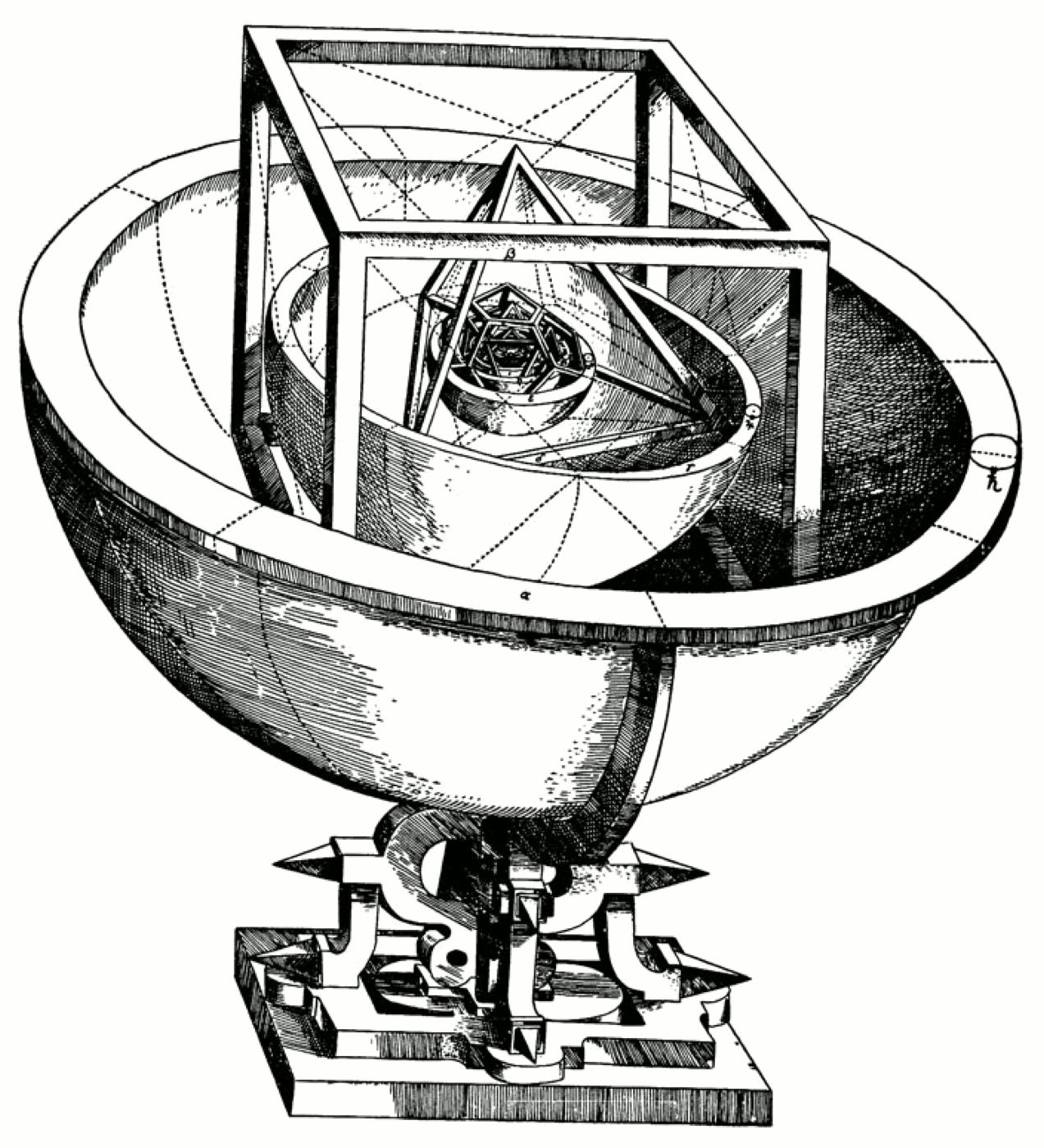
How well does it fit?
The idea can be tested. For each solid the ratio of the inner to the outer sphere is fixed, and one can compare it with today’s ratio of the mean orbital radii. The table sets both side by side, with the deviation:
| Planets | Solid | Spheres | Orbits | Dev. |
|---|---|---|---|---|
| Jupiter to Saturn | cube | 0.577 | 0.546 | 6 % |
| Mars to Jupiter | tetrahedron | 0.333 | 0.293 | 14 % |
| Earth to Mars | dodecahedron | 0.795 | 0.656 | 21 % |
| Venus to Earth | icosahedron | 0.795 | 0.723 | 10 % |
| Mercury to Venus | octahedron | 0.577 | 0.535 | 8 % |
With the mean distances, then, it fits only roughly. Kepler gave the spherical shells a thickness lying between the smallest and largest distance of each planet from the sun, and with that the agreement became better, but never exact. He blamed the deviations on inaccurate observations. He needed better data, and only one man had them.
Eight minutes of arc
That man was Tycho Brahe, the most accurate observer of the sky before the invention of the telescope. In 1600 Kepler went to him in Prague, and after Tycho’s death the following year he took over his observations, much to the annoyance of Tycho’s heirs. He took on the orbit of Mars, which puzzled astronomers most.
For years he calculated with circles, as everyone since Plato had done. At last he found a circular orbit that explained almost everything, except for a deviation of eight minutes of arc, about a quarter of the width of the full moon. Anyone else would have blamed measuring errors. But Kepler knew how accurately Tycho had measured, and wrote: “These eight minutes alone have shown the way to the reform of all astronomy.” He gave up the circle, after two thousand years, and found the ellipse. In the New Astronomy of 1609 stand his first two laws: the planets move on ellipses with the sun at one focus, and they move the faster the nearer they are to the sun (see Dialectic: reasoning soundly).
The harmony of the world
That did not mean Kepler gave up harmony. He only looked for it in another place. In 1619 his Harmony of the World, Harmonices mundi, appeared in five books on geometry, music and the heavens. He studied how the plane is filled with regular polygons (see Islamic ornament), how the intervals of music arise from the division of the circle, and finally which notes the planets sing. For this he compared the angular velocity of each planet at its nearest and farthest point from the sun and found musical intervals in them. The earth sings mi, fa, mi, and Kepler read this as miseria and fames, misery and famine (see Harmony of the spheres).
In the middle of this book, which seems so strange to us today, stands the third law, which Kepler found on 15 May 1618: the squares of the periods are as the cubes of the mean distances. A planet four times as far from the sun needs eight times as long for one revolution. With this law Newton could show seventy years later that all planets follow the same gravity. Kepler himself was beside himself with joy: he had found the harmony, only not where he had first looked for it.
The snowflake
Kepler thought about many other things too. In 1611 he gave his patron a little New Year’s book On the Six-Cornered Snowflake. In it he asks why snowflakes always have six arms, and he considers whether they might be built of tiny globules in densest packing, but in the end leaves the question open. In doing so he makes the claim that equal spheres cannot be packed more densely than the way a greengrocer stacks oranges. This Kepler conjecture was proven only in 1998 and completely checked by computers in 2014 (see From point to solid).
A hard life
Kepler’s life was full of misfortune. He lost his first wife and several children, as a Protestant he had to flee the Counter-Reformation several times, and his mother Katharina was accused of witchcraft in 1615. Kepler defended her himself, for years, and achieved her acquittal in 1621. He died in 1630 in Regensburg, on a journey to collect salary owed to him. His grave was lost in the Thirty Years’ War.
What Kepler teaches
Kepler coined a sentence that could stand over this whole website: Ubi materia, ibi geometria, “Where there is matter, there is geometry”. He believed in the harmony of the world as firmly as hardly anyone before or after him. And yet he let his most beautiful idea fall when observation disagreed.
The physicist Wolfgang Pauli later showed how much Kepler’s discoveries grew out of inner images, out of the sphere as an image of the Trinity and the conviction that God thinks geometrically (see Quantum physics, magic and the unconscious). Both belong together. Without his faith in harmony Kepler would not have searched so long. Without his honesty before the data he would have found nothing. Whoever takes the tetractys seriously can learn from him how to love an idea and still test it (see Chance and pattern).
Sources and further reading
Sources
- Johannes Kepler, Mysterium cosmographicum, Tübingen 1596, 2nd ed. Frankfurt 1621
- Johannes Kepler, De fundamentis astrologiae certioribus, Prague 1601, thesis 20
- Johannes Kepler, Astronomia nova, Heidelberg 1609, especially ch. 19
- Johannes Kepler, Strena seu de nive sexangula, Frankfurt 1611
- Johannes Kepler, Harmonices mundi libri V, Linz 1619, especially book V, ch. 3
- Wolfgang Pauli, The Influence of Archetypal Ideas on the Scientific Theories of Kepler, in: C. G. Jung and W. Pauli, The Interpretation of Nature and the Psyche, German original Zurich 1952
Further reading
- Max Caspar, Kepler, translated by C. Doris Hellman, New York 1959
- Arthur Koestler, The Sleepwalkers, London 1959
- Ulinka Rublack, The Astronomer and the Witch. Johannes Kepler’s Fight for His Mother, Oxford 2015