Man as measure: Vitruvius, Leonardo and the microcosm
Cubit, foot and span: how the human body became the standard of architecture. Vitruvius' man in circle and square, why he called ten and six perfect, what Leonardo made of it, man as a small world, and what there really is to the golden ratio in the body.
“Man is the measure of all things,” said the sophist Protagoras. He meant that everyone knows the world only as it appears to him. But there is also a quite literal meaning of this sentence, and it is older than any philosophy. The first measures of humanity were parts of the body: the cubit from elbow to fingertip, the foot, the span of the spread hand, the thumb, from which the inch came, and the fathom, as wide as the outstretched arms. Whoever built measured with himself. The cubit of the Temple of Solomon was such a body cubit (see The Temple of Solomon).
Vitruvius
Around 25 BC the Roman architect Vitruvius wrote ten books on architecture, the only ones to survive from antiquity. The third book concerns temples, and he begins with a thought that was to shape Renaissance art: a temple must be as well ordered in its parts as the body of a well-formed man.
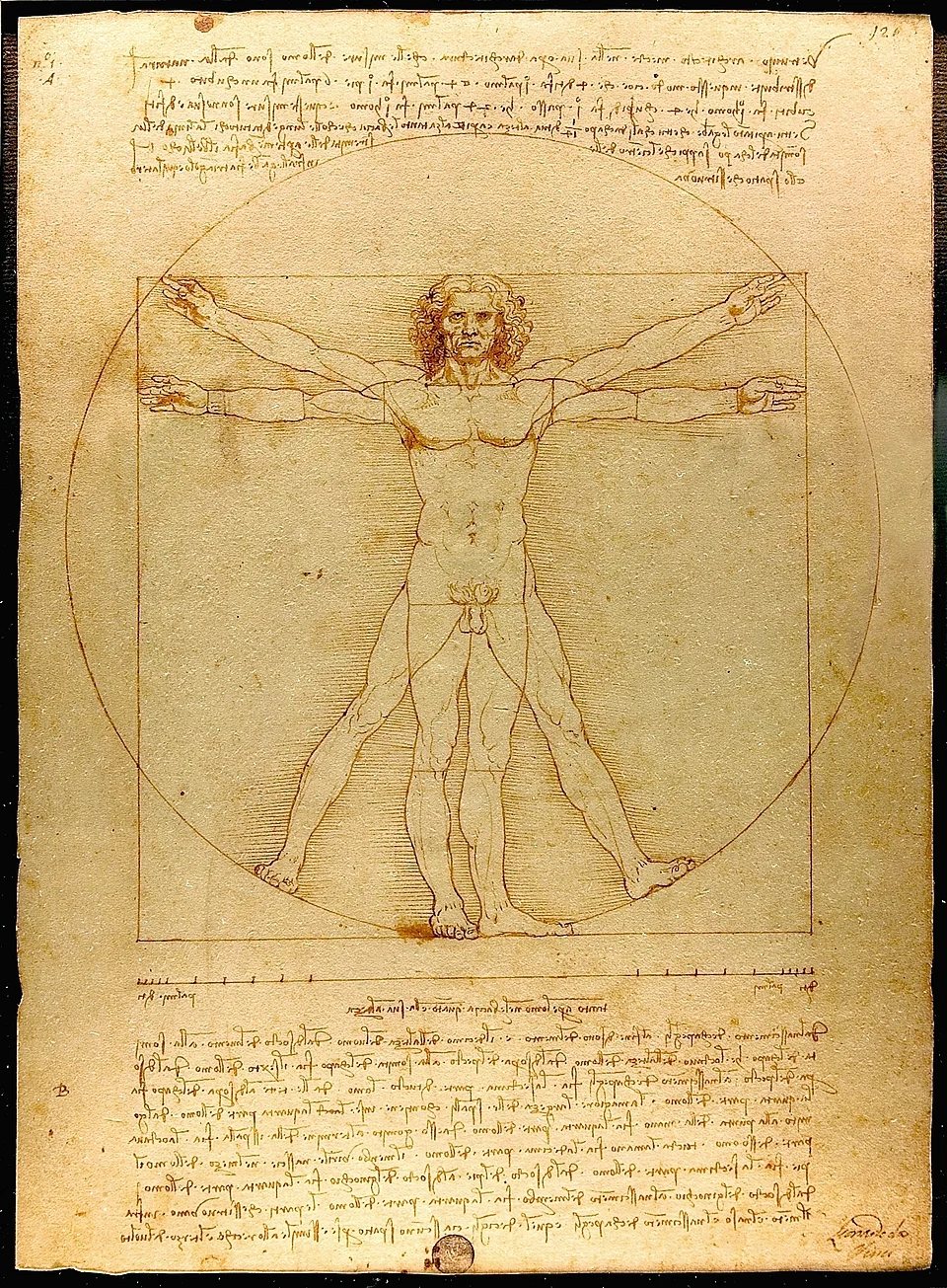
Then he gives the ratios. The face from chin to hairline is a tenth of the body’s height, as is the hand from wrist to the tip of the middle finger. The head is an eighth, the foot a sixth, forearm and chest a quarter each. And he describes the famous figure: if a man lies on his back with arms and legs outstretched and one sets a compass at his navel, fingers and toes touch the circle. And just as he fits into the circle, he fits into the square, for the span of the arms equals the body’s height.
Ten and six
Remarkable is how Vitruvius goes on. From the limbs of the body, he says, the ancients also obtained the numbers. Ten counts as perfect because man has ten fingers, and Plato called it perfect. The mathematicians, by contrast, considered six perfect, because the foot is a sixth of the body and because its parts 1, 2 and 3 together make six. And some took both together and called sixteen the most perfect number.
Here, in a single paragraph by an architect, the tetractys, whose sum is ten, meets the first perfect number of the Pythagoreans (see The numbers from one to ten). For Vitruvius body, number and building are three sides of the same order.
Leonardo
Many Renaissance draughtsmen tried Vitruvius’ figure, and most failed. Whoever draws a man in a circle around the navel and at the same time in a square with the same centre gets a man with absurdly long arms. Around 1490 Leonardo da Vinci solved the problem with a simple step: he gave circle and square different centres. The circle has its centre in the navel, the square lower, at the groin. And he drew two postures on top of each other, one with legs spread and arms raised for the circle, one with legs together and arms horizontal for the square.
The sheet is kept today in the Gallerie dell’Accademia in Venice and only rarely shown, and it is one of the best-known drawings in the world. Above and below it Leonardo noted and checked Vitruvius’ measures in mirror writing. Whether circle and square, heaven and earth or compasses and square, man stands between them and belongs to both (see Circle, triangle and square).
The small world
The thought reaches further than architecture. Since antiquity man was called a microcosm, a small world repeating in miniature the order of the great cosmos. In Hermeticism it says “as above, so below” (see Hermeticism), and physicians assigned the signs of the zodiac to the parts of the body and the planets to the organs.
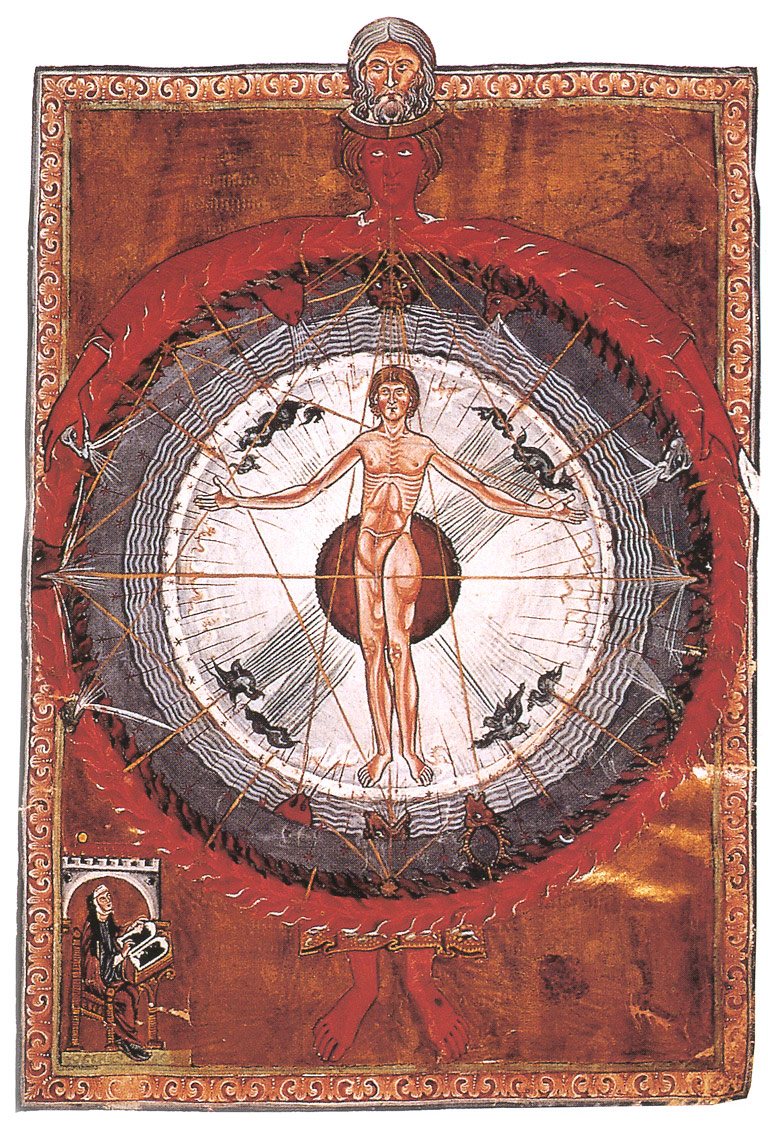
In the twelfth century Hildegard of Bingen saw in a vision man standing at the centre of the universe with outstretched arms, surrounded by the circles of the elements, the winds and the stars. A red figure, whom Hildegard interprets as divine love, holds the whole in her arms.
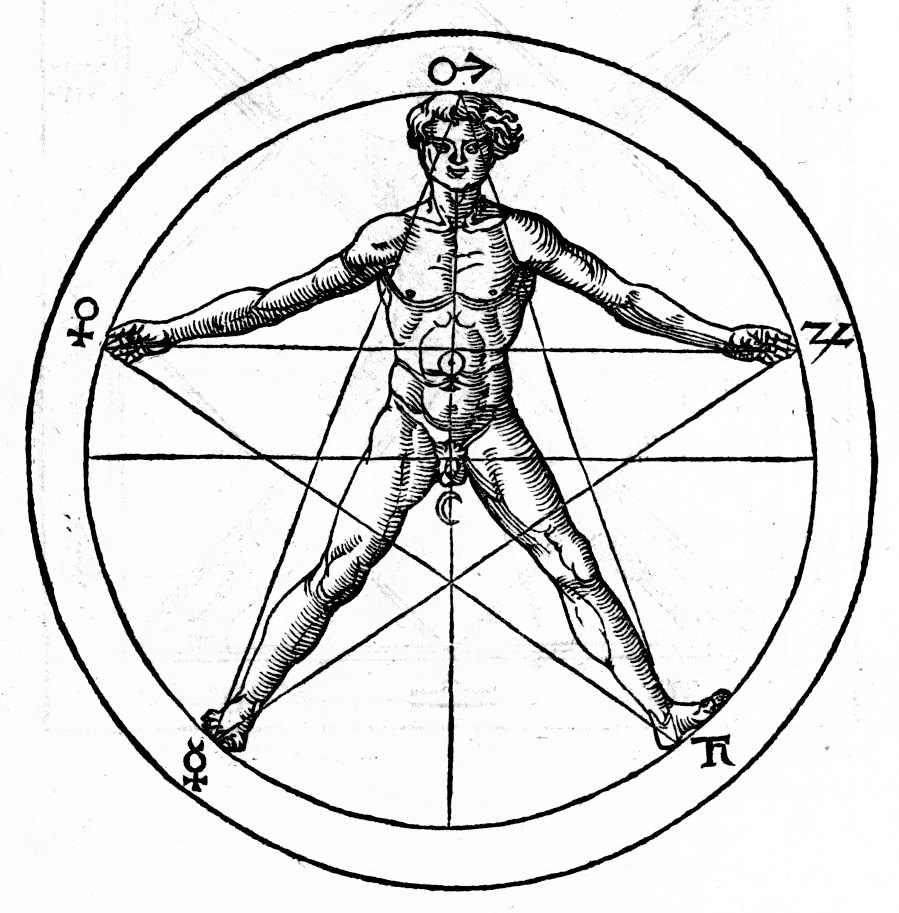
In 1533 Heinrich Cornelius Agrippa drew man several times in geometric figures: with spread limbs in the circle, in the square and in the pentagram, with head, hands and feet forming the five points. Thus the pentagram became the sign of man, as Eliphas Lévi later interpreted it (see Eliphas Lévi). And in 1528, in his Four Books on Human Proportion, Albrecht Dürer measured hundreds of bodies and showed that there is not one right measure but many.
The golden ratio in the body?
In the nineteenth century the philosopher Adolf Zeising claimed that the golden ratio is the fundamental law of the human body: the navel divides the body’s height in the ratio of about 0.618 to 0.382. This claim is still often repeated. What is there to it?
If one measures real people, the navel does lie on average somewhere around 60 per cent of the height. But the values scatter widely, from person to person, between men and women, between children and adults. A newborn has its navel almost in the middle. Whoever searches carefully enough finds many ratios near 0.6 in the body, just as one finds sacred numbers in any building (see Chance and pattern). That the body is built after the golden ratio is a beautiful idea but not a measurement.
The architect Le Corbusier nevertheless built a whole system of measures from body size and golden ratio in 1948, the Modulor, and designed many of his buildings by it. That is legitimate, for an artist may choose a measure. He should only not claim that nature prescribed it to him.
Exercise
Measure your height and your arm span, from fingertip to fingertip. For most people the two values lie only a few centimetres apart, so Vitruvius was not wrong. Then measure the height of your navel and divide it by your height. Compare the result with those of friends and family. You will see how widely the values scatter, and you can judge for yourself whether the golden ratio is in them.
Sources and further reading
Sources
- Vitruvius, Ten Books on Architecture III 1, around 25 BC
- Leonardo da Vinci, proportion study after Vitruvius, around 1490, Venice, Gallerie dell’Accademia
- Heinrich Cornelius Agrippa, De occulta philosophia II 27, Cologne 1533
- Albrecht Dürer, Vier Bücher von menschlicher Proportion (Four books on human proportion), Nuremberg 1528
- Adolf Zeising, Neue Lehre von den Proportionen des menschlichen Körpers (New theory of the proportions of the human body), Leipzig 1854
- Le Corbusier, Le Modulor, Boulogne 1950
- Plato, Theaetetus 152a (the saying of Protagoras)
Further reading
- Frank Zöllner, Vitruvs Proportionsfigur (Vitruvius’ proportion figure), Worms 1987
- Mario Livio, The Golden Ratio, New York 2002