I Ching and Leibniz: the world from zero and one
Six lines, each whole or broken, make 64 signs. How Leibniz in 1703 rediscovered his own binary system in a Chinese diagram, why he saw in it an image of creation out of nothing, what Pascal's numbers have to do with it and where his interpretation went too far.
The I Ching, the “Book of Changes”, is one of the oldest books of China. Its base text arose in the early first millennium BC, in the time of the Zhou dynasty, and later commentaries were added that were attributed to Confucius. It served for divination, but it was also read as a book of wisdom, a mirror of the order in which everything changes.
Its building blocks could not be simpler. There are only two kinds of line: the whole one, later called yang, and the broken one, yin (see The masculine and the feminine). Three lines stacked make a trigram, and there are exactly eight of these, for 2 × 2 × 2 = 8. They stand for heaven, earth, thunder, wind, water, fire, mountain and lake. Two trigrams stacked make a hexagram of six lines, and there are 8 × 8 = 64 of these.
Leibniz and the binary system
At the other end of the world Gottfried Wilhelm Leibniz had already worked out in 1679 a way of calculating with only two digits, 0 and 1. In this binary system every place is worth twice the one to its right: 1, 2, 4, 8, 16, 32. The number 23, for instance, is written 10111, for 16 + 4 + 2 + 1 = 23. Leibniz was delighted by this simplicity but at first found no use for it.
In 1701 the Jesuit Joachim Bouvet, who lived as a missionary in Beijing, sent him a diagram of all 64 hexagrams in an order set up by the scholar Shao Yong in the eleventh century. When Leibniz received it in 1703, he recognised at once what he was seeing. If one puts a 0 for every broken line and a 1 for every whole one, the hexagrams in this order stand exactly in the sequence of the numbers from 0 to 63 in binary.
A hexagram as a number. Each line has a value, 32 at the bottom, 1 at the top. Whole lines count, broken ones do not. A tap on a line flips it, the buttons count on or back. Below stands which two trigrams form the sign and what number it bears in the Book of Changes.
In the same year Leibniz submitted his Explanation of Binary Arithmetic to the Paris Academy, and its subtitle says that it reveals “the meaning of the ancient Chinese figures of Fu Xi”. Fu Xi was regarded as the legendary originator of the trigrams.
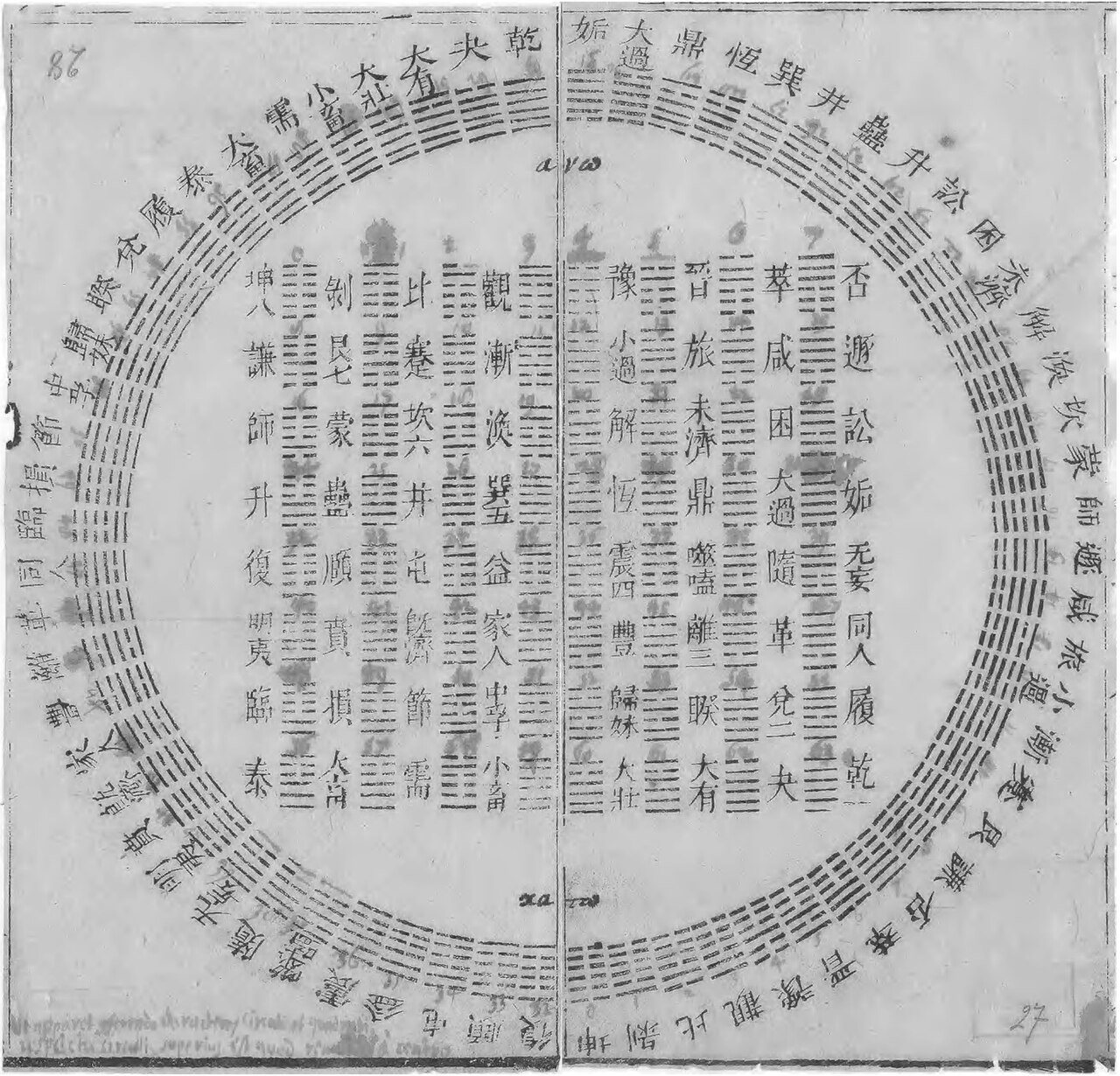
One and zero as creation
For Leibniz this was more than mathematics. As early as 1697 he had proposed to Duke Rudolf August of Brunswick a medal on which the binary system was to appear as an image of creation. Its legend read: Omnibus ex nihilo ducendis sufficit unum, “To bring forth everything from nothing, one suffices”. God is the one, nothingness is the zero, and from both all numbers can be formed. That the ancient Chinese should have known the same order seemed to him proof that truth is common to all peoples, and a bridge for the mission.
Here a close look pays off (see Grammar: reading closely). Shao Yong’s order really is the same as that of the numbers in binary, that is no illusion. It arises when one starts from one line and divides it again and again into yang and yin, and this procedure necessarily produces the same sequence as counting with two digits. But Shao Yong did not calculate with it. For him the hexagrams were not numbers but signs of situations and changes, and with their decimal numerals the Chinese had no reason to calculate in binary. Leibniz found his own invention in the diagram, and he read more into it than it contained. The mathematical agreement is real, the interpretation is his.
Pascal’s numbers in the Book of Changes
A further order is hidden in the 64 signs, and it leads back to the tetractys. How many hexagrams have exactly one whole line? Six, for it can stand in any of the six places. How many have exactly two? Fifteen. Counting them all gives:
| whole lines | 0 | 1 | 2 | 3 | 4 | 5 | 6 |
|---|---|---|---|---|---|---|---|
| hexagrams | 1 | 6 | 15 | 20 | 15 | 6 | 1 |
This is the sixth row of Pascal’s triangle, and its sum is 64. For the trigrams it is the third row, 1, 3, 3, 1, with the sum 8. The same numbers count the vertices, edges and faces of the many-dimensional tetrahedra (see Simplex: multidimensional tetrahedra). This is no coincidence: whether one chooses six lines or six vertices, one counts the same selections.
What became of it
Leibniz’s binary system remained a curiosity for almost two hundred and fifty years. Only when in the twentieth century people began to build calculating machines from switches that know only on or off did it become the language of all computers. In 1937 the engineer Claude Shannon showed that every logical connection can be built with such switches. Every picture, every text and every number on the screen on which this page now stands consists of zeros and ones.
So three things touch in the 64 signs: an old book of wisdom, an idea about creation out of nothing and the foundation of today’s technology. They are joined not by a secret tradition but by the simplest of all distinctions, yes or no, whole or broken, one or zero.
Exercise
Write your age in binary. Start with the largest power of two that fits, subtract it and continue with the remainder. Then draw the number as a hexagram, the bottom line for 32, the top one for 1. Whoever is older than 63 needs a seventh line, and with that leaves the Book of Changes.
Sources and further reading
Sources
- Zhouyi (Book of Changes), base text around 9th to 8th century BC, with the later commentaries of the “Ten Wings”
- Shao Yong, diagram of the hexagrams in the Fuxi order, 11th century
- Gottfried Wilhelm Leibniz, De progressione dyadica, manuscript 1679
- Joachim Bouvet, letter to Leibniz from Beijing, 4 November 1701
- Gottfried Wilhelm Leibniz, Explication de l’Arithmétique Binaire, Mémoires de l’Académie Royale des Sciences, Paris 1703 (printed 1705)
- Gottfried Wilhelm Leibniz, letter to Duke Rudolf August of Brunswick-Wolfenbüttel, 2 January 1697 (design of the medal “Imago creationis”)
Further reading
- Richard Wilhelm (trans.), The I Ching or Book of Changes, English by Cary F. Baynes, Princeton 1950
- Hans J. Zacher, Die Hauptschriften zur Dyadik von G. W. Leibniz (Leibniz’s main writings on the dyadic), Frankfurt 1973