Grammar: reading closely
The first art: what is really written there, who says it and how does he know? How Isaac Casaubon dated the supposedly ancient Corpus Hermeticum in 1614, how old famous secret writings really are and why a late date says nothing about worth.
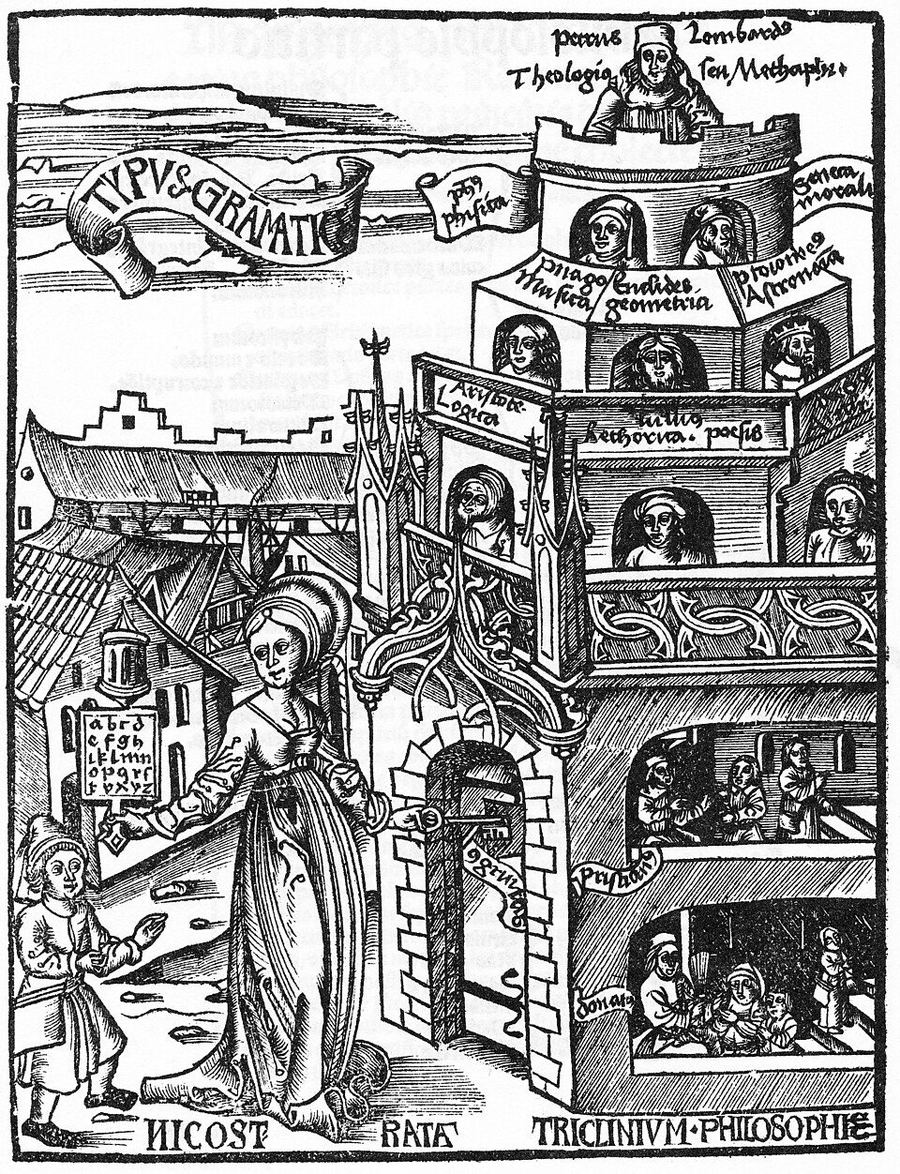
For the Greeks grammar did not mean the rules of sentences but the art of letters: reading, understanding and interpreting what is written. In the Middle Ages grammar therefore stood at the start of the whole curriculum, like a gatekeeper. Whoever cannot read closely gets no use from all the other arts.
Three questions for every text
Close reading comes down to three questions:
- What is really written there? Not what one expects, not what the summary says, but the wording.
- Who says it, and when? A text has an author and a date, even when it hides them.
- How does he know? Did he see it, read it, hear it or think it up?
An example is the sentence “All is number”, quoted everywhere as a teaching of Pythagoras. In this form it stands in no ancient source. Aristotle reports in the Metaphysics (I 5) that the Pythagoreans took the elements of numbers to be the elements of all things. That is related, but not the same, and it is the report of a later writer, not the word of Pythagoras, of whom not a single line survives. That does not make the thought false. But whoever reads closely knows what he holds in his hands.
How to date a book
The most famous example of the power of grammar concerns Hermeticism. When Marsilio Ficino translated the Corpus Hermeticum into Latin in 1463, he and his contemporaries believed Hermes Trismegistus had been an Egyptian sage from the time of Moses, older than Plato and Pythagoras. Cosimo de’ Medici even had the translation of Plato put aside so that Ficino would render Hermes first.
In 1614 the philologist Isaac Casaubon examined the texts closely. He found words and phrases that existed in Greek only centuries after Plato, and ideas that clearly came from Platonism and early Christianity. His conclusion: the writings were composed not before Plato but long after Christ. Today’s scholarship dates them to about AD 100 to 300 (see Hermeticism). Casaubon needed no laboratory for this, only grammar.
Many texts of Western esotericism have such a history. They claim a great age that turns out to be legend on close reading:
claimed origin actual date of writing
Claimed origin and actual date of writing of some famous texts. The dates follow current scholarship. More on the texts can be found on the pages on Hermeticism, Kabbalah, Rosicrucians and Freemasonry.
The Sefer Yetzirah is ascribed to Abraham and comes from late antiquity. The Zohar presents itself as the work of Rabbi Shimon bar Yochai from the second century and was written around 1280 in Castile, probably by Moses de León. The Rosicrucian Fama Fraternitatis tells of a Christian Rosenkreuz said to have lived from 1378 to 1484, and appeared in 1614 from a circle around Johann Valentin Andreae. Anderson’s Constitutions of the Freemasons trace the history of the order back to Adam, while the first Grand Lodge was founded, according to tradition, in 1717. And the Kybalion, which proclaims “ancient Hermetic principles”, appeared in Chicago in 1908.
Late does not mean worthless
Here lies a trap in the other direction. That a text is younger than it claims says nothing about whether it is true or wise. The Corpus Hermeticum remains a profound book, even if it was not written by a contemporary of Moses. The Zohar is the chief work of the Kabbalah, whoever wrote it. And the legends of the Freemasons were never meant as history in today’s sense, but as a narrative that gives meaning.
Close reading only separates two questions that are easily mixed up: How old is it? and Is it true? Grammar answers the first. The other arts answer the second.
Exercise
Take a quotation that you come across, online, in a book or in conversation, such as “Pythagoras said …” or “Even the ancient Egyptians knew …”. Try to trace it back to its first source. Note where the trail breaks off. You will find that a surprising number of famous quotations end at a point where nobody can say any more who said them first.
To begin with you can practise on this website: Samuel Prichard’s catechism on the page on Freemasonry comes with a link to the original. Read the passage yourself and check the text.
Sources and further reading
Sources
- Isaac Casaubon, De rebus sacris et ecclesiasticis exercitationes XVI, London 1614
- Fama Fraternitatis, Kassel 1614
- Three Initiates, The Kybalion, Chicago 1908
- Sefer Yetzirah (Book of Creation), composed between the 3rd and 6th century AD
- Gershom Scholem, Die jüdische Mystik in ihren Hauptströmungen, Zurich 1957
Further reading
- Anthony Grafton, Forgers and Critics. Creativity and Duplicity in Western Scholarship, Princeton 1990