Polygons and star polygons in Freemasonry
Triangle, pentagram, hexagram and the blazing star are fixed elements of Masonic symbolism. Were they only signs, or was there knowledge behind them?
Freemasons see their brotherhood as a community in which each member works on himself to become a better person. Their basic ideals are liberty, equality, fraternity, tolerance and humanity. In Germany the umbrella organisation is the United Grand Lodges of Germany.
Why is Freemasonry in the section on mysticism? Because it concerns itself with number symbolism and mysticism. Its roots lie not only in the cathedral builders’ lodges (see The signatures of the cathedral builders) but also in Kabbalistic and Rosicrucian thought. This Western esotericism was a return to the Gnostic roots of Christianity and a protest against the dogmas of the time. Some lodges are even named after Pythagoras.
The figures
Freemasonry works with symbols in which numbers and geometric figures play a large part. In publications, ritual objects and lodge rooms polygons and star polygons appear again and again. Their meanings are not strictly fixed:
- The triangle can mean the “Great Architect of the Universe”, but also the degree of Entered Apprentice.
- The pentagram can mean the human being, but also the degree of Fellow Craft.
- The hexagram can mean the union of God and world, or polarity as such, but also the degree of Master Mason.
The four start figures of the tetractys in particular, triangle, hexagram, pentagram and double pentagram (which might be read as the “blazing star”), are among the most important symbols. They also appear on the jewels, the insignia lodge members wear during ritual work. Besides these four there are many other figures in Masonic symbolism, but almost always symmetries around a centre.
The four start figures of the tetractys: triangle, hexagram, pentagram and double pentagram, the 'blazing star'.
Square and compasses
The emblem of Freemasonry is the square and compasses, interlocked, sometimes with the letter G in the middle. Freemasons themselves often read this G as geometry, which is exactly what one practises with compasses and square. Both tools can be linked with many pairs of concepts, in the broadest sense like yin and yang. Could it not be that the spiritual forerunners of Freemasonry, such as Pythagoras, and later “initiates of geometry” discovered the secrets of creation with precisely these tools? With compasses and square one draws circles, polygons and star polygons, the very figures explained number-theoretically under The key to the tetractys. Here are connections where one need no longer be content with mystical interpretation. They could give Masonic symbolism something like a scientific foundation.
Why were these figures so important to the founding fathers? Were they only symbols? Discretion is a virtue of the brotherhood, and perhaps the old knowledge was buried with the last initiates. One example is an old Masonic gravestone in a churchyard in Castleton, Derbyshire, bearing Masonic symbols.
Point, line, surface and solid in Samuel Prichard
In 1730 Masonry Dissected by Samuel Prichard appeared in London. It made Masonic custom public in detail for the first time, went through many editions and translations and prompted the Grand Lodge of London to change its rituals. It is built as a question-and-answer piece, and in it the Pythagorean tetractys of point, line, surface and solid appears quite directly. Its very first sentence names the liberal arts as the foundation of Masonry, above all the fifth, geometry. The Entered Apprentice’s catechism reads:
Q. How many Principles are there in Masonry?
A. Four.
Q. What are they?
A. Point, Line, Superficies and Solid.
Q. Explain them.
A. Point the Centre (round which the Master cannot err) Line Length without Breadth, Superficies Length and Breadth, Solid comprehends the whole.
And in the Fellow-Craft’s part:
Q. Why was you made a Fellow-Craft?
A. For the sake of the Letter G.
Q. What does that G denote?
A. Geometry, or the fifth Science.
A clear sign that Pythagorean-Platonic thought ranked high at least in the early days of Freemasonry. Early Masonic literature also reproduced these passages faithfully. The full text is freely available at archive.org.
The tetractys in the Rebis
The woodcut from Heinrich Nollius’ Theoria philosophiae hermeticae (Hanover 1617) shows a Rosicrucian allegory, the “philosophical egg”. Rebis, Latin for “two things”, denotes in alchemy the union of two principles into a higher one, such as sulphur and mercury, but above all of the male and female principle in the hermaphrodite in the preparation of the philosophers’ stone.
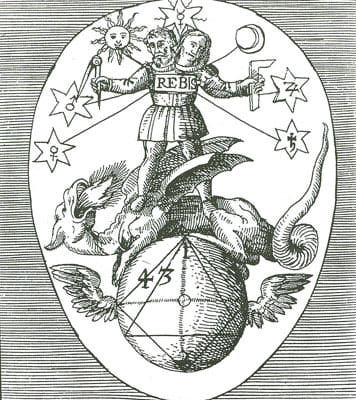
For Freemasonry it is remarkable that the hermaphrodite, uniting sun (male) and moon (female), holds compass and square: the compass for spirit, male, the triangle, and the square for matter, female, the four-sided figure. And what does the sphere at the bottom mean, with its triangle and square and the numerals 3 and 4? Looking closely, the numerals 1 and 2 also stand at the ends of the vertical line through the centre of the sphere. So once again 1 + 2 + 3 + 4. Evidently a geometric law is being pointed out: densely packed spheres, when their centres are joined, form a lattice of triangles and squares (see Space filling without gaps and The signatures of the cathedral builders).
The four elements in Emil Stejnar
For anyone interested in the esotericism of Freemasonry, the books of the mystic and Freemason Emil Stejnar are recommended: Exerzitien für Freimaurer (Exercises for Freemasons, 1984) and Die vier Elemente. Der geheime Schlüssel zur geistigen Macht (The four elements: the secret key to spiritual power). Stejnar’s main theme is the doctrine of the four elements and its correspondence with the four-letter name of God, YHWH. What is meant are the four elements of the “microcosm”, their counterparts in the human psyche. He takes as his model a four-pole magnet, an image going back to the magician Franz Bardon (Initiation into Hermetics), whose poles depend on each other:
| Element | Effect | Quality | Power of the soul |
|---|---|---|---|
| Fire | energy | active | willing |
| Water | resonance | passive | feeling |
| Air | information | light | thinking |
| Earth | storage | heavy | awareness |
One of Stejnar’s drawings shows four pairs of interlocking hands with the name of God at the centre: the four elements are inseparable. The same motif appears in the Secret Symbols of the Rosicrucians.
Alfried Lehner
Another Freemason and author who has studied the Pythagorean brotherhood and the lambdoma is Alfried Lehner. Worth reading are his book Die Esoterik der Freimaurer (The esotericism of the Freemasons) and a second, hard-to-find work, Das wunderbare Wissen vom Wesen der Welt (The wondrous knowledge of the nature of the world), a ritual guide for Master Masons that deals among other things with the philosophical aspects of the lambdoma.
Oswald Wirth
Books on the original Christian-esoteric Freemasonry and its roots in Pythagoreanism, Platonism and Neoplatonism, which also make today’s rituals more understandable, are few. A worthwhile standard work is the trilogy by Oswald Wirth, three volumes corresponding to the three degrees of Apprentice, Fellow and Master (first German edition 2014, Edition Königliche Kunst). In Germany Wirth is known mainly as a tarot researcher and hermeticist, in France he was an important Freemason and Masonic writer. His volumes contain much on esotericism and alchemy in Freemasonry and derive its symbols geometrically, from Pythagorean and Platonic sources. He touches, if briefly, on the ten-point triangle of the tetractys and comments on the circle with a point in the centre, the ten sefirot of the Kabbalah, the four-letter name of God, triangle, square, pentagram and hexagram. He understands the cubic stone not only as a building stone but as a construction that comes about through crystallisation. What philosophy lies behind this only becomes clear through studying the cubic crystal systems.
The parts and the whole
Complex things cease to exist as soon as they are taken apart into their elements, for they are only recognised by their relations to other things. A symbol too is defined only by its difference from similar ones, and for that one must know the system in which it is embedded. This site wants to encourage readers to explore that system in nature for themselves.
On Freemasonry see also Herder’s Metacritique and The throne of God and the number 24.
Circle, triangle and square around one centre: the geometric framework from which the builders' lodges derived their marks.