The tetractys at a glance
Numbers as quantities, cycles in four phases, the first stroke of the compass, the ten in the division table and the pentagram in DNA: a walk through the basic ideas of this site.
This overview does not set out to repeat the familiar music-theoretical readings of the tetractys that go back to Hans Kayser (1891–1964) and are found everywhere today (they are treated in the section Harmonics). It pursues the largest gap: what is the connection between the “sacred four” and the “sacred ten” of the Pythagoreans, between 1 + 2 + 3 + 4 and its sum?
The geometric key figure is the simplest Platonic solid, the tetrahedron, and its continuation into any number of dimensions, the simplexes. Only with them does it become clear what the pentagram, the Pythagoreans’ sign of recognition, has to do with the tetractys. And it becomes understandable why magical powers were ascribed to these figures: they stand for timeless principles and became the basis of a philosophy of religion that shaped the West from the Pythagoreans through Platonists, Kabbalists and Rosicrucians into the Renaissance.
The tetractys was a kind of ancient theory of everything, secret into the bargain, and so it stood for many things. Anyone who does not understand everything at once should not be discouraged. Only the alternating view of number and figure opens the way, and some things are deliberately repeated here because they are better shown directly in context.
What are numbers anyway?
Number mystics like to ask: have numbers always existed, or only while we think of them? Is their order in themselves or in our consciousness? Is there an intelligence behind it? But first another question must be settled: what do we mean by “number” at all?
Digits are invented signs for quantities. They depend on a counting system, for us the decimal system, a freely chosen order that makes calculating with large numbers possible in the first place. Whoever wants to explore the essence of number must lead the signs back to their origin, to quantities of points:
- the point itself, as the sign of unity
- two points, the line
- three points, the triangle
- four points and more, the tetrahedron and the other solids
Even looking at quantities of points in the dimensions we experience leads to a fourness that shows itself as geometry. From it arose the number mysticism of the Pythagoreans, Platonists and Kabbalists.
An example: thirteen points are a prime quantity, whatever sign one writes them with. In another counting system the sign changes, the quantity remains prime. That is why the nature of the primes can show itself only in geometry, in symmetry, which is free of the accidents of a counting system. Whoever reflects on the great questions of number without knowing this geometry misses the essential.
Cycles in four phases
The movements in the cosmos, Greek for “order”, are mostly circular, and from them arise the recurring cycles on earth: the course of the sun through the four cardinal points, the four phases of the moon, the four seasons. Every such cycle has four phases, and such cycles are found in living and non-living nature alike. A wave, too, is at heart a cycle divided into four sections: rise, peak, fall, trough.
A point runs round a circle, on the right its height as a wave. Circle and wave divide into four quarters. The buttons switch between three familiar cycles of four phases.
The same fourfold “rotation” lies in the series of numbers as soon as the digits are replaced by polygons. The quantity three, the triangle, is the first to have the angle sum of half a circle. One more corner, and the square has the angle sum of a full circle, the only polygon to do so. The pentagon has one and a half full circles, the hexagon two, and so on (see Angle sums and full circles).
Every odd quantity thus begins a new half circle, and the following even quantity closes it to a full circle. A full circle always takes two points. This makes it understandable why the Pythagoreans and Platonists ascribed male, creative qualities to the odd numbers and female, preserving ones to the even. Also, only in the even polygons can right angles be formed between the corners, because only in them do corners lie exactly opposite each other.
Yin and yang likewise contain two resting and two moving phases. And a Rosicrucian work of the eighteenth century, Des Hermes Trismegistos wahrer alter Naturweg (Hermes Trismegistus’ true old way of nature), shows on its title a sign that combines the alchemical double ouroboros, two creatures biting each other’s tails, with the compasses and square of the Freemasons and two interlaced triangles. Since Egypt the ouroboros has stood for infinity, recurrence and “as above, so below”, the double ouroboros for heaven and earth, spirit and body. Compasses and square stand for the active and the passive principle. Together they describe exactly this law of the number series.
In short: all cycles in the cosmos and on earth follow a fourfold periodicity. Every cycle can be divided into an active and a passive triangle, like the two halves of a wave, and together they again make a square with the angle sum of a full circle. The series of numbers as geometry begins with point, line, triangle and square and then repeats without end in the alternation of triangle and square.
Space as a sphere
But what is the empty space like in which these cycles take place? If from a centre all directions reach equally infinitely far, infinite space is a sphere. And since in infinite space every point is a centre, every point must have the same properties as its neighbours.
That is exactly fulfilled when space is filled with equal spheres, each touching the others as closely as possible. Join their centres and you get an even lattice of triangles and squares, built from tetrahedral and octahedral cells: the cubic crystal systems, of the greatest importance in crystallography and philosophically significant from Plato through Kepler to Buckminster Fuller (see Gap-free filling of space). Resting, “crystalline” space and the moving cycles within it are thus both governed by fourness.
The first stroke of the compass
Let the plain formula of the tetractys sink in and it yields a basic statement about the structure of the world: 1 + 2 + 3 + 4 are point, line, surface and solid, space as the precondition of an order that fills it with life. The matching figure is the tetrahedron.
The primes play a key role, the “first” numbers, divisible only by themselves and one. They interested the Pythagoreans and Platonists because it was a matter of fathoming how the many arise from the One. The first numbers 1, 2 and 3 (one was formerly counted among the indivisible “first” numbers, today it is not considered a prime), that is vertex, edge and face, together create the space for solids, the four. Four is no longer prime, since it is divisible by two. In Hermeticism it stands for the element earth, that which becomes embodied, just as ten does in the Kabbalah. Here the connection of 1 + 2 + 3 + 4 = 10 with this Hermetic principle already shows.
The next prime is five. It is the first that must submit to the order of space arising from the “threeness”, and at the same time, depending on the point of view, it dissolves this strict order or fills it with life and movement. Its figure is the pentagram, a crosser of boundaries because it exceeds the right angle, and at the same time bounded itself, because it must fit into space (see The pentagram and the golden ratio).
A saying of Bernard of Clairvaux (1090–1153) alludes to this insight. Asked what God is, he answers: length, breadth, height and depth.
All further orders that follow from the tetractys are fourfold as well. It is about the combinatorics that necessarily result from the natural numbers and that can be experienced only through a geometry that directly expresses number.
Hexagram and pentagram
The “tetractys of space” as the first cause of all embodiment appears in combinatorics and in geometry alike as unbounded, resting and crystalline. Its sign is the hexagram, the six-pointed star, as an image of the union of energy and unbounded space. The religious reading of creation and fall, of God and world, can be attached to it as well.
The pentagram, the five-pointed star, stands by contrast for fleeting becoming and passing away, the union of time and matter and so the limiting principle of life, which also shows in the proportions of the golden ratio.
The four start figures: triangle, hexagram, pentagram and double pentagram. Hermeticism assigns the four elements to them.
The four elements fire, air, water and earth can be assigned to the four start figures. This is little known and may confuse. But compare the traditional signs of the elements with these four figures and you recognise them as a simplified form (see The tetractys analogy table).
What the ten means
The Pythagoreans were a school of science and a religious secret society at once, at a time when science, philosophy, magic and religion had not yet gone separate ways. Their oath was sworn by him “who gave our soul the tetractys, the source and root of ever-flowing nature”, that is, Pythagoras himself. The testimonies on the tetractys itself are late: the oath, Lucian, Theon of Smyrna and Iamblichus. From Philolaus comes the praise of the decad (see The ancient sources), together with the tradition that the pentagram was their sign of recognition.
There are two common readings of the ten-point triangle. One sees in it the harmonic ratios of music, the other the steps of dimension, point, line, surface, solid. In neither does ten as the sum have a recognisable meaning. In number symbolism, however, there is a clear pointer: the four worlds and ten sephirot of the Kabbalistic tree of life and the tarot that corresponds to it, the four worlds corresponding to the four elements.
There is a clean link between the two readings. Point, line, surface and solid are the beginning of an endless chain of figures, and this chain corresponds to the natural numbers: the number of vertices is the number itself, the lines through the polygon show its divisors. These are the simplexes.
The geometric chain of numbers: point, line, triangle, tetrahedron (as a square with diagonals), and so on. Each figure shows the divisibility of its number.
Take them apart into their polygons and star polygons and arrange these in a division table, and it turns out that there are exactly four types, corresponding to the kinds of divisibility in number theory. In music theory the same table is called the lambdoma, the most important diagram of harmonic research. Here the two readings meet.
One of the four types is the pentagram, 5 : 2 = 2.5. And 2.5 × 10 = 25 is the first number on a twin position that is not prime. The dividing numbers 1, 2, 3 and 4 secure the rhythm of six of the twin primes, and from the dividing prime 5 on the channels of this rhythm become “clogged” (see The sieve of Eratosthenes). Ten is the first number containing the fourth type, 10 : 4 = 2.5, two pentagrams, and so uniting all four (see The key to the tetractys). It is always about ratios. The decimal system has nothing to do with it, the geometry proves it.
The division table as a language
The star polygons fill only a quarter of the table, namely up to the quotient 2, the diagonal with the line stars.
The division table with the four figure types as colours. Star figures exist only up to the quotient 2, that is in one quarter of the table.
The series of numerators and denominators face each other as equals and can be exchanged at will. Only the human mind assigns the active principle to one side and the passive to the other. The cause of the fourness thus lies in the even and odd numbers, in both series, and this doubling necessarily shows in the quotients. “Infinitely large” is the series of numbers, “infinitely small” the series of divisors. Between them stand 2/1 and 1/2, the doubled and the divided unity, in the ratio 4 : 1. Put philosophically: the divided and the doubled unity mediate between the infinitely small and the infinitely large.
The table itself is fourfold too. Mathematics names only three kinds of divisibility, but for the Pythagoreans one was not a number but the primal ground, and yet it is the first of a fourfold tetractys. The coloured pattern can also be read as an interference pattern, arising when two equal series of numbers meet like two waves (see All is number – all is frequency).
A table at right angles is only one of four quadrants of a coordinate system. Multiplication faces division, subtraction faces addition: the four basic arithmetic operations form a tetractys too (see Tetractys and the Cartesian coordinate system). This coordinate system resembles the four-pole magnet of the Rosicrucians (see The secret figures of the Rosicrucians) and a Templar cross, and it recalls Peter Plichta’s prime number cross. Cause and effect, active and passive are reversible in it.
What the tetractys might be
An attempt at a description: the Pythagorean tetractys is the general, fourfold, hierarchically fractal order that follows from the rotation of cycles and the combinatorics of quantities, represented as points, vertices, circles and spheres. It shows itself in symmetries such as the fractal polygons, in the crystal lattices of sphere packings, in the Platonic solids, and it arises from circle and sphere in any number of dimensions, whose plane images are the simplexes (see The simplex – the fixed form of number). How this shows in the distribution of the primes and in the number π is treated in the section Number theory.
The pentagram in life
Finally an observation that one could easily take for an analogy contrived after the fact. Look along the axis of DNA, the molecule of heredity, and you see a tenfold cross-section: one full turn of the double helix has about ten base pairs, and the arrangement can be read as two interlaced pentagons or a double pentagram. The length of one turn and the diameter of the helix, about 34 and 20 to 21 ångström, stand roughly in the golden ratio, and 21 and 34 are consecutive Fibonacci numbers.
The double pentagram 10/4. A cross-section of DNA shows a similar tenfold figure. With ‘Draw’ it appears line by line.
For the tetractys and the primes, the appealing thought is that the principle of life, which the pentagram has always embodied, shows itself in the figure 10 : 4, the first in which all four types come together. That is no proof, but a hint that invites further thought. A good introduction to the geometry of the pentagram in nature is given by a documentary of the German educational channel BR-alpha.
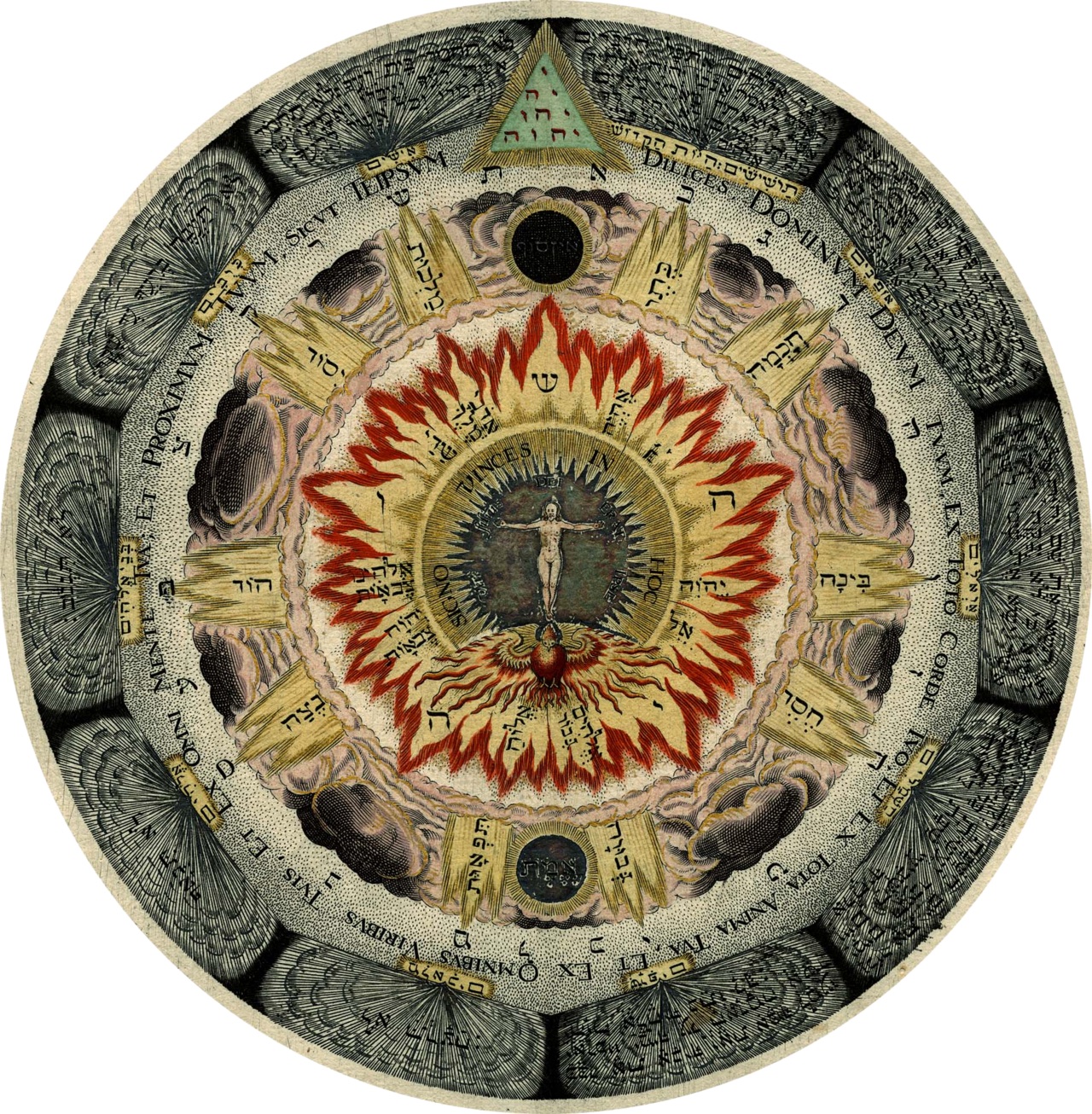
The same link between ten and pentagram appears in a famous Kabbalistic-Rosicrucian engraving by Heinrich Khunrath from 1595: at the centre the “God-man” Adam Kadmon in the flaming five-pointed star, around him ten circles, the ten sephirot, and above them the name of God in the form of a tetractys (see The Kabbalah).