The secret symbols of the Rosicrucians
A "simple ABC booklet" from 1785 full of circles, triangles and six-pointed stars, and the thesis that the fourness is explained geometrically in it.
Rosicrucians are the members of a secret mystical society whose beginnings lie in the 17th century. Their teaching combines alchemical, Hermetic and Kabbalistic elements. Anyone who looks into them soon comes across the work Geheime Figuren der Rosenkreuzer aus dem 16ten und 17ten Jahrhundert (Secret Symbols of the Rosicrucians of the 16th and 17th Centuries), published in Altona in 1785 in three parts. One part is subtitled a “simple ABC booklet” for young pupils in the school of the Holy Spirit.
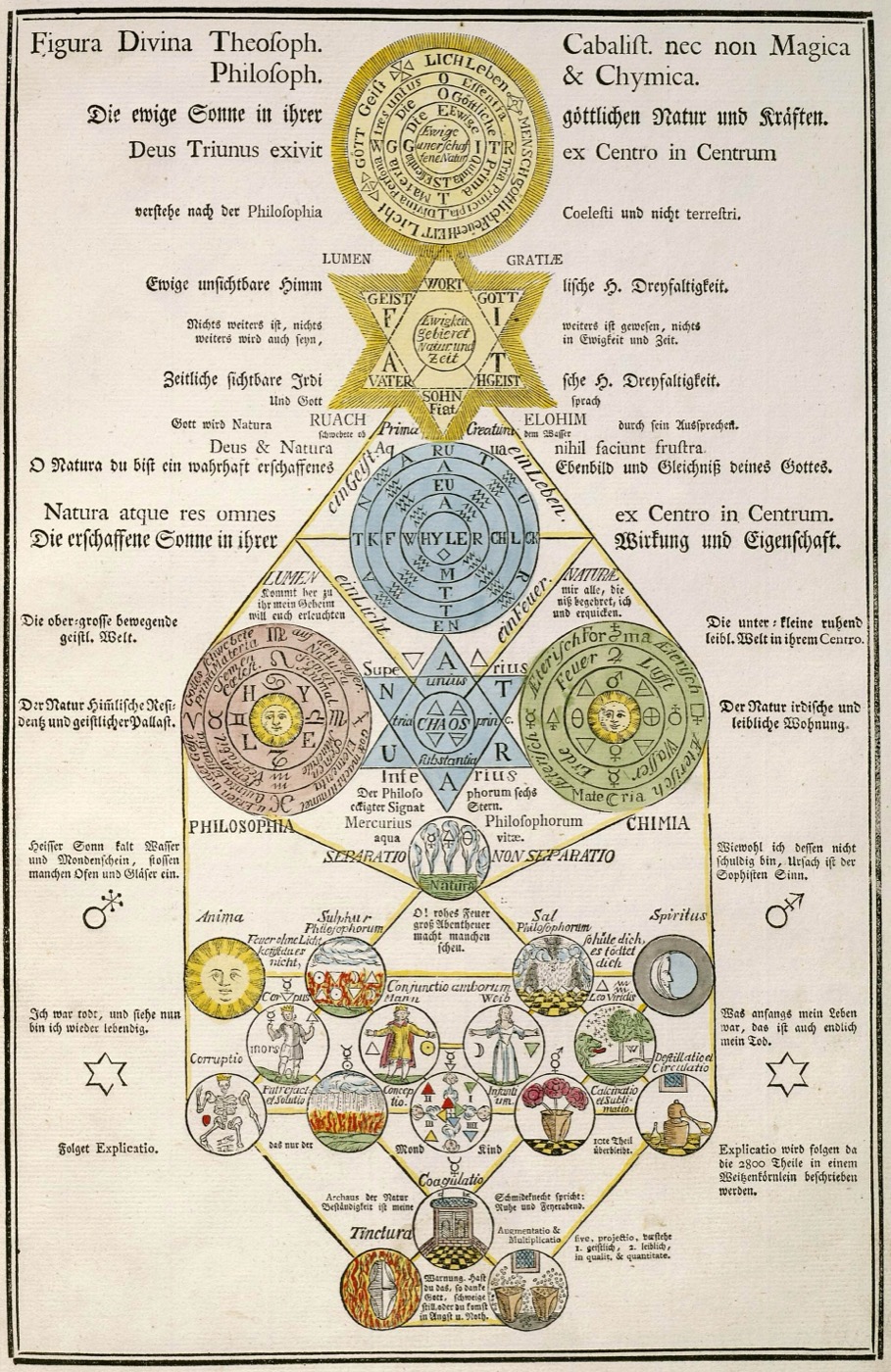
The many hand-coloured drawings and diagrams do not explain themselves. The texts that go with them make matters worse: Bible verses, allegories in verse and a great deal of incomprehensible explanation. One gets the impression that the author wanted to confuse the reader on purpose, or was himself confused. Against this stands the fact that figures such as Isaac Newton studied Rosicrucian material intensively. Newton devoted himself at least as thoroughly to alchemy and theology as to physics, and his library also held Rosicrucian writings, as his papers show. His original Latin writings have been newly translated by Ed Dellian (see Links). And the very title “simple ABC booklet” hints that there were people who knew more than the ABC.
Some of the truly symbolic figures belong to the geometric foundations of the tetractys. These strong symbols were probably surrounded deliberately with a great deal of confusing decoration: whoever wanted to understand the secret was meant to work for it.
Luther, Protestantism and the rose
Revealing is the seal of Martin Luther, the Luther rose with a cross in a heart in a rose. Luther himself was not yet a Rosicrucian, the movement only emerged from 1614 with its manifestos, but these were written in Lutheran Tübingen, and the coat of arms of their presumed author Johann Valentin Andreae, with cross and roses, clearly recalls the Luther rose. On this view Rosicrucianism was the counter-programme to the Catholic Church of its time: a return to the Gnostic roots of Christianity, to spiritual self-determination and the vision of a new humanity, against dogmas and the sale of indulgences. Freemasonry sympathised with it too. In this reading Protestantism arose from esoteric and Kabbalistic roots and later itself hardened into dogma. Luther himself, in his later years, became a dogmatic reformer and an enemy of the Jews. Most Protestant Christians do not know these origins of their faith.
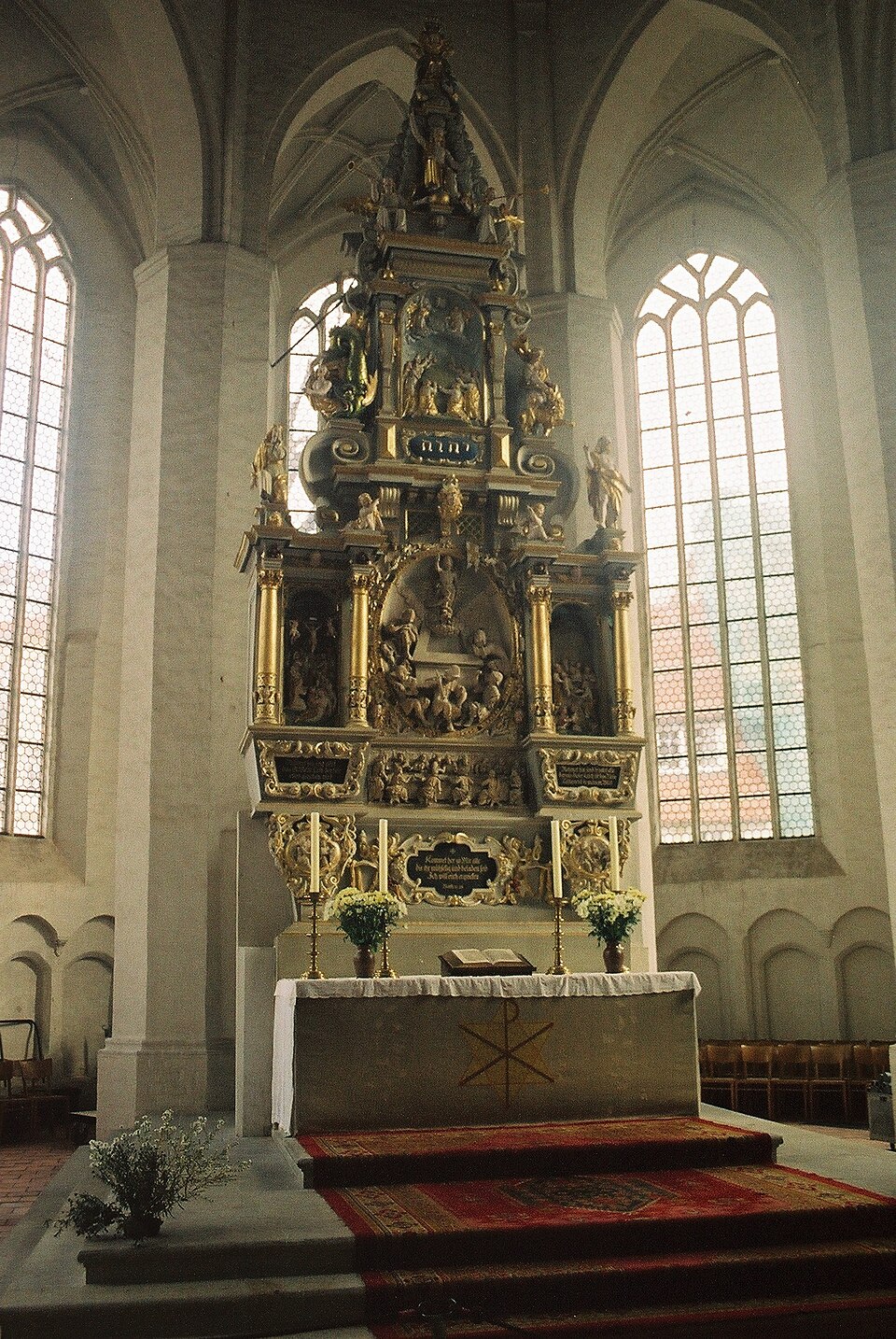
How closely Kabbalah, Rosicrucianism and the Reformation were connected is shown by some churches. One example is the Protestant Oberkirche St. Nikolai in Cottbus (German Wikipedia), the largest medieval church in Lower Lusatia. Its altar of 1664 bears in its upper third, in golden Hebrew letters, the four-letter name of God, YHWH. It too corresponds to the four elements and the tetractys.
The four elements
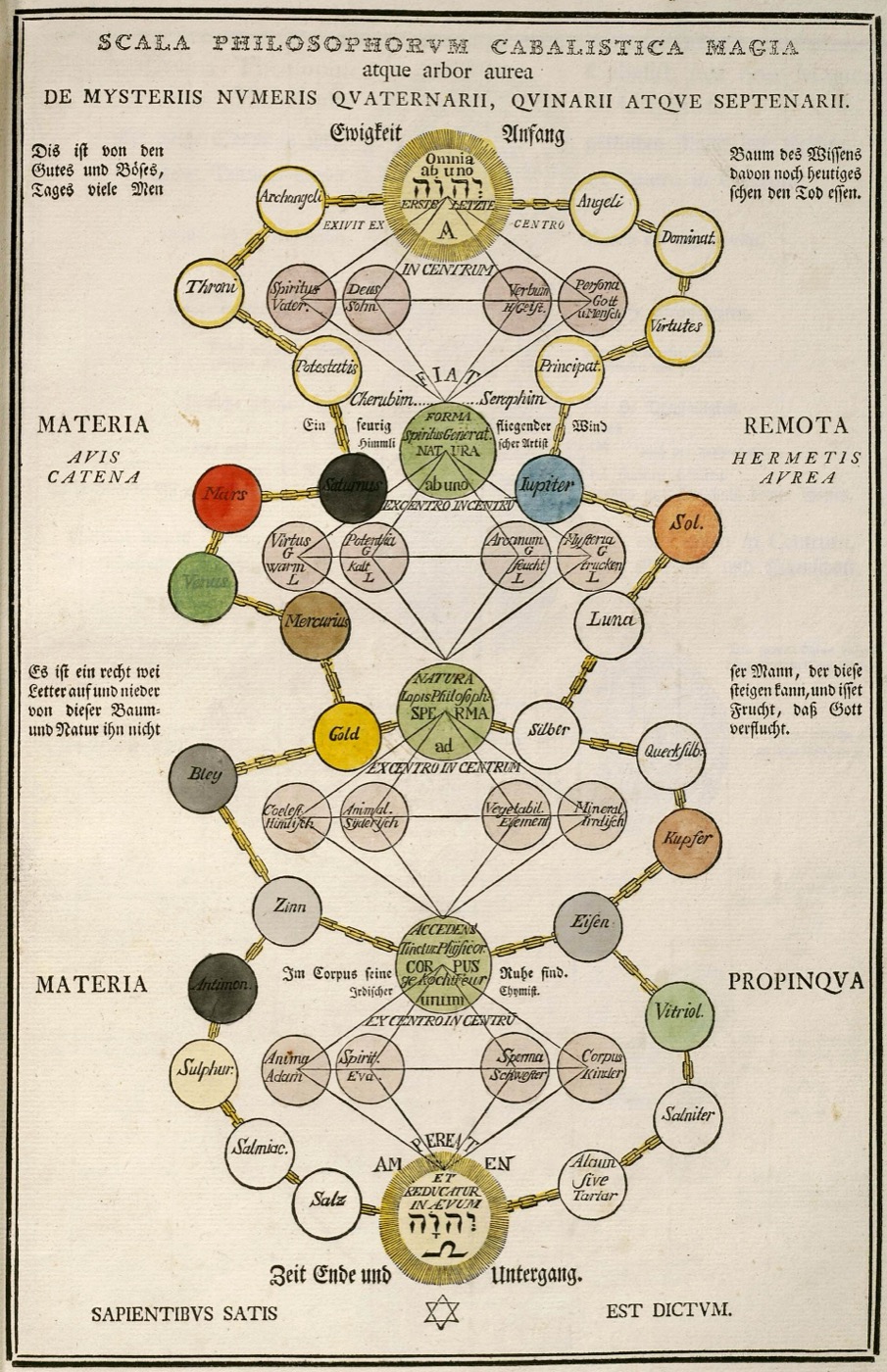
The four elements are a focus of the booklets. One plate shows them as four figures holding hands: the fourness is to be understood as a unity, not as a naive image of God but as a fractal system of a universal order. One may safely assume that Pythagoras too meant these four elements when he spoke of the tetractys. Anyone versed in religion who has the Trinity in mind and cannot make much of a fourness: four is the realisation of the divine in matter, in the element earth. That is how it appears in the Kabbalistic tree of life, in the throne of God in Revelation and in the Merkabah mysticism of Ezekiel. The frequent references to the Kabbalah underline the connection, for there the four worlds together yield the ten sephirot (see The Kabbalah).
Good and evil on one trunk
Another plate shows the tree of knowledge, from which Adam and Eve ate the forbidden fruit. Three hands reach for the good fruit, three for the evil one, but both hang on the same trunk, and from the cloud the hand of God reaches for this one tree. The roots grip two triangles, upright and inverted. Above, they unite into a six-pointed star. Good and evil depend on each other: without light no shadow, without darkness the candle’s glow would not be seen. Triangle and hexagram are two of the four start figures, and this allegory corresponds exactly to the rhythm of six, in which the primes lie mirrored about their axes of symmetry.
A plate full of stars
Another plate shows a whole collection of star polygons. The texts on it bear no recognisable relation to the figures, but the mixture of magical symbolism and pious sayings, partly from the Bible, scattered over the page without order, is remarkable. Some examples from the booklet of 1785 (in the original German):
- “O Mensch erkenne Gott und dich: Im Himmel und auf Erden gebricht dir nichts.” (O man, know God and yourself: in heaven and on earth you lack nothing.)
- “Wie aus einem Wesen alle Dinge entspringen und hervorkommen im Himmel und auf Erden, wie die Ewigkeit aus sich selber gebiehret die Zeit, und Natur.” (How all things spring from one being in heaven and on earth, how eternity gives birth from itself to time and nature.)
- “Die Wiedergeburt und Vereinigung in Gott.” (Rebirth and union in God.)
The same simple figures recur on many pages of all three booklets, so they evidently carry weight in the teaching. Especially in the light of sphere packings and their crystal lattices they are worth thinking about afresh.
Figura Cabalistica: 1, 2, 3, 4
One page is headed Figura Cabalistica and speaks of “the true ground of God’s wondrous number: 1. 2. 3. 4.”, with a circle in four segments bearing the numbers 1 to 4 below it. Directly underneath, without explanation, comes the turn to the Trinity and the six-pointed star: three that bear witness in heaven, and three on earth. Where an explanation is needed, there is only “O Arcana Arcanorum”, O secret of secrets.
The explanation is geometric:
- Threeness is in Hermeticism the purely spiritual creative principle. Fourness is its realisation in matter.
- A triangle has the angle sum of half a circle. One more vertex, and the square has the angle sum of a full circle, the only polygon to do so. This is exactly what the circles with four segments show.
- The six-pointed star expresses the same: two triangles, each with half a circle, together make a full one. The hexagram is the only star polygon composed of polygons with this property. The circles with six segments show this.
And here lies the open secret of the full circles: there is only a single polygon whose angles sum to one full circle, the square. Stars and compound stars with the angle sum of one full circle, by contrast, exist in infinite number, the hexagram being only the first (see Simplexes and the number π). Carried over, this means: there can be only one God, but infinitely many creatures. God is the eternal union of energy in space, his creation is subject to the movement and transience of time and matter. Compare how the primes are ordered: the one rhythm of six and the infinitely many, irregularly distributed primes within it.
The full circle stands for unity and perfection, that is, for God. But this is not only about symbols. Circle geometry, that is symmetry, and number theory are two sides of the same coin. It is about describing a spiritual world that describes the visible world, “God and the world” as it were, about the foundations of number theory, which go hand in hand with the geometry of circle and sphere, and probably about the blueprint for energy, space, time and matter. The same reflections lead to the secrets of the pentagram, the third start figure. They should not only be read but checked for oneself.
The booklets today
The Secret Figures appeared from 1785 in Altona near Hamburg. According to the title page they were made public by an unknown brother who calls himself “P. F.”, with additions by a second, “P. S.”. The figures themselves go back to older manuscripts and are partly attributed to Adrian von Mynsicht (c. 1588 to 1638), a physician and alchemist who wrote under the name Hinricus Madathanus Theosophus. They have long been in the public domain.
All three booklets are freely available today as scans: complete in the Internet Archive, where a private collector uploaded them, and individual plates in high resolution on Wikimedia Commons, where the illustrations on this page come from. Anyone who wants to study the figures will find every page there, and much to puzzle over.