From apprentice to master
What this guide is for: whoever meets Hermeticism, Gnosis, Pythagoreans, Rosicrucians and Freemasons needs one thing above all, the ability to test things for oneself. The old curriculum of the seven liberal arts was made for exactly that.
Whoever looks around this website meets Hermes Trismegistus and the Gnostics, the Pythagoreans with their tetractys, the Rosicrucians and the Freemasons. It is fascinating, and it is confusing. Much sounds deep, some of it contradicts itself, and not everything that presents itself as ancient wisdom is either ancient or wise. How does one find what is true in all this?
The answer of this section is not more knowledge but a tool. The old schools called it the seven liberal arts. They are no secret knowledge but a curriculum by which every educated person in Europe learned to think, from antiquity to the eighteenth century. This section reads it anew, as a guide for young adepts who want to find their way in the old teachings and in the present.
Apprentice, journeyman and master
The old crafts had three stages. The apprentice learned from a master to know and use the tools. The journeyman then went travelling, often for years, and learned from many masters how to build something sound with those tools. A master was whoever presented a masterpiece and so showed that he could not only do something but also bear responsibility and train apprentices himself.
The Freemasons took over these three stages, at first only two degrees, with the master’s degree added around 1725, and made them degrees of self-knowledge. The earliest printed texts already link the Fellow Craft with the liberal arts. In 1730 Samuel Prichard gives “Geometry, or the fifth Science” as the meaning of the letter G (see Polygons and star polygons in Freemasonry). In 1723 James Anderson even begins his history of Freemasonry by saying that Adam “must have had the Liberal Sciences, particularly Geometry, written on his Heart”.
The word master leads here too. The medieval universities began with the faculty of the liberal arts, and whoever completed it became magister artium, “master of the arts”. The title lives on today in the Master of Arts. A master was originally someone who commanded the arts so well that he was allowed to teach them.
The seven arts
The idea is old. In the seventh book of the Republic Plato has the future philosophers first learn arithmetic, geometry, astronomy and harmonics before they are admitted to dialectic, reflection on truth itself. The Pythagorean Archytas called these sciences “sisters”. In the fifth century AD Martianus Capella described, in an allegorical romance, the Marriage of Philology and Mercury, at which seven bridesmaids appear, each one of the arts. From then on the number was fixed. Around 500 Boethius coined the word quadrivium, “four ways”, for the four arts of number, and the three arts of the word were later accordingly called the trivium, “three ways”.
| Art | Subject | trains | |
|---|---|---|---|
| Trivium | Grammar | the word | reading closely |
| Dialectic | the thought | reasoning soundly | |
| Rhetoric | the speech | speaking honestly | |
| Quadrivium | Arithmetic | number in itself | counting and ordering |
| Music | number in relation | hearing and comparing | |
| Geometry | magnitude at rest | seeing and constructing | |
| Astronomy | magnitude in motion | observing and predicting |
The reasoning behind this division is handed down by the Pythagorean Nicomachus of Gerasa (around AD 100): arithmetic considers multitude in itself, music multitude in relation, geometry magnitude at rest and astronomy magnitude in motion.
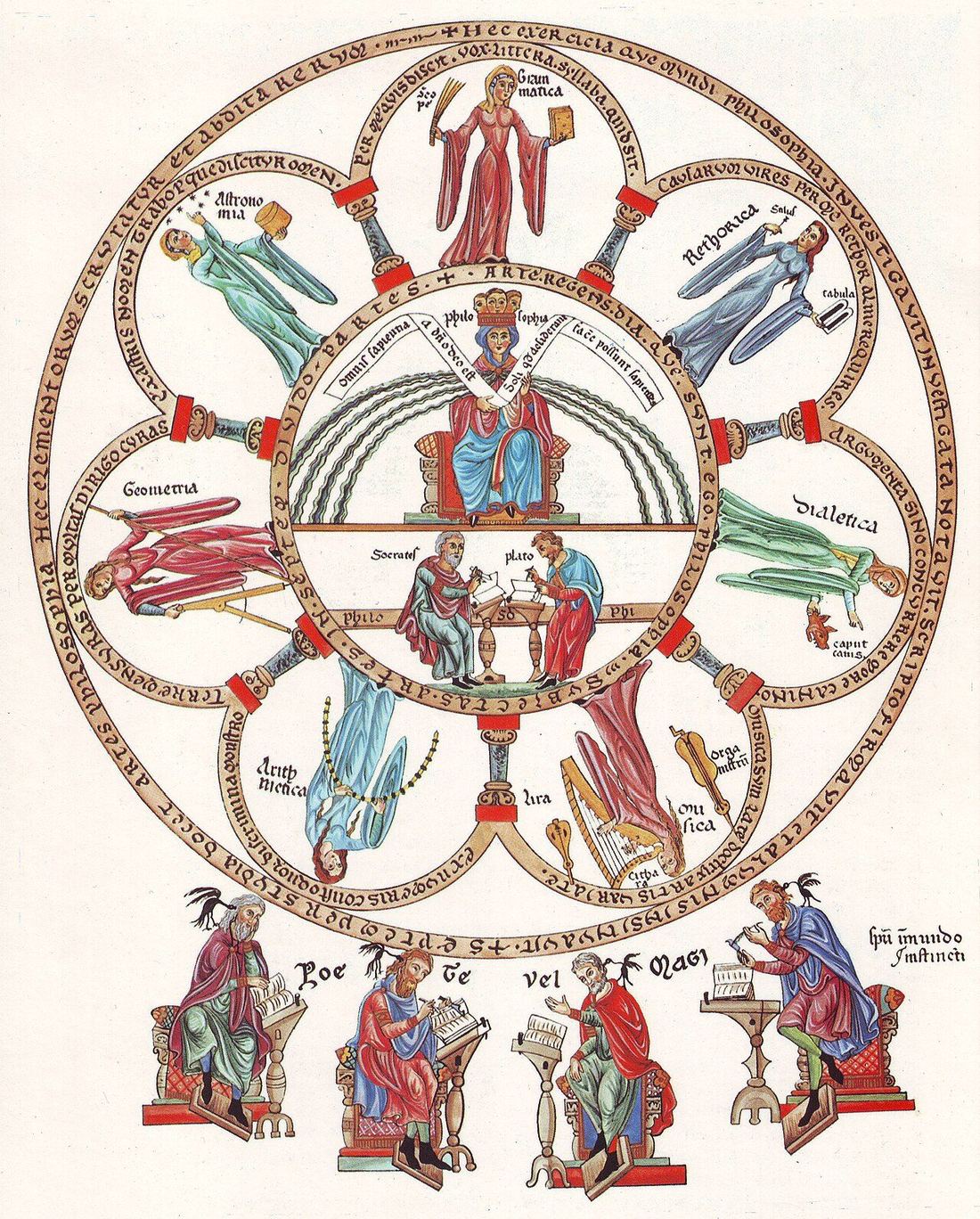
These arts were called “liberal” because, as Seneca writes, they are worthy of a free person, unlike the trades by which one earned a living. Today one can read it another way too: they are the arts that make free. Whoever reads closely, reasons soundly and recognises persuasion is harder to deceive, by others and by oneself.
How to read this guide
The section follows the old curriculum. The three chapters of the trivium are the actual school of thinking, supplemented by a chapter on chance and pattern, the most important caution for anyone who interprets numbers. The four chapters of the quadrivium are short, for their material fills the rest of this website. They explain what each art trains and lead along a path through the matching pages. The last chapter, Know thyself, turns the gaze inward, for that is where all the old schools ended.
- Trivium: Grammar, Dialectic, Chance and pattern, Rhetoric
- Quadrivium: Arithmetic, Music, Geometry, Astronomy
- The goal: Know thyself
Every chapter ends with an exercise, for thinking is learned like a craft: not by reading but by doing.
Over everything there can stand a sentence from Paul’s first letter to the Thessalonians: “Prove all things, hold fast that which is good” (5:21). It asks for both, the openness to look at everything and the courage to put most of it down again.
Sources and further reading
Sources
- Plato, Republic VII 521c to 535a
- Nicomachus of Gerasa, Introduction to Arithmetic, around 100 AD, book I, ch. 3
- Seneca, Letters to Lucilius 88
- Martianus Capella, The Marriage of Philology and Mercury, 5th century AD
- Boethius, De institutione arithmetica I 1
- 1 Thessalonians 5:21
Further reading
- David L. Wagner (ed.), The Seven Liberal Arts in the Middle Ages, Bloomington 1983