Hermeticism: Hermes Trismegistus and the doctrine of correspondence
What Hermeticism is, where its writings come from and how old they really are. As above, so below, the seven spheres of the Poimandres and the path from Hermes via Pythagoras to the Rosicrucians.
Many pages of this website speak of Hermeticism: the four elements, threeness and fourness, the seven planets and metals, the Rosicrucians and the Freemasons. This page explains what is meant by it, where the Hermetic writings come from, and what is true and what is not about their reputation as age-old Egyptian wisdom.
The thrice-greatest Hermes
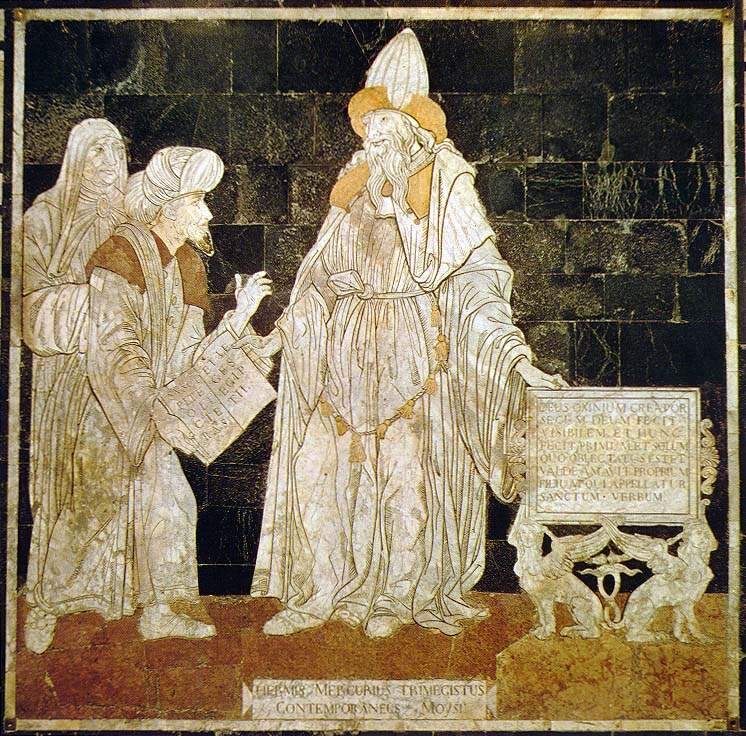
In Hellenistic Egypt the Egyptian god Thoth, lord of writing, number and wisdom, merged with the Greek messenger god Hermes into a single figure. He was called Hermes Trismegistus, the “thrice-greatest Hermes”. Writings of very different kinds appeared under his name, on astrology, alchemy and magic, but also on God, the world and the soul. It is these philosophical and religious texts that are meant when one speaks of Hermeticism.
The writings
The most important collection is the Corpus Hermeticum: 17 Greek treatises, numbered I to XVIII with number XV missing. They are written as dialogues, mostly between Hermes and his son Tat or his pupil Asclepius, and were composed between about AD 100 and 300, probably in the milieu of Alexandria. To these belongs the Asclepius, a dialogue preserved only in Latin translation and wrongly attributed to Apuleius in the Middle Ages. In 1945, at Nag Hammadi in Egypt, a library of mainly Gnostic writings also turned up several Hermetic texts, among them the Discourse on the Eighth and Ninth. Hermeticists and Gnostics evidently read the same books (see The Gnostics and the thirty aeons).
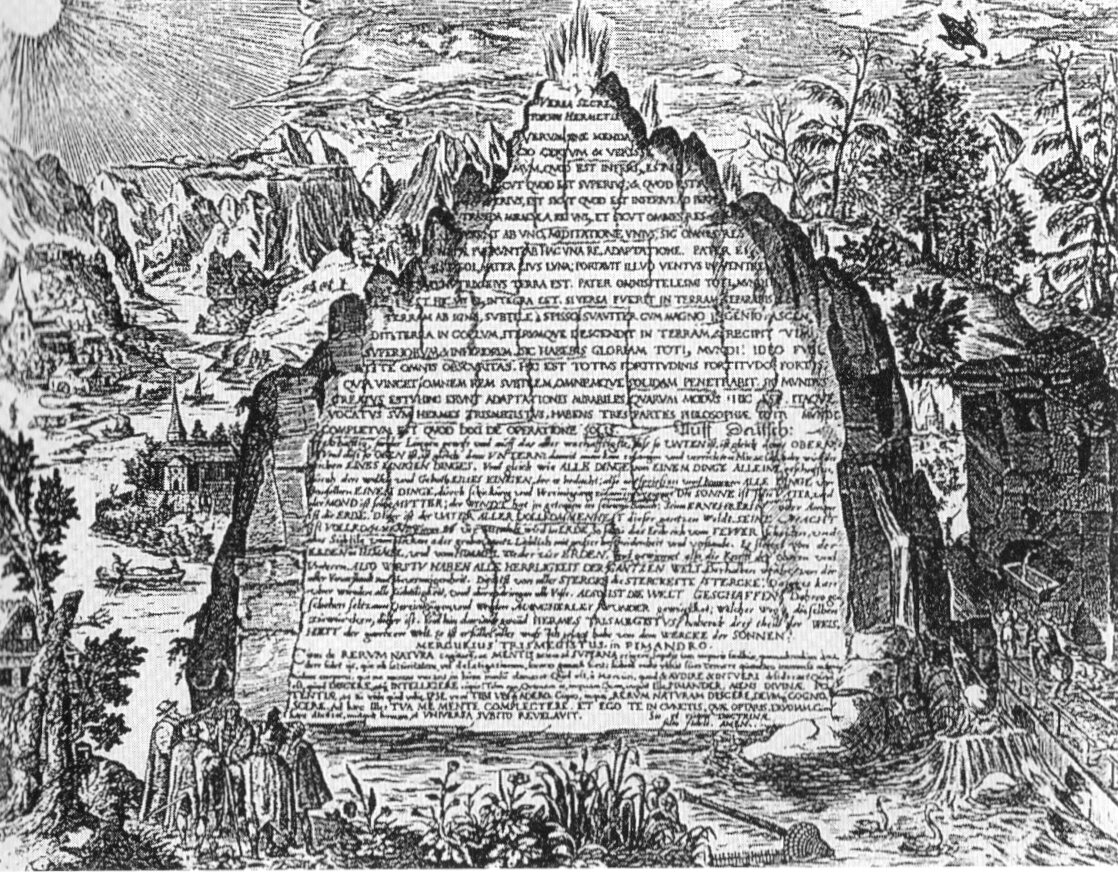
The Emerald Tablet, the Tabula Smaragdina, has quite a different history. Its oldest known text is in Arabic, in the Book of the Secret of Creation, dated to the late 8th or early 9th century. It was translated into Latin in the 12th century and became the founding text of the alchemists. Its best-known sentence reads in the Latin version:
Quod est inferius est sicut quod est superius, et quod est superius est sicut quod est inferius.
What is below is like what is above, and what is above is like what is below. From this came the formula “As above, so below”.
As above, so below
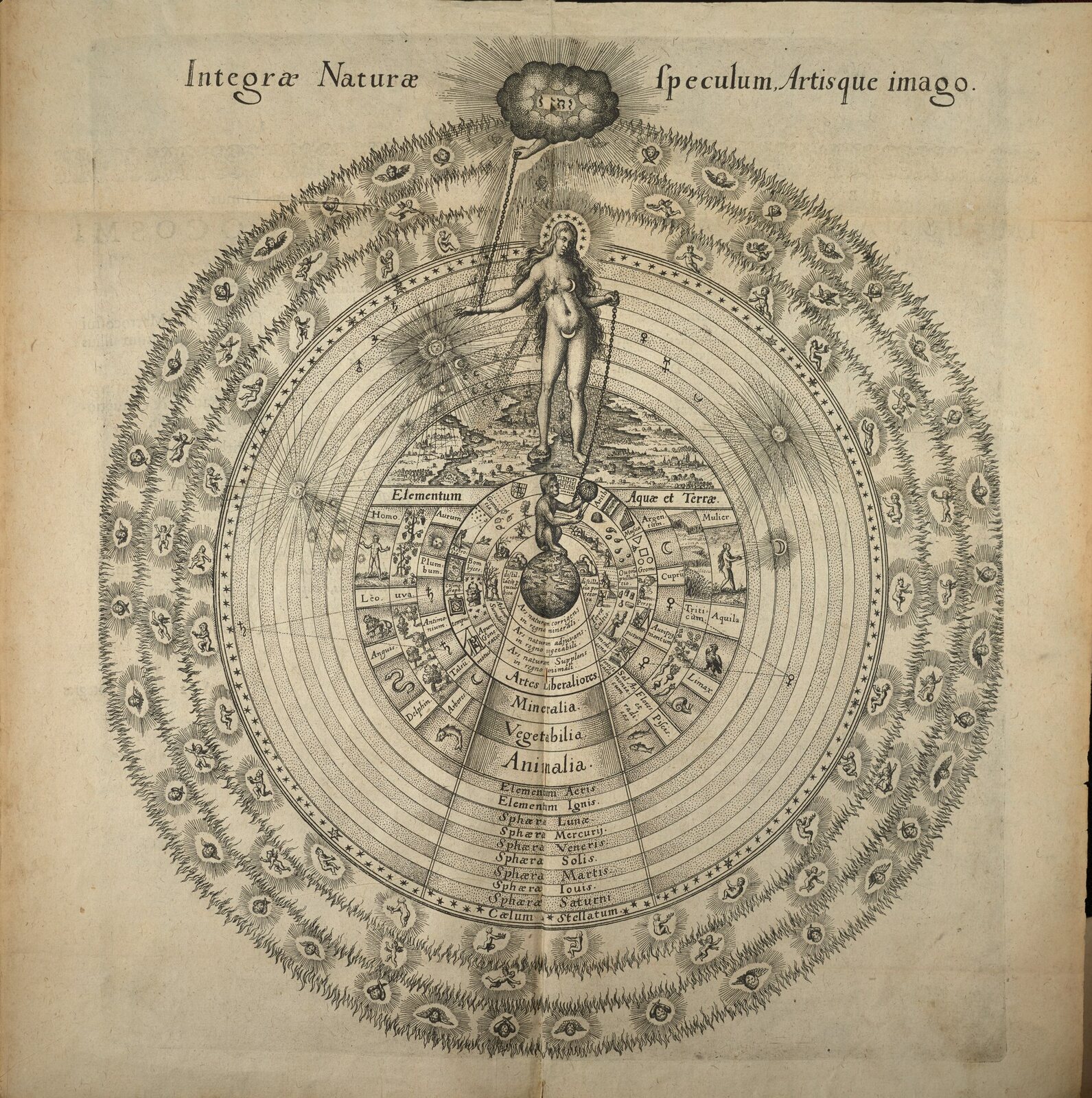
This sentence is the core of Hermeticism: between the great world, the macrocosm, and the small world of the human being, the microcosm, there is a correspondence. What happens in the heavens has its counterpart on earth and in the human being, and whoever understands the one understands the other. The seven planets correspond to the seven metals, the four elements to the four temperaments, the order of the heavens to the order of the soul.
For this website this is the decisive idea. If an order shows itself in number and figure, then on the Hermetic view it must recur in nature and in the human being too. This is exactly the comparison the analogy table attempts, and the page The tetractys in mysticism, Hermeticism and religion follows it through the four elements. Correspondence is a principle of thought, though, not a proven fact. It invites one to look for parallels but does not say which of them hold.
The seven spheres of the Poimandres
The first treatise of the Corpus Hermeticum, the Poimandres, tells of creation and the path of the soul. Around the earth turn seven spheres, those of the planets, and their governors determine fate. Descending into the body, the soul receives a power from each sphere. After death it rises again and in each zone gives back what it received there, until, freed of everything, it reaches the eighth sphere, the Ogdoad, and from there enters into God.
The ascent of the soul according to the Poimandres (Corpus Hermeticum I, 24–26). In each of the seven zones it gives back a power, and at last it reaches the eighth sphere. The text names the zones only in sequence. Assigning them to the planets follows the ancient order from inside out, Moon, Mercury, Venus, Sun, Mars, Jupiter, Saturn.
Here the numbers return that play a part on this website: seven planets, seven metals, seven torches before the throne, and the eight as completion beyond the seven. Agrippa later assigned the seven planets to the seven magic squares (see Magic squares), and Mylius shows the seven metals in his engraving (see Pyramids, knightly crosses, spatial lattices).
From Hermes to Pythagoras
In the Middle Ages the West knew above all the Asclepius and the Emerald Tablet, along with a few writings circulating under the name of Hermes, such as the Book of the Twenty-Four Philosophers. Around 1460 a Greek manuscript of the Corpus Hermeticum reached Florence. Cosimo de’ Medici had Marsilio Ficino interrupt his translation of Plato to render Hermes into Latin first. Hermes was held to be older than Plato, a contemporary of Moses, and so the source of all later wisdom.
In the preface to his translation Ficino set out a chain of six theologians through which a single ancient wisdom was handed down: Hermes, Orpheus, Aglaophemus, Pythagoras, Philolaus and Plato. This prisca theologia, the “ancient theology”, ties Hermeticism directly to this website. In it Pythagoras and Philolaus, who praised the power of the number ten (see The ancient sources), stand in the same line as Hermes. Through this idea the Pythagorean doctrine of number became, in the Renaissance, part of a Hermetic world view.
From Ficino the path leads to Pico della Mirandola, who joined Hermeticism and Kabbalah, to Agrippa von Nettesheim and Paracelsus, and in the 17th century to the Rosicrucians and their collections such as the Musaeum Hermeticum. Through them Hermetic images reached Freemasonry.
How old is Hermeticism really?
In 1614 the philologist Isaac Casaubon showed that the writings of the Corpus Hermeticum cannot come from ancient Egypt. Their Greek is that of the Roman imperial period, and they presuppose ideas of Plato and of early Christianity. They are therefore younger than Plato, not older. More recent research has shown that this was already being argued about in Venice and Padua in the 1580s. With this Ficino’s chain fell: Hermes was not the teacher of Pythagoras. His writings are a late echo of Greek philosophy, above all of Plato and the Stoics.
A word on today’s best-known book of Hermeticism: the “seven Hermetic principles” come from the Kybalion, published anonymously in Chicago in 1908 as the work of “Three Initiates”. It is a text of the American New Thought movement, not of ancient Hermeticism, even though it invokes Hermes.
What remains
Hermeticism is not an age-old Egyptian secret doctrine but a collection of late antique writings in which Egyptian religion, Greek philosophy and Pythagorean-Platonic number doctrine flow together. Its influence, however, can hardly be overstated. Through it the idea of correspondence, the fourness of the elements and the sevenness of the planets travelled through the Renaissance, alchemy, Rosicrucianism and Freemasonry down to our time. Whoever follows the traces of the tetractys in mysticism and religion therefore very often follows the traces of Hermeticism, and at its beginning stands, contrary to what the Hermeticists believed, not Hermes. Its number doctrine is, in this website’s reading, above all a legacy of the Pythagoreans and Plato.
Sources and further reading
Sources
- Corpus Hermeticum, Greek and French ed. A. D. Nock and A.-J. Festugière, Paris 1945 to 1954
- Marsilio Ficino (trans.), Mercurii Trismegisti Pimander, Treviso 1471
- Tabula smaragdina, Arabic in the Book of the Secret of Creation, around 800 AD
- Isaac Casaubon, De rebus sacris et ecclesiasticis exercitationes XVI, London 1614
- Nag Hammadi Codex VI, 6 (The Discourse on the Eighth and Ninth)
- Three Initiates, The Kybalion, Chicago 1908
Further reading
- Florian Ebeling, Das Geheimnis des Hermes Trismegistos, Munich 2005
- Garth Fowden, The Egyptian Hermes, Cambridge 1986