Goethe's Faust: number, sign and transformation
The harmony of the spheres in the first verse, a pentagram on the threshold, the four elements, the chymical wedding, the witches’ times table and the mystery gods of Samothrace: how much of this website is in Goethe’s Faust, and where Goethe himself laughs at it.
The historical Doctor Faust really existed. In the first half of the sixteenth century he travelled through southern Germany as an astrologer, fortune teller and magician, and he died around 1540. Soon after his death it was said that he had made a pact with the devil, and in 1587 the Historia von D. Johann Fausten appeared in Frankfurt, the chapbook from which puppet plays and stage plays arose. Goethe knew the story from the puppet play and wrote later that its tale had echoed in him “in many tones”.
Goethe worked on his Faust for sixty years. He wrote the first scenes around 1773, published the first part in 1808 and finished the second in 1831, a few months before his death. Almost everything that occupied him went into this work, and among it is an astonishing amount of what stands on this website: the harmony of the spheres, the pentagram, the four elements, alchemy, number mysticism and the mysteries. Goethe takes all of this seriously and mocks it at the same time, and precisely this double attitude makes the play so instructive for our subject. The verse renderings on this page are literal and keep close to the German.
Goethe and the secret books
Goethe himself tells in Poetry and Truth where he knew all this from. In the winter of 1768 to 1769, after a serious illness, he lay in his parents’ house in Frankfurt. A friend of his mother, the pious Susanna Katharina von Klettenberg, led him to the books of the alchemists and mystics: to Paracelsus, to Georg von Welling’s Opus mago-cabbalisticum and to the Aurea catena Homeri, the “golden chain of Homer”, an alchemical treatise about the chain that joins heaven and earth. The young Goethe set up a small furnace and tried experiments himself (see Alchemy).
Later he became a naturalist, wrote on the metamorphosis of plants and a theory of colours of his own (see Octaves of light). In 1780 he was initiated in Weimar into the lodge “Amalia” (see Freemasonry). All three paths, the hermetic, the scientific and the masonic, run through Faust.
The sun sounds
The play begins in heaven. The three archangels step before God, and Raphael speaks first:
The sun sounds in the ancient manner
In the rival song of brother spheres,
And its prescribed journey
It completes with a march of thunder.
The sun sounds. With this verse Goethe places his whole drama under the oldest image of the Pythagoreans, the harmony of the spheres: the heavenly bodies move in ratios like those of music and produce a sound that we only fail to hear because it has surrounded us since birth (see Harmony of the spheres). The “brother spheres” are the orbits of the planets, and the “prescribed journey” is their order by measure and number.
What holds the world together at its core
Then we see Faust at night in his Gothic study. He has studied everything a university could teach:
Alas, I have studied philosophy,
Law and medicine,
And sadly theology too,
Thoroughly, with ardent effort.
These are the four faculties of the old university, philosophy as the basic course resting on the seven liberal arts, and above it the three higher faculties (see From apprentice to master). Faust has gone through them all and stands there “as wise as before”. That is why he has given himself to magic, “that I may know what holds the world together at its core”. It is the question with which the Pythagoreans began too.
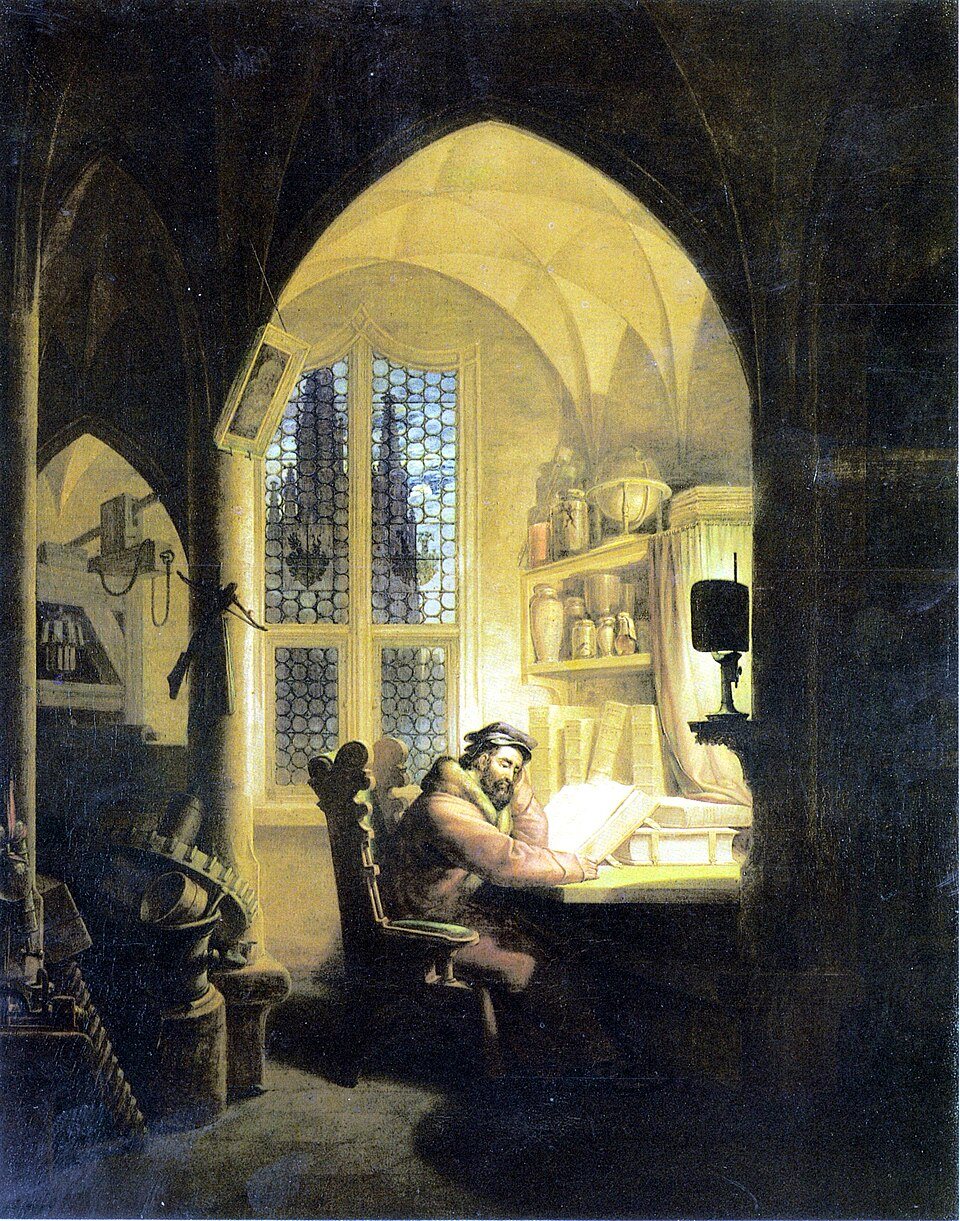
He opens the book of Nostradamus and beholds the sign of the macrocosm, the great world, whose image according to the old teaching is man as the small world (see Man as the measure). Enraptured, he cries:
How everything weaves itself into the whole,
One works and lives in the other!
How heavenly powers rise and descend
And hand each other the golden buckets!
This is the world view of Hermeticism in four lines: everything is connected with everything, and between above and below the powers rise and descend (see Hermeticism). Commentators hear in the “golden buckets” the golden chain Goethe knew from the Aurea catena. But at once comes the disenchantment: “What a spectacle! But alas, a spectacle only!” The sign shows the order, but it does not bestow it. Whoever wants to understand it must penetrate it himself, and that is just what Faust cannot force. He turns to the sign of the Earth Spirit, which seems closer to him, and is rejected by it too: “You resemble the spirit you comprehend, not me!”
In the beginning was the deed
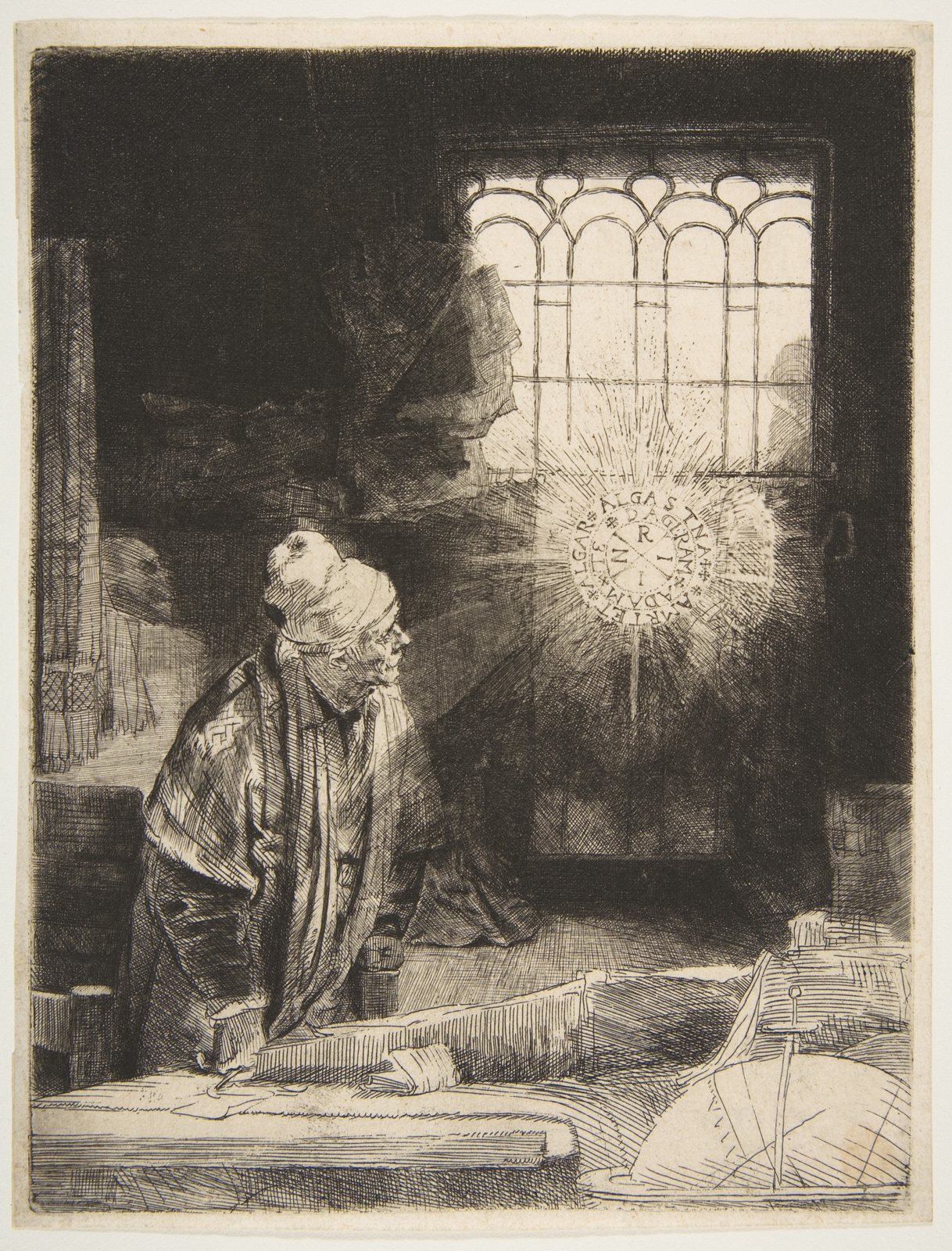
Later Faust sits over the New Testament and wants to translate the beginning of the Gospel of John into German. “It is written: in the beginning was the Word!” He is not satisfied with this, for the word seems too little to him. He tries “in the beginning was the Sense”, then “in the beginning was the Power”, and at last he writes with confidence: “In the beginning was the Deed!”
The scene is a lesson in close reading. The Greek word logos really does mean all of this: word, speech, sense, reason, ratio and measure. Each of the four attempts hits a part of it, and none hits the whole. In Greek mathematics logos was the ratio of two magnitudes, the basic word of harmonics (see Grammar: reading closely and Ratios). Faust’s translation says more about Faust than about the text, and that a translator bends the original to his own need is itself a warning.
For Freemasons the scene has a special ring. In many St John’s lodges the Bible, one of the three great lights, lies open at the first chapter of the Gospel of John, at the very sentence Faust broods over: “In the beginning was the Word.” Whether Goethe, a Freemason since 1780, thought of this while writing we do not know (see Freemasonry). But a reader from the lodge can hardly help hearing in Faust’s struggle over this one word a question to himself as well: what does the beginning mean, and what follows from it for one’s own doing?
The four elements and the pentagram
A black poodle has come into the room with Faust, and it behaves strangely. Faust conjures it with the “spell of the four”, with the spirits of the four elements:
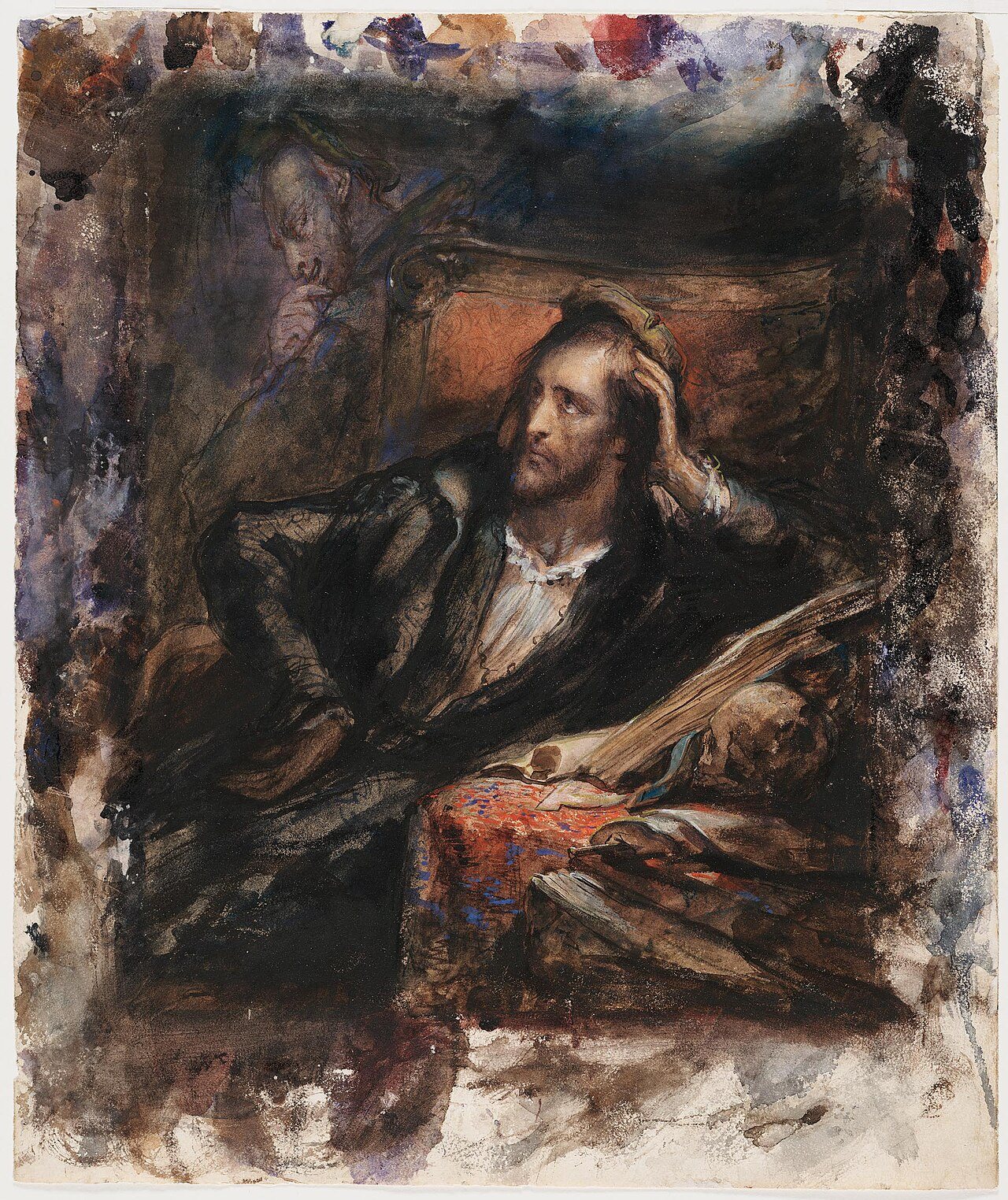
Salamander shall glow,
Undine shall writhe,
Sylph shall vanish,
Kobold shall toil.
They are the elemental spirits of fire, water, air and earth as Paracelsus described them (see Paracelsus). In his work the spirits of earth are called gnomes, Goethe puts the kobold in their place. But the poodle is no elemental spirit. It turns into Mephistopheles, who introduces himself as “a part of that power which always wills evil and always works good”. And more precisely: “I am a part of the part that in the beginning was everything, a part of the darkness that gave birth to light.” Mephisto claims darkness as the older, from which light only came forth. This is an opposition that cannot simply be reconciled (see The union of opposites).
When Mephisto wants to leave, he cannot. A Drudenfuß, a pentagram, is drawn on the threshold, and the devil cannot get past it. He got in only because it is badly drawn:
Look at it closely! it is not well drawn:
The one angle, the one facing outwards,
Is, as you see, a little open.
The pentagram on Faust’s threshold. A pentagram is drawn in one stroke and returns to its beginning. Here the draughtsman did not quite close the line at the outer point. Through this gap the poodle came in, but the sign does not let it out again.
Since antiquity the pentagram was regarded as a sign of health and as a protection against evil, and it must be perfect to work: a single line that returns to itself without a break. Mephisto only gets free when spirits have sung Faust to sleep and he summons a rat that gnaws the point out of the threshold. Whether one sees superstition in this or a parable that an order only holds when it is whole, Goethe knew the meaning of the sign exactly (see The pentagram and the golden ratio and Eliphas Lévi).
The red lion and the lily
On Easter Sunday Faust walks out of the city gate with his assistant Wagner. The peasants honour him because he and his father treated the sick during a plague. But Faust is ashamed, and he tells how his father prepared the medicine:
There a red lion, a bold suitor,
Was wedded to the lily in a lukewarm bath,
And both then, with open flame,
Tormented from one bridal chamber into the other.
Then, with many colours, appeared
The young queen in the glass,
Here was the medicine, the patients died,
And no one asked: who recovered?
This is the language of the alchemists. The red lion and the white lily are code names for the masculine, fiery and the feminine principle. Their wedding in the bath is known from the pictures of the Rosarium philosophorum, in which king and queen are united in the bath. The glass is the bridal chamber, and the many colours are the peacock’s tail, a stage of the Great Work after which the queen finally appears (see Alchemy and The masculine and the feminine). Goethe knew this language from his Frankfurt years. And he has Faust pronounce the bitterest verdict on it: the beautiful symbolism killed people. Whoever takes images for recipes does harm.
In the same scene stands Faust’s best-known confession: “Two souls, alas, dwell in my breast.” One clings to the world, the other rises to the “fields of lofty ancestors”. The alchemists would have said that the two must be united. Faust does not succeed.
The witches’ times table
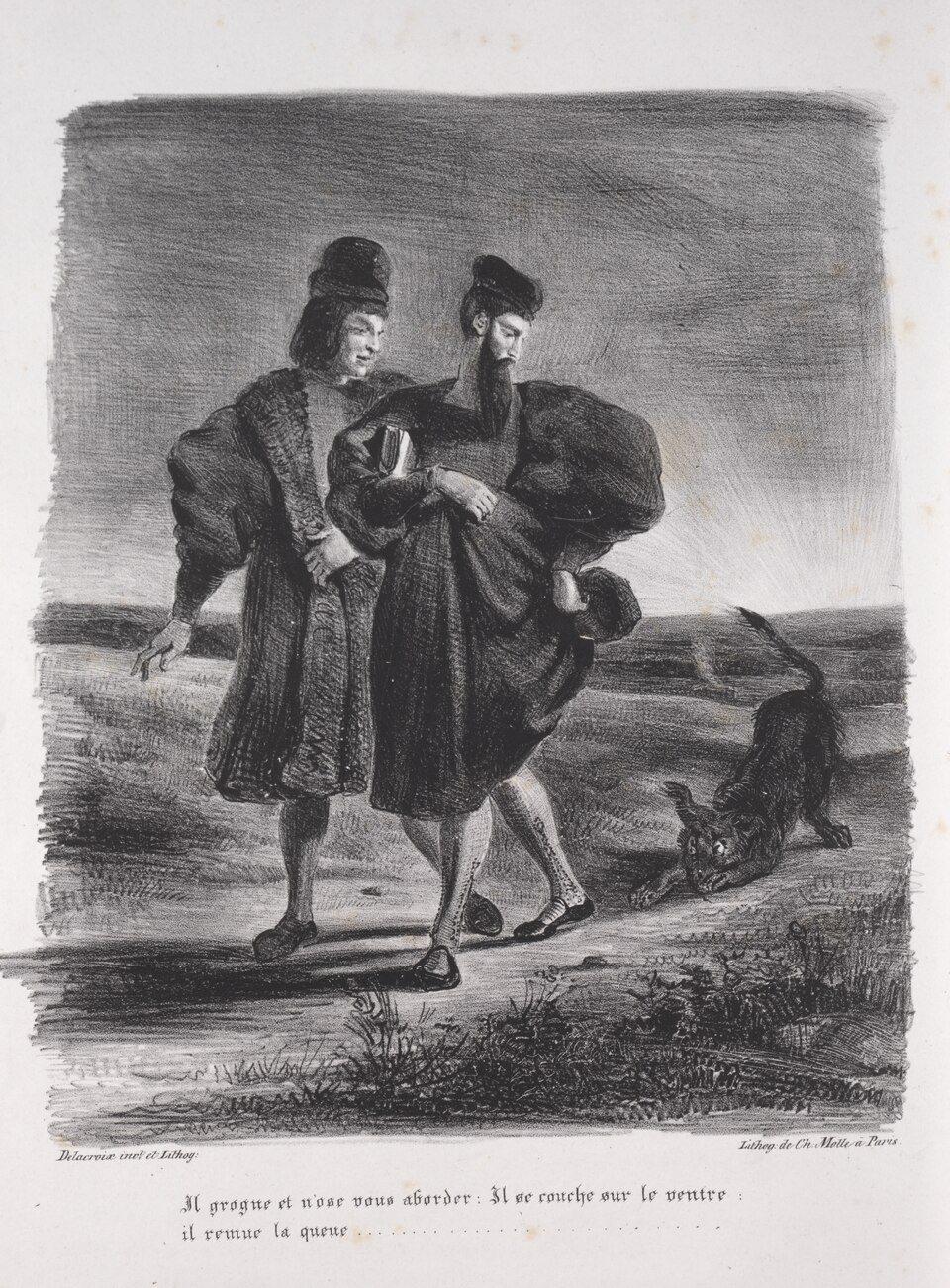
To become young again, Faust lets Mephisto take him into a witch’s kitchen. The witch brews him a potion, and as she does so she reads aloud from a large book with great emphasis. Here the German is given first, because the rhymes matter:
Du mußt verstehn!
Aus Eins mach Zehn,
Und Zwei laß gehn,
Und Drei mach gleich,
So bist du reich.
Verlier die Vier!
Aus Fünf und Sechs,
So sagt die Hex,
Mach Sieben und Acht,
So ist’s vollbracht:
Und Neun ist Eins,
Und Zehn ist keins.
Das ist das Hexen-Einmaleins!
In English, roughly: “You must understand! Out of one make ten, and let two go, and make three even, then you are rich. Lose the four! Out of five and six, so says the witch, make seven and eight, then it is done: and nine is one, and ten is none. That is the witches’ times table!” The spell counts from one to ten, through exactly the numbers of the tetractys and the decad (see The numbers from one to ten). It sounds as if it hid a secret. Faust only says: “I think the old woman is speaking in a fever.” And Mephisto replies:
I know it well, the whole book sounds like that,
I have lost much time over it,
For a perfect contradiction
Remains equally mysterious to the wise and to fools.
My friend, the art is old and new.
It was the way in every age,
Through three and one, and one and three,
To spread error instead of truth.
Here the devil speaks, and yet it is Goethe who laughs at a certain kind of number mysticism: the kind that recites nonsense solemnly until it sounds deep. Many commentators hear in “three and one” a swipe at speculation about the Trinity, of the sort one finds on this website in Thierry of Chartres with unity, equality and connection (see Measure, number and weight). And Mephisto’s sentence about the perfect contradiction is exactly the limit Aristotle drew: a contradiction is no deep mystery but a mistake.
Nevertheless readers have tried again and again to find a hidden sense in the witches’ times table. The best-known interpretation, which goes back to the Hamburg physician Ferdinand Maack, reads the spell as instructions for a magic square, in which all rows, columns and diagonals give the same sum (see Magic squares). One can try it out:
The witches’ times table as a square of numbers. The interpretation begins with 1 to 9 in order and changes the numbers verse by verse. To the right and below stand the sums of the rows, columns and diagonals, a 15 is highlighted. A real magic square of 1 to 9 would have 15 everywhere.
The result is revealing. At the end five of the eight lines give 15. That is more than in the starting square, but no magic square, and even for this the interpretation had to add something that is not in the verse: a swap in which seven and eight become five and six. To get further, the mathematics teacher Ernst Bindel even brought back the “lost” four. And even then ten and zero remain in the square, which have no business in a real magic square of the numbers one to nine.
Here one can practise what the page Chance and pattern recommends. Whoever has enough freedom in interpreting finds a pattern in almost any text. Whether Goethe had a square in mind we do not know. What he quite certainly had in mind stands in Mephisto’s reply.
Homunculus and the four elements
In the second part alchemy returns, now as a great game. Faust’s former assistant Wagner has become a famous scholar and produces an artificial man in the laboratory, the Homunculus. The recipe for it stood in a treatise that circulated under the name of Paracelsus. The Homunculus is pure spirit without a body, a shining being in a glass phial, cleverer than his maker but unfinished. He wants to “come into being”, to become real, and sets out in search.
The search leads him into the Classical Walpurgis Night, a dream journey through Greek mythology. There he asks two philosophers for advice, and they quarrel like the Presocratics: Anaxagoras claims the world arose through fire, Thales objects: “In the moist the living arose.” It is the old dispute over which element is the origin of everything, which Plato answered in the Timaeus with his teaching of the four elements in proportion.
In the same night sirens and nereids travel over the sea with the Cabiri, the mysterious gods of the mysteries of Samothrace. How many there were nobody knew exactly even in antiquity, and Goethe makes a number joke of it:
Three we have brought along,
The fourth would not come,
He said he was the right one
Who thought for them all.
Straight after it is said that there are “really seven of them”, and at last an eighth is mentioned, “whom no one has yet thought of”. Three, four, seven, eight: once again Goethe laughs at the scholars who argued over the right number of the mystery gods (see What a secret is).
At the end the Homunculus’ phial shatters on the shell chariot of the sea goddess Galatea, and his light pours into the sea. Fire and water unite, and the chorus celebrates all the elements at once:
Highly celebrated be here,
Elements, all four of you!
The spirit that wanted to “come into being” finds its way into the world through water, from which, according to Thales, all life comes. This is Goethe’s answer to the question that occupied him as a naturalist: life is not made in a glass, it arises in a whole in which the elements work together.
The Mothers
One of the most puzzling scenes of the whole play stands in the first act of the second part. Faust is to make Helen appear at the emperor’s court, the most beautiful woman of antiquity, and Mephisto tells him that for this he must go down to the Mothers. The word alone makes Faust shudder. The Mothers are enthroned in a realm without place or time, surrounded by the images of all things:
Formation, transformation,
The eternal mind’s eternal entertainment.
Many commentators see in this Plato’s realm of archetypes, the eternal forms after which the demiurge built the world in the Timaeus (see Plato’s Timaeus). Goethe himself never explained what he meant. To Eckermann he said only that he had found in Plutarch that in Greek antiquity Mothers were spoken of as deities. “This is all I owe to tradition, the rest is my own invention.” The scene is a good example of a secret that cannot be dissolved into an explanation without being lost.
All that is transient is only a parable
Faust dies at a great age, and Mephisto wants to fetch the soul that he claims by the pact. But angels carry off Faust’s “immortal part” and sing:
Whoever always strives and toils,
Him we can redeem.
In the last scene Faust’s soul rises through a landscape of mountain gorges where holy hermits dwell at different heights. It is an ascent in stages. According to a widespread view Goethe had in mind engravings after the frescoes of the hermits in the Campo Santo in Pisa, and it recalls the picture of the blessed that Hieronymus Bosch painted (see Death and reincarnation). The play ends with the Chorus mysticus:
All that is transient
Is only a parable,
The insufficient
Here becomes event,
The indescribable
Here is done,
The eternal feminine
Draws us upward.
The first sentence could stand above this whole website. The numbers, the figures and the tones, the stones and the tools are parables, images for something that can only be said in images. And the last sentence takes up what the old teachings said about the masculine and the feminine: striving alone, which drove Faust all his life, does not redeem. Something is needed that receives and draws upward (see The masculine and the feminine).
The mason’s way
A decade and a half before he completed Faust, Goethe wrote a poem for his lodge that he called “Symbolum”. It begins:
The mason’s way,
It is like life,
And his striving,
It is like the doing
Of men on earth.
At the end the voices of the spirits and of the masters call: “We bid you hope.” This is the same attitude as at the close of Faust: man walks his way through darkness and light, he strives, and the goal does not lie in his hand. Whoever reads Faust with the eyes of a Freemason finds in it no encoded ritual, but certainly the great theme of the work on the rough stone: the striving that is never finished (see Freemasonry).
Exercise
Read the macrocosm monologue from the scene “Night” aloud, from “Ha! what bliss flows in this sight” to “a spectacle only!”. Notice at which point Faust’s enthusiasm tips over. Then take the witches’ times table and try to find an interpretation of your own that also yields many fifteens. You will notice how easy it is, and understand why Mephisto laughs.
Sources and further reading
Sources
- Johann Wolfgang von Goethe, Faust. Eine Tragödie, Tübingen 1808, lines 243 to 246 (Prologue in Heaven), 354 to 807 (Night), 1034 to 1055 and 1112 (Outside the City Gate), 1224 to 1237, 1273 to 1276, 1335 to 1350 and 1393 to 1404 (Study), 2540 to 2562 (Witch’s Kitchen). Line numbers after the Weimar edition
- Johann Wolfgang von Goethe, Faust. Der Tragödie zweiter Teil, Stuttgart and Tübingen 1832, scenes Dark Gallery, Laboratory, On the Upper Peneios and Rocky Coves of the Aegean Sea, lines 11936 to 11937 and 12104 to 12111 (Mountain Gorges)
- Johann Wolfgang von Goethe, Aus meinem Leben. Dichtung und Wahrheit (From my life. Poetry and truth), part 2, book 8, Tübingen 1812
- Johann Wolfgang von Goethe, Symbolum, 1815, for the lodge Amalia in Weimar
- Johann Peter Eckermann, Conversations with Goethe, conversation of 10 January 1830
- Historia von D. Johann Fausten, Frankfurt am Main (Johann Spies) 1587
Further reading
- Albrecht Schöne (ed.), Johann Wolfgang Goethe. Faust. Texte und Kommentare, 2 vols., Frankfurt am Main 1994
- Rolf Christian Zimmermann, Das Weltbild des jungen Goethe (The world view of the young Goethe), 2 vols., Munich 1969 and 1979
- Ronald D. Gray, Goethe the Alchemist, Cambridge 1952
- Florian Freistetter, Wie man aus Hexenreimen ein magisches Quadrat konstruiert (How to construct a magic square from witches’ rhymes), Spektrum der Wissenschaft, 2021 (a different, freer interpretation that leads to a real magic square)
- Das Hexeneinmaleins, worksheet, ZUM, with the interpretations of Maack and Bindel