Freemasonry: history, degrees and symbols
From the masons' lodges of the cathedral builders to the lodges of the Enlightenment: how Freemasonry arose, what really happened in 1717 and 1723, how it came to Germany, what the three degrees mean and which tools and signs it took over from the craft.
Freemasonry is a brotherhood of people who want to work on themselves to become better people, and who use the tools and images of the stonemasons for this. It is neither a religion nor a party. Its basic values are liberty, equality, fraternity, tolerance and humanity. It has always called its field of work the “Royal Art”, and its image for it is building: every individual is a stone that must be dressed so that it fits into a greater building.
This page tells where Freemasonry comes from and how it is structured. Its geometric figures and number symbolism are the subject of the page Polygons and star polygons in Freemasonry.
The masons’ lodges and the masons
The roots lie with the stonemasons and masons of the Middle Ages. Whoever built a cathedral worked for decades in one place, in a workshop beside the site, called a Bauhütte in Germany and a lodge in England. The stonemasons had their own regulations, their own signs of recognition and their own geometry, with which they constructed their marks and measures (see The signatures of the cathedral builders).
In England manuscripts survive from the late fourteenth or early fifteenth century that are called the Old Charges. The oldest, the Regius Manuscript, is a poem once dated to around 1390, today rather to the first half of the fifteenth century. It tells a legendary history of the craft reaching back to Euclid, and later Old Charges carry it back to the Temple of Solomon (see The Temple of Solomon). The Regius poem lists the duties of the mason: to be faithful, to work honestly and to train the apprentice well.
In Scotland William Schaw, the king’s master of works, regulated the masons’ lodges with fixed statutes in 1598 and 1599. The oldest minutes of lodges that still exist today date from this time. And as early as the seventeenth century men who were not masons were admitted there and in England, scholars and noblemen. The best known is the antiquary Elias Ashmole, who was admitted in Warrington in 1646 and recorded it in his diary. Such members are called “accepted” masons, and with them begins the transition from operative to speculative masonry.
1717 and 1723
The year 1717 counts as the birth of modern Freemasonry. On 24 June, St John’s Day, four London lodges are said to have joined in the tavern Goose and Gridiron to form a Grand Lodge. So the clergyman James Anderson tells it in the second edition of his Book of Constitutions of 1738. From 1717 itself, however, there is no evidence, and recent research considers it possible that the Grand Lodge arose only around 1721 (see Grammar: reading closely).
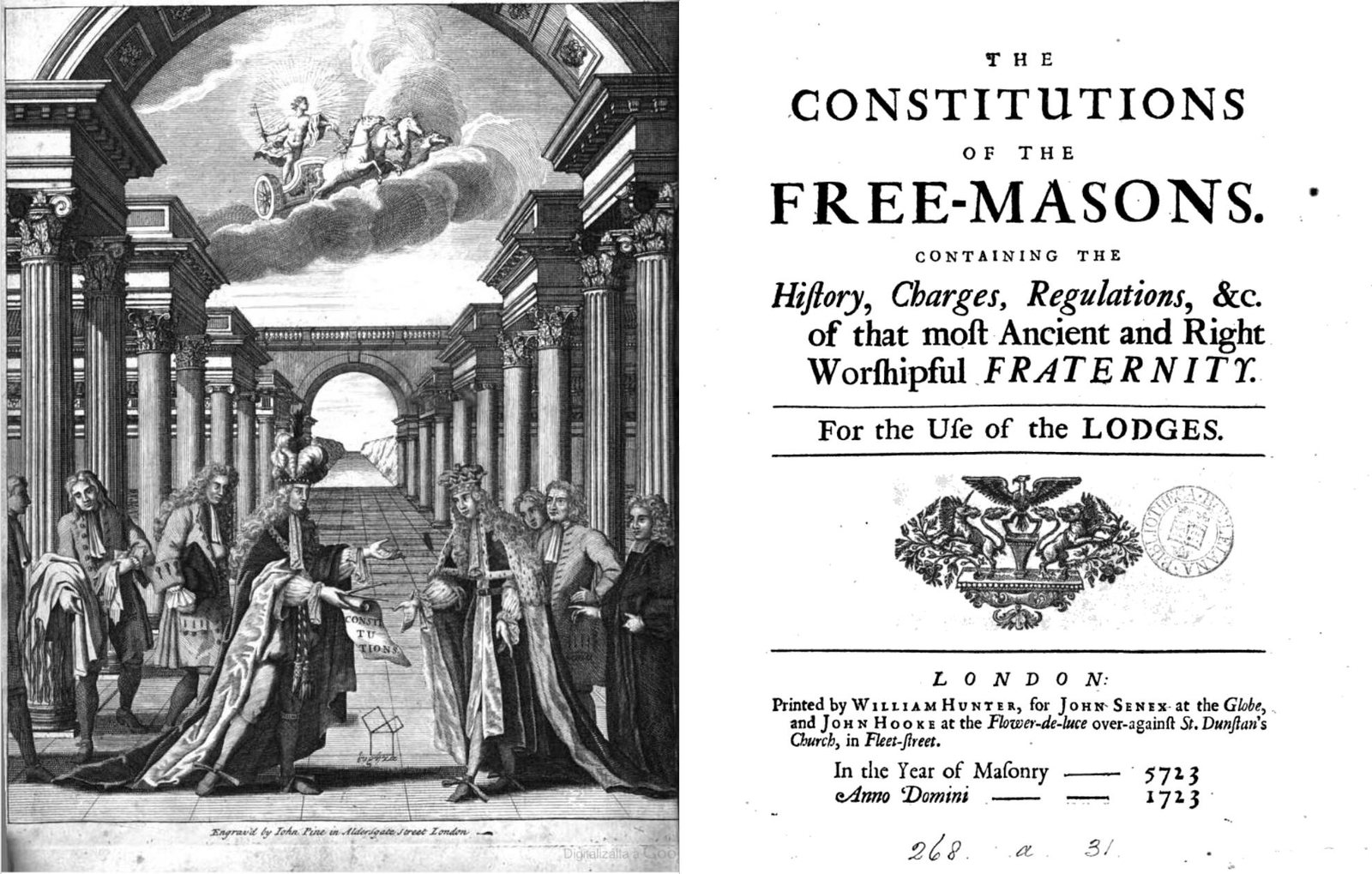
Certain is the year 1723. Then Anderson’s Constitutions appeared, the foundational book of Freemasonry. Their first “Old Charge” concerns God and religion. In former times, it says, masons were obliged to be of the religion of their country. Now, however, it is thought more expedient only to oblige them to that religion in which all men agree, that is, to be good men and true, men of honour and honesty, by whatever denomination. Thus masonry becomes the “Center of Union” between people who would otherwise have remained strangers to one another. After a century of religious wars this was a bold sentence.
In 1730 Samuel Prichard published the rituals of the lodges in Masonry Dissected (see What a secret is). His work is the first printed evidence of the three degrees.
How it came to Germany
From London Freemasonry spread across all of Europe within a few decades. The first German lodge was founded in Hamburg on 6 December 1737, today’s lodge “Absalom zu den drei Nesseln”. In 1738 the Prussian crown prince Frederick, later Frederick the Great, was initiated in Brunswick, and in 1740 the lodge “Zu den drei Weltkugeln” (To the Three Globes) arose in Berlin, from which the oldest German Grand Lodge emerged. In the same year, 1738, Pope Clement XII forbade Catholics to become members.
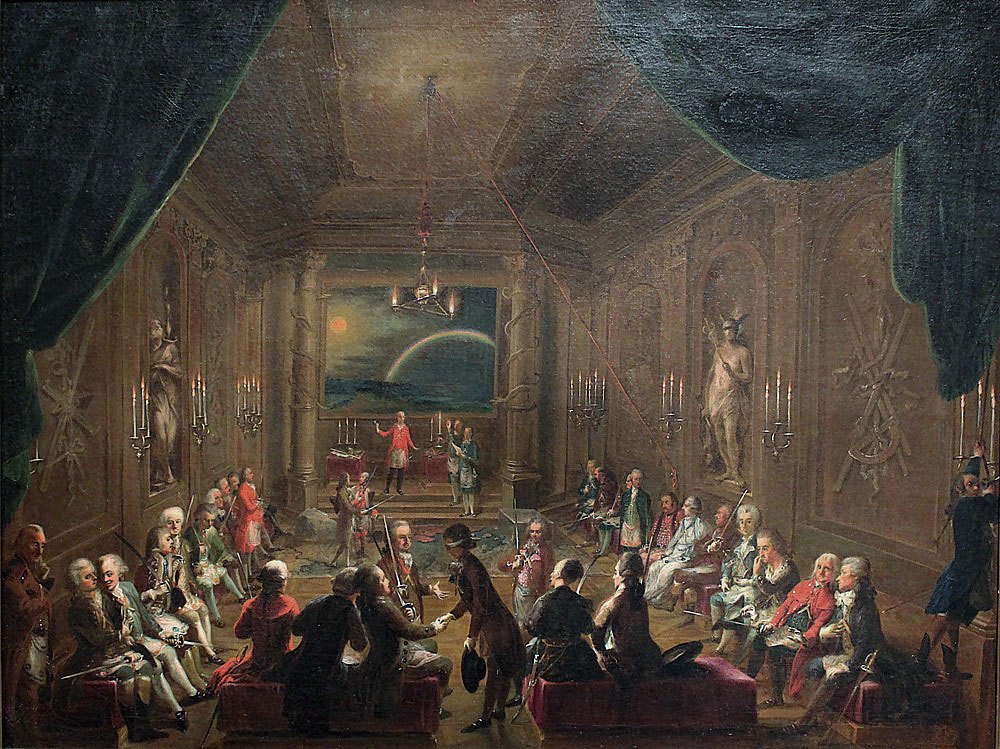
In the eighteenth century the lodges were places of the Enlightenment. Here nobles, burghers, officers and scholars met as equals, which was hardly possible elsewhere. Lessing was initiated in Hamburg in 1771, Goethe in Weimar in 1780 and Mozart in Vienna in 1784. Goethe’s Faust is full of images from Hermeticism and alchemy (see Goethe’s Faust). With Ernst and Falk Lessing wrote the deepest dialogues on the meaning of the brotherhood, and with The Magic Flute of 1791 Mozart wrote an opera full of Masonic images, with three as its guiding number and a path of trials from darkness into light.
In the twentieth century the lodges in Germany were persecuted. Between 1933 and 1935 all lodges dissolved themselves or were dissolved, their archives were confiscated, and many members lost their positions. After the war they rebuilt themselves. Since 1958, in their present form since 1970, the regular Grand Lodges have been joined in the United Grand Lodges of Germany. Besides them there are women’s Grand Lodges and mixed lodges that do not belong to it. They differ in origin and custom, one speaks of different rites, but they recognise one another as regular.
The three degrees
The basis of all Freemasonry is the three degrees of the St John’s lodges, named after John the Baptist, whose feast on 24 June is their most important holiday. The degrees follow the old craft:
- The Entered Apprentice learns to know the tools and begins the work on the rough stone, on himself.
- The Fellow Craft continues the work, now with an eye to the laws by which one builds. In Prichard’s catechism he becomes a Fellow Craft “for the sake of the letter G”, and he reads the G as geometry (see Geometry: magnitude at rest).
- The Master Mason has come of age and bears responsibility for the others.
Beyond the St John’s degrees there are in some rites and systems further, so-called higher degrees, for instance the St Andrew degrees or the degrees of the Ancient and Accepted Scottish Rite. What happens in the degrees in detail one learns by experiencing them. This website describes only what has long been public, and follows the thought that an initiation loses its force if one knows it beforehand (see What a secret is).
Tools and signs
Almost all symbols of Freemasonry come from the stonemasons’ workshop. They are not guarded as secrets but interpreted as images, and every member is meant to work out their meaning for himself.
- Square and compasses. The square tests whether a stone is right-angled and stands for right action. The compasses draw the circle and stand for the measure one sets oneself. Together with the Bible, mostly called the “Volume of the Sacred Law” in lodges, they are the three great lights.
- The rough and the perfect ashlar. The rough stone comes from the quarry as it is. The cubic stone is dressed and fits into the building. Between them lies the work, and it never ends (see Know thyself).
- Plumb and level. The plumb shows the vertical, the level the horizontal. The one is read as uprightness, the other as the equality of all.
- The apron. The stonemasons wore a leather apron for protection at work. In the lodge the apron is the sign that one has come to work.
- The mosaic pavement. The black and white chequered floor shows light and dark, good and bad, lying side by side in life.
- The two pillars. On the lodge carpet, a working carpet on which the symbols of the lodge are gathered, two pillars stand on the west side, after the model of the pillars Jachin and Boaz at the Temple of Solomon. Early English lodges knew similar floor cloths, from which the tracing boards developed. The pillars form the entrance to the temple the carpet depicts, and there the way towards the east, towards the light, begins (see The Temple of Solomon).
- The three pillars wisdom, strength and beauty support the lodge, and with them begins the meaning of the three (see Polygons and star polygons in Freemasonry).
The lodge room is oriented like a church: the Worshipful Master sits in the east, where the sun rises, for from there comes the light. This too is an image: the time of the lodge is other than that of everyday life.
What binds it together
Freemasonry has no doctrine one must believe and no tenets one learns by heart. What holds it together is a method: to think in images, to meet in rituals and to work on oneself. Lessing’s Falk put it this way: the essence of Freemasonry is something “that even those who know it cannot say”. Whoever wants to pursue it can try from many sides on this website, from the tetractys through alchemy to the seven liberal arts, whose fifth, geometry, Prichard already placed at the beginning of masonry.
Sources and further reading
Sources
- Regius Manuscript (Halliwell Manuscript), England, around 1390 or later, British Library, Royal MS 17 A I
- William Schaw, statutes for the Scottish masons, 1598 and 1599
- James Anderson, The Constitutions of the Free-Masons, London 1723, and 2nd ed. London 1738
- Samuel Prichard, Masonry Dissected, London 1730
- Pope Clement XII, bull In eminenti apostolatus specula, 1738
- Gotthold Ephraim Lessing, Ernst und Falk. Gespräche für Freimäurer (Ernst and Falk. Dialogues for Freemasons), Wolfenbüttel 1778 and 1780
- Andrew Prescott and Susan Mitchell Sommers, Searching for the Apple Tree. Revisiting the Earliest Years of Organized English Freemasonry, in: Reflections on Three Hundred Years of Freemasonry, London 2017
Further reading
- Helmut Reinalter, Die Freimaurer (The Freemasons), Munich (C. H. Beck Wissen), several editions
- Eugen Lennhoff, Oskar Posner and Dieter A. Binder, Internationales Freimaurerlexikon, revised edition, Munich 2000
- David Stevenson, The Origins of Freemasonry. Scotland’s Century 1590 to 1710, Cambridge 1988