Plato's Timaeus: the world from number and triangle
The most influential text between Pythagoras and Kepler: how Plato built the world soul from the numbers 1, 2, 3, 4, 8, 9 and 27, composed the elements from two triangles and called time a moving image of eternity. What of it is wrong and why it shaped physics all the same.
A single book shaped the picture of the world in Europe for almost two thousand years like no other beside the Bible: Plato’s Timaeus. Plato wrote it around 360 BC as one of his last dialogues. The speaker is not Socrates but Timaeus of Locri, a scholar from southern Italy, the home of the Pythagoreans. He tells how the world came to be, and he tells it in the language of numbers and figures.
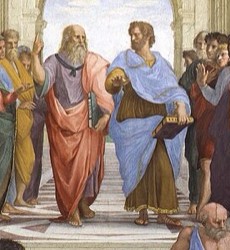
In the Latin Middle Ages the Timaeus was for a long time the only dialogue of Plato one could read, in the translation and with the commentary of Calcidius from the fourth century. In Raphael’s School of Athens Plato carries exactly this book under his arm (see The School of Athens). Ancient opponents even claimed that Plato had copied it from the books of the Pythagorean Philolaus. That is gossip, but it shows how Pythagorean the text already seemed to contemporaries.
The craftsman and the model
The world, says Timaeus, did not arise by itself. A divine craftsman, in Greek demiourgos, built it, and in doing so he looked to an eternal, unchanging model. Because he was good and without envy, he wanted everything to become as like it as possible, and so he brought order into what had before moved about without rule.
Plato himself calls this account only a “likely story”. About what becomes, he says, one cannot speak with the same certainty as about what is eternal. The Timaeus is thus no textbook but a sketch: this is how it might be. The Gnostics later reinterpreted the demiurge as a lower, ignorant creator (see The Gnostics and the thirty aeons). In Plato he is good.
Four elements in proportion
The body of the world is to be visible and tangible, so it needs fire and earth. But two things can be joined only by a third, and the most beautiful bond is proportion. For surfaces one mean suffices, for solids two are needed. So the demiurge set air and water between fire and earth, so that as fire is to air, so is air to water, and as air is to water, so is water to earth. This is the same chain one sees in the numbers 1, 2, 4, 8, in which each member stands to the next in the same ratio.
The world soul
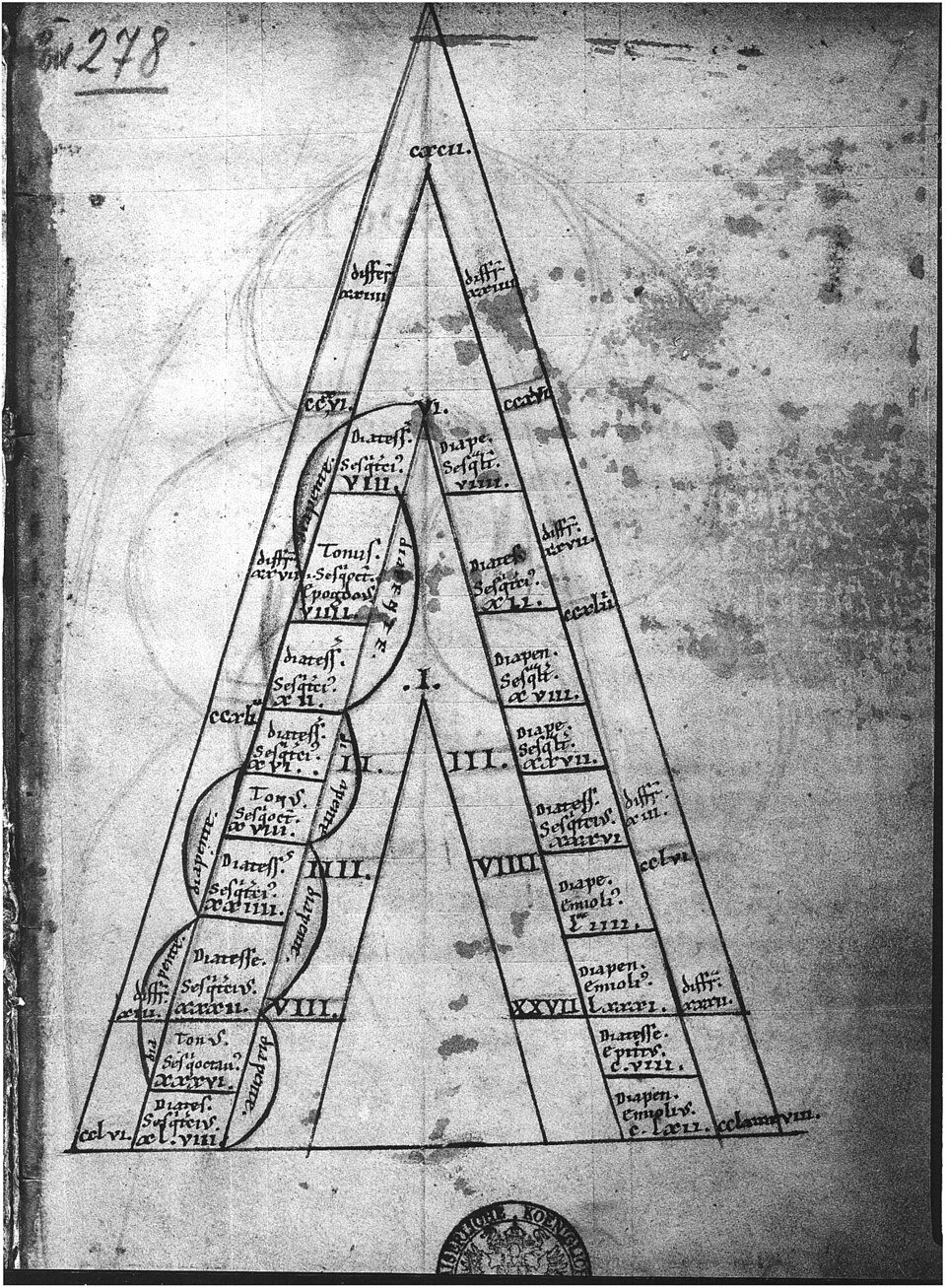
Then the demiurge built the soul of the world, and he built it from numbers. He took one part, then the double, the triple, the fourfold, the ninefold, the eightfold and the twenty-sevenfold. Arrange these numbers in two rows and the figure arises that is called the Platonic lambda:
The Platonic lambda. On the left the doublings, on the right the triplings, each up to the cube: 8 = 2 × 2 × 2 and 27 = 3 × 3 × 3. Together with one it contains all the numbers of the tetractys, 1, 2, 3 and 4, and their continuation into space.
The demiurge filled the gaps between these numbers with intermediate values, and in doing so exactly the ratios of music arise: 4 : 3, the fourth, 3 : 2, the fifth, and 9 : 8, the whole tone. What then remains is a small remainder in the ratio 256 : 243. The soul of the world is thus a musical scale. This thought shaped the older teaching of the harmony of the spheres, and by many detours the lambdoma arose from it (see The lambdoma and Ratios).
Time
Because the model is eternal but the world has come to be, the demiurge could not give it eternity entirely. So he made a “moving image of eternity” that proceeds according to number, and that is time. Its instruments are sun, moon and planets, whose revolutions count days, months and years. When all the planets return to their starting place at once, the “perfect year” is fulfilled. Time in Plato is thus number in motion, just as the astronomy of the liberal arts is magnitude in motion (see Astronomy).
The elements from triangles
Boldest is the part in which Plato builds the elements themselves from geometry. All bodies, he says, are bounded by surfaces, all surfaces can be divided into triangles, and all triangles into two basic forms: the half square, a right triangle with two equal sides, and the half equilateral triangle. From these two building blocks he assembles four regular solids:
| Element | Solid | Faces | Building block |
|---|---|---|---|
| Fire | tetrahedron | 4 triangles | half equilateral triangle |
| Air | octahedron | 8 triangles | half equilateral triangle |
| Water | icosahedron | 20 triangles | half equilateral triangle |
| Earth | cube | 6 squares | half square |
Fire is sharp and cuts, hence the tetrahedron. Earth is heavy and immovable, hence the cube, which stands firmly on its face. The fifth solid, the dodecahedron, the god “used for the whole, decorating it” (see The Platonic solids and Is the universe a dodecahedron?).
Something surprising follows. Fire, air and water consist of the same triangles, so they can turn into one another as their bodies break up and recombine. Two bodies of fire of four faces each make one body of air of eight. Earth, however, consists of different triangles and can turn into nothing else. Plato thus sketched a chemistry made of geometry, with a kind of conservation law for triangles. Aristotle rejected the teaching and preferred to explain the elements by qualities, hot, cold, dry and moist (see Alchemy).
Wrong and yet fruitful
In content the Timaeus is outdated. The elements are not polyhedra, the planets carry no musical scale, and the world has no craftsman that physics could measure. And yet this text is one of the most consequential in the history of science, for it set up a programme: nature is built according to mathematical forms, and whoever finds these forms understands nature.
In 1596 Johannes Kepler sought the distances of the planets in the five Platonic solids (see Johannes Kepler). And Werner Heisenberg tells how as a grammar-school pupil in 1919 he read the Timaeus on the roof of a building in Munich, and how Plato’s thought that the smallest parts of matter must have mathematical form never let him go. Today’s particle physics does indeed describe the smallest building blocks by symmetries (see Quantum physics, magic and the unconscious). Plato’s triangles were wrong. His question was right.
Exercise
Cut equilateral triangles out of card, 32 of them for all three solids together. Glue a tetrahedron, an octahedron and an icosahedron from them. Count how many triangles each needs, and then try to build an octahedron from the faces of two tetrahedra. That is how Plato imagined fire turning into air.
Sources and further reading
Sources
- Plato, Timaeus, around 360 BC, especially 27c to 29d (craftsman and model), 31b to 32c (proportion of the elements), 35a to 36d (world soul), 37c to 39e (time), 53c to 56c (element solids)
- Cicero, Timaeus (partial Latin translation), around 45 BC
- Calcidius, translation of and commentary on the Timaeus, 4th century AD
- Werner Heisenberg, Der Teil und das Ganze (Physics and Beyond), Munich 1969, ch. 1
- Diogenes Laertius III 9 (the story of buying the books of Philolaus)
Further reading
- Plato, Timaeus, translated by Donald J. Zeyl, Indianapolis 2000
- Francis M. Cornford, Plato’s Cosmology, London 1937