The Temple of Solomon: measure and image
Sixty cubits long, twenty wide, the holy of holies a perfect cube: what the Bible reports about the temple in Jerusalem, why the molten sea gives π as three, what the pillars Jachin and Boaz mean and how the temple became the archetype of the Masonic lodge.
No building has shaped Freemasonry like one that has not stood for more than two and a half thousand years: the temple that King Solomon, according to the biblical account, had built in Jerusalem in the tenth century BC. The Bible describes it as precisely as hardly any other building of antiquity, with length, breadth and height of every room, and these very numbers have occupied theologians, builders and mathematicians over the centuries.
What the Bible reports
The sixth chapter of the First Book of Kings gives the measures in cubits, a length of about half a metre. The temple house was 60 cubits long, 20 wide and 30 high. In front of it lay a porch 20 cubits wide and 10 cubits deep. Inside the house was divided: in front the holy place, 40 cubits long, with the ten golden lampstands and the altar of incense, at the back the holy of holies, where the ark of the covenant stood.
The ground plan after the measures in 1 Kings 6 and 7, in cubits. In front of the porch stand the pillars Jachin and Boaz, behind it the holy place, 40 cubits long, and at the very back the holy of holies, a cube of 20 cubits. The temple house itself is 60 cubits long, 20 wide and 30 high. The side chambers that surrounded it are left out here.
The holy of holies, it says expressly, was “twenty cubits in length, and twenty cubits in breadth, and twenty cubits in the height thereof” (1 Kings 6:20). It was thus a perfect cube. It had no windows, and only the high priest was allowed to enter it, once a year. The holiest place of Israel was a dark, empty cube of cedar and gold.
The building itself has its numbers too. It began in the four hundred and eightieth year after the exodus from Egypt and took seven years. And the Bible reports a detail that has always moved stonemasons: the stones were dressed ready at the quarry, “so that there was neither hammer nor axe nor any tool of iron heard in the house, while it was in building” (1 Kings 6:7).
Jachin and Boaz
In front of the porch Solomon had two pillars of bronze set up, cast by a craftsman from Tyre. Each was 18 cubits high and 12 cubits round, with a capital of 5 cubits on top, adorned with lilies, network and rows of pomegranates. The right one he called Jachin, “he shall establish”, the left one Boaz, “in it is strength” (1 Kings 7:21).
They carried nothing. They stood free before the entrance, as signs. Of what, the Bible does not say. That is why they have invited countless interpretations: stability and strength, light and dark or mercy and severity, that is, the two poles between which one passes on entering the holy. In Freemasonry they appear on the lodge carpet, on its west side, as the entrance to the temple the carpet depicts (see Freemasonry).
The molten sea and the number π
In the court stood a huge basin of bronze, the molten sea, on twelve bronze oxen, three facing each direction. The Bible gives its measures: “ten cubits from the one brim to the other: it was round all about, and his height was five cubits: and a line of thirty cubits did compass it round about” (1 Kings 7:23).
A circle of 10 cubits diameter and 30 cubits circumference: that gives exactly 3 for the ratio of circumference to diameter. This passage has often been cited as proof that the Bible gives π wrongly. The rabbis of the Talmud already thought about it and simply accepted the ratio 3 (Eruvin 14a). Later interpreters found a simple explanation: the rim was a handbreadth thick and bent outward “like the brim of a cup, with flowers of lilies”. Whoever measures the diameter across the outer rim and the circumference inside below the rim comes very close to the true value. Besides, these are a narrator’s round numbers, not records of measurement. How one really determines π is shown by Archimedes (see Approaching π). The passage is a good example of asking what a text means before taking it at its word (see Grammar: reading closely).
What archaeology knows
Nothing of Solomon’s temple has been found. It was destroyed by the Babylonians in 587 BC, in its place the second temple arose after the exile, which Herod rebuilt splendidly and the Romans burned down in AD 70. Where exactly the first one stood, how large Jerusalem was in Solomon’s time and how much the account was embellished by later narrators is disputed among archaeologists. But similar temples with porch, main hall and rear sanctuary are known from the region, for instance at Ain Dara in Syria, even with two pillars at the entrance. The form of the temple is therefore credible, even if the details are uncertain.
From the cube to the heavenly city
After its destruction the temple became an image. The prophet Ezekiel saw in a vision a new temple, which a man with a measuring reed measured cubit by cubit, and his description fills nine chapters. At the end of the Bible stands the heavenly Jerusalem of Revelation, and again it is measured: the city is as long as it is broad and high, twelve thousand furlongs in each direction (Revelation 21:16). The new Jerusalem is a cube like the holy of holies, only immeasurably large. What was once a dark room that one man entered is now a city of light for all (see The throne of God and the number 24).
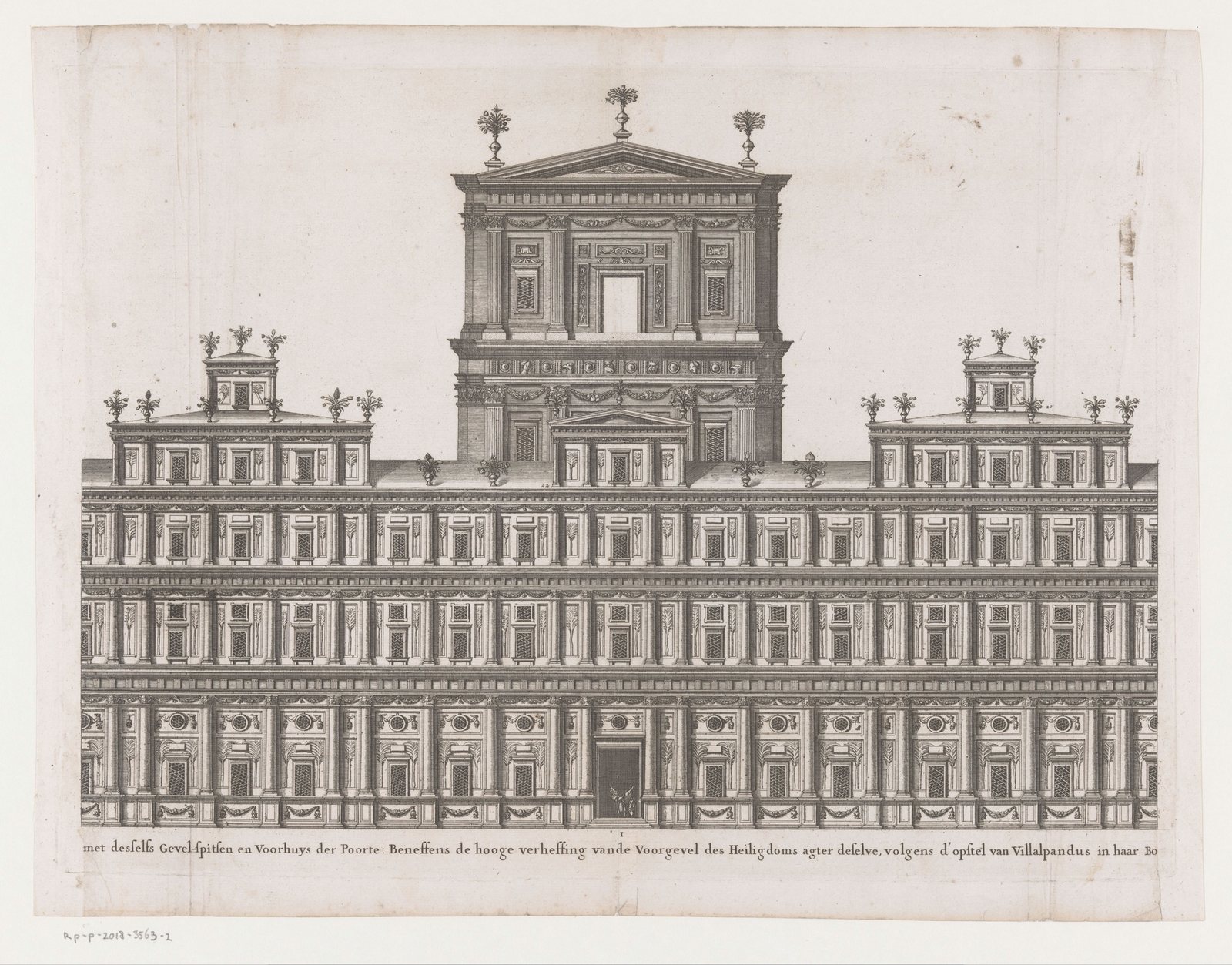
The builders and scholars of the early modern period wanted to restore this temple, at least on paper. The Spanish Jesuit Juan Bautista Villalpando published a magnificent reconstruction around 1600, in which he sought to show that the classical orders of architecture came from the Temple of Solomon, designed by God himself. And Isaac Newton spent years reconstructing the temple from Ezekiel’s data and determined the sacred cubit, mainly from the measures of the Great Pyramid. He hoped to find in the measure of the temple the order of the world and the course of history.
The temple in the lodge
For Freemasonry the Temple of Solomon is the archetype. The Old Charges of the late Middle Ages already tell of the building of Solomon’s temple, first the Cooke Manuscript of the 15th century, and Anderson’s Constitutions of 1723 elaborate on it. Every lodge understands its room as an image of the temple, with the east as the place of light, the mosaic pavement and the two pillars that form the entrance to the temple in the west of the lodge carpet.
More important than any detail, though, is the image itself. Freemasons build no temple of stone but the one Paul speaks of: “Know ye not that ye are the temple of God?” (1 Corinthians 3:16). Man is the building being worked on, quietly and without a hammer blow, as with the Temple of Solomon. And at the end of the work stands the dressed stone that fits into the building, a cubic stone. The holy of holies was a cube.
Sources and further reading
Sources
- 1 Kings 5 to 8, especially 6:1 to 38 (measures of the temple) and 7:13 to 26 (pillars and molten sea)
- 2 Chronicles 3 to 4
- Ezekiel 40 to 48 (the temple vision) and Revelation 21:15 to 17 (the new Jerusalem)
- Talmud, Eruvin 14a (on the circumference of the molten sea)
- Juan Bautista Villalpando and Jerónimo de Prado, In Ezechielem explanationes, Rome 1596 to 1604
- Isaac Newton, Prolegomena ad lexici prophetici partem secundam, manuscript around 1680, printed posthumously
- Cooke Manuscript, 15th century, and James Anderson, The Constitutions of the Free-Masons, London 1723
Further reading
- Israel Finkelstein and Neil Asher Silberman, The Bible Unearthed, New York 2001
- Othmar Keel, Jerusalem and the One God. A Religious History, Minneapolis 2017