Alchemy: the art of transformation
Where alchemy comes from, what it taught and what became of it: the four elements and their qualities, the seven metals and planets, the axiom of Maria from one to four, the Great Work, the question of inward or outward, and why lead really does turn into gold today.
Alchemy turns up on many pages of this website: in the Rebis with compass and square, in the seven metals beneath the earth, in the chymical wedding of king and queen, in the Emerald Tablet of Hermes. This page tells what alchemy was, what it taught and what has become of it. It was neither mere superstition nor an encrypted secret science, but something third that one must understand before judging it.
Where it comes from
Alchemy arose in the first centuries AD in Greek-speaking Egypt, above all in Alexandria. There Egyptian craft knowledge of metals, dyes and glass, Greek natural philosophy and the religiosity of late antiquity came together. The first alchemist we can grasp more closely as a person and author is Zosimos of Panopolis around 300. Older are some collections of recipes on papyrus and writings that circulated under the name of Democritus. He appeals to an older teacher, Mary the Jewess, to whom the invention of several pieces of apparatus is ascribed. One of them still bears her name: the water bath, French bain-marie.
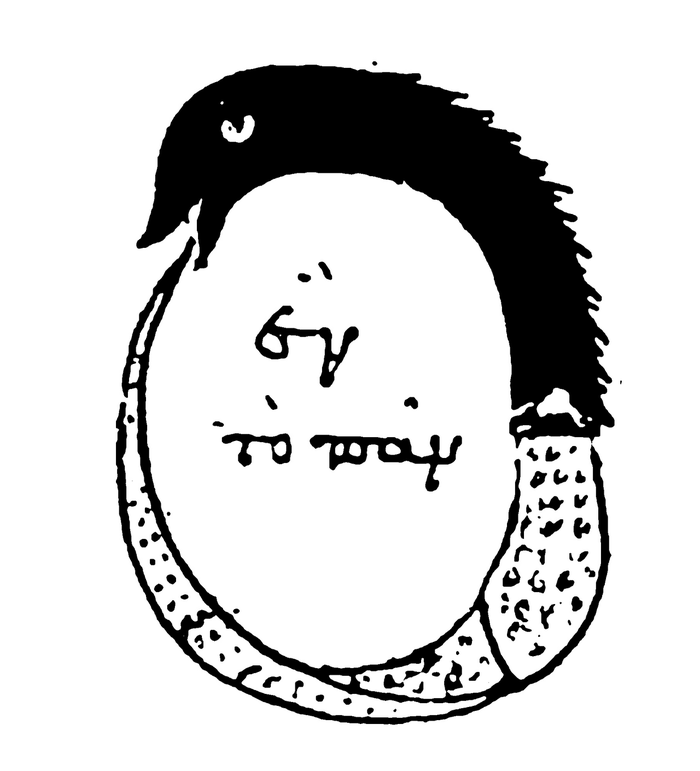
The word itself has come a long way. Greek said chemeia or chymeia, the Arabs made it al-kimiya, and it reached us through Latin as alchemy. Where the Greek word comes from is disputed. Perhaps from Kemet, the “black land”, as the Egyptians called their country, perhaps from the Greek word for casting or juice.
From the eighth to the tenth century alchemy flourished in the Arab world. A huge collection of writings arose under the name of Jābir ibn Ḥayyān, and physicians such as al-Rāzī described distillation and crystallisation more precisely than anyone before them. The Emerald Tablet also appeared in this period. In 1144 Robert of Chester translated the first alchemical text into Latin, and from then on the art spread through Christian Europe until it reached its greatest flowering in the sixteenth and seventeenth centuries.
The four elements
The theory of alchemy rests on Aristotle’s doctrine of elements. Everything consists of four elements, fire, air, water and earth, and each element is determined by two of four basic qualities: hot or cold, dry or moist. Fire is hot and dry, air hot and moist, water cold and moist, earth cold and dry.
The decisive thought is in Aristotle’s On Generation and Corruption (II 4): the elements pass into one another when one of their qualities changes. Water that becomes hot turns into air, as one sees in steam. But if the elements can transform, then so can the substances made of them. That is the foundation of all alchemy.
The four elements and their qualities. Neighbouring elements share one quality and pass into each other when the other changes. Opposites face each other. The signs are those of the alchemists: triangles pointing up for fire and air, down for water and earth.
The Pythagoreans would have enjoyed this order. Four elements combining two times two qualities, and Theon of Smyrna expressly counts the four elements among his tetractyes, the fours in which the world is ordered. The alchemists’ signs for the elements are triangles pointing up or down. Lay the triangle of fire and the triangle of water over each other and the hexagram appears, the union of opposites.
Sulphur, mercury and salt
The Arab alchemists added a doctrine of their own. According to it all metals consist of two principles, sulphur and mercury, in different proportions and of different purity. What is meant is not the ordinary substances of these names but principles: sulphur stands for the combustible, the fixed and the male, mercury for the volatile, the flowing and the female. In gold both are perfectly pure and perfectly balanced. All other metals are unfinished gold, and the alchemist’s art consists in correcting the proportion.
In the sixteenth century Paracelsus added a third principle, salt, for the stable and bodily (see Paracelsus). With that alchemy had its threeness: sulphur, mercury and salt, often read as soul, spirit and body.
The seven metals
The ancients knew seven metals, and they assigned each to one of the seven wandering stars. Gold belonged to the sun, silver to the moon, and so on. The signs with which the planets were written became the signs of the metals as well. The same order lives on in the names of our weekdays.
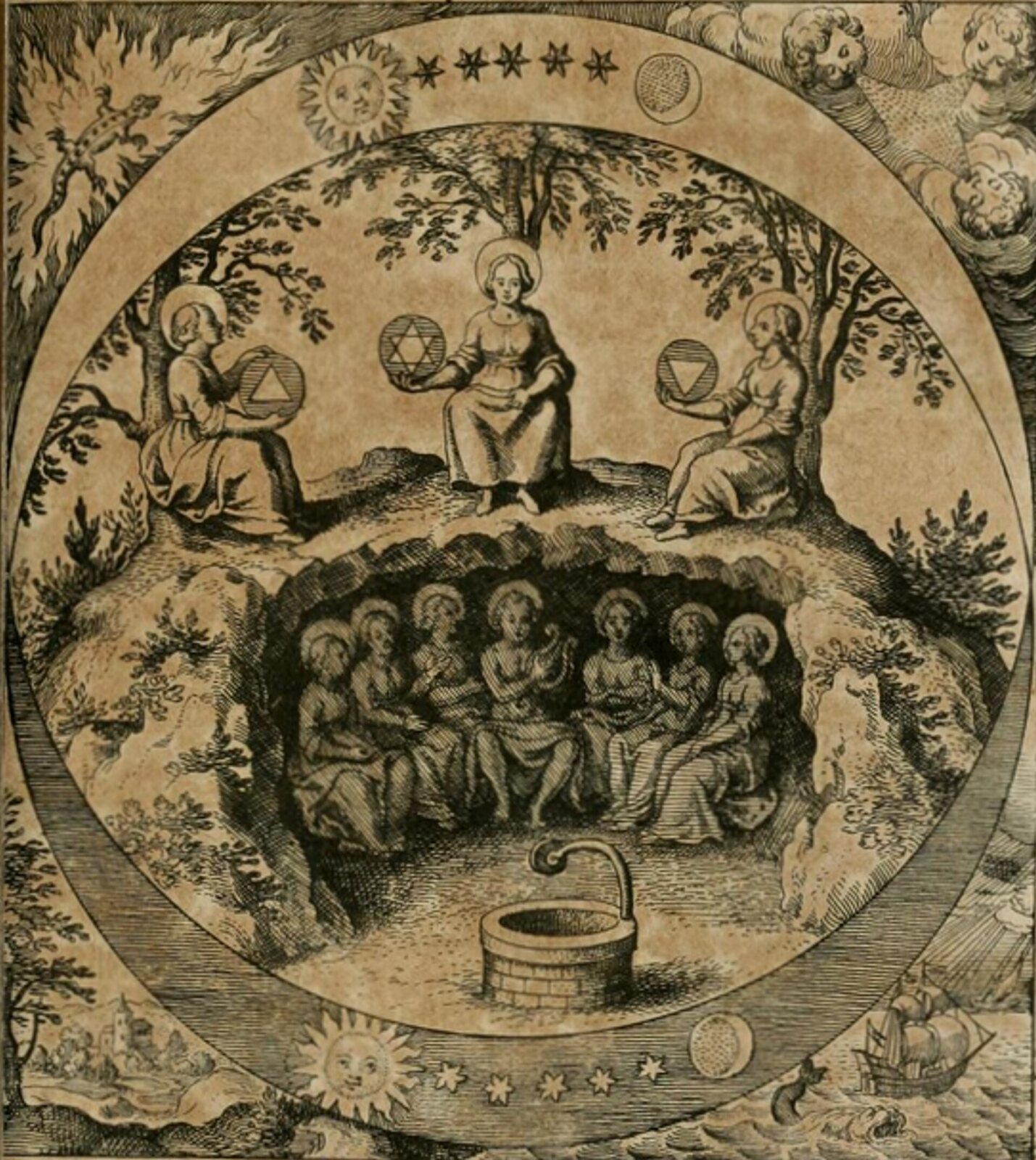
Three and seven stand together in this picture, and between them lies the four of the elements, for 3 + 4 = 7. The Hermeticists read in it spirit and matter, which together make up the world (see the section “The three” on the page on Freemasonry).
The axiom of Maria
One of the formulas ascribed to Mary the Jewess sounds like a description of the tetractys:
One becomes two, two becomes three, and out of the third comes the one as the fourth.
The formula is handed down in later Greek alchemical texts and became famous only in the twentieth century through Carl Gustav Jung. Whether it really comes from Maria we do not know. But it shows how the alchemists thought. From unity comes the twoness of opposites, sulphur and mercury, male and female. From their union a third arises, and this third leads back to unity, but now on a higher level, as the fourth. It is the same path the tetractys takes with 1, 2, 3 and 4, and that the page The masculine and the feminine describes.
The Great Work
The goal of alchemy was the Great Work, the making of the philosophers’ stone. This stone was to turn base metals into gold and, as an elixir, heal diseases and prolong life. The way there led through stages recognised by the colours of the substances in the glass:
- Nigredo, the blackening: the substance is broken down, “killed”, until only a black mass remains.
- Albedo, the whitening: the substance is purified and turns white. A stone of this stage, the white stone, was to turn metals into silver.
- Rubedo, the reddening: the purified substance is joined with new force and turns red. Only this red stone, often described as a red powder or red tincture, was to turn metals into gold. Some texts name a yellowing before the reddening, citrinitas.
The principle of this path is solve et coagula, “dissolve and bind”: first the old must be dissolved, then it can be put together anew. A famous formula of the seventeenth century, circulated under the name of Basilius Valentinus, sums up the path in one word, VITRIOL: Visita interiora terrae, rectificando invenies occultum lapidem, “Visit the interior of the earth, by purification you will find the hidden stone”. Vitriol was at the same time the name of a real substance, sulphuric acid and its salts. French Freemasonry later took the formula into its rituals.
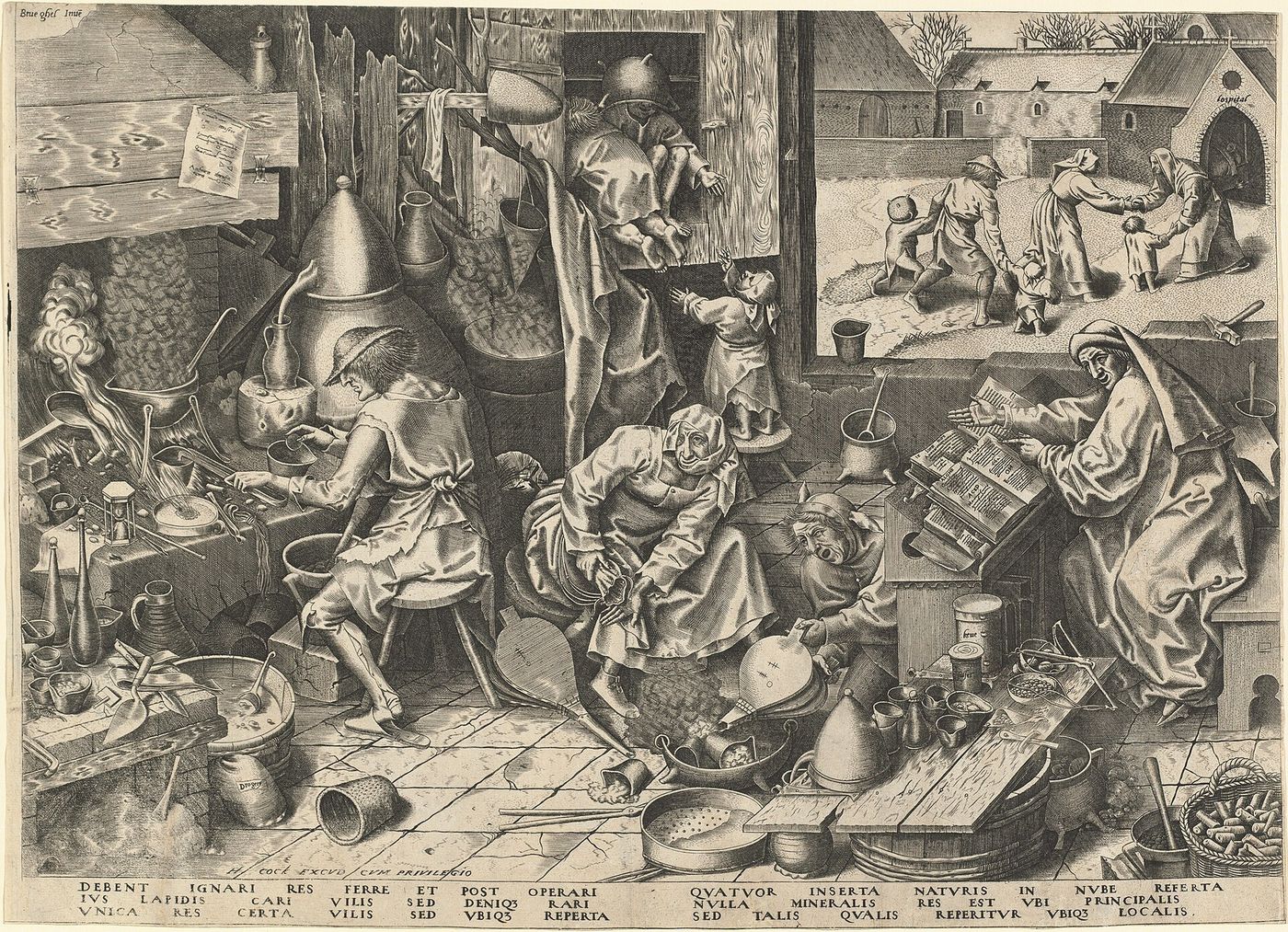
The dream of artificial gold had its dark side too. Princes kept court alchemists, swindlers travelled from court to court, and many ruined themselves and their families. Contemporaries already mocked it.
Outward or inward?
Was alchemy chemistry or mysticism? The question is still debated.
Since the nineteenth century a reading has been widespread according to which the alchemists did not really work with metals at all, but with the soul. Mary Anne Atwood (1850) and Ethan Allen Hitchcock (1857) read the alchemical texts as encrypted instructions for spiritual purification. In 1944, in Psychology and Alchemy, Carl Gustav Jung interpreted them as images for the development of the personality, which he called individuation. The blackening would then be the encounter with one’s own shadow, the wedding of king and queen the union of opposites in the soul.
The history of science sees it differently today. Scholars such as Lawrence Principe and William Newman have shown that most alchemists did stand in the laboratory, with real substances, real furnaces and often astonishingly precise observations. Some of their encrypted recipes could be cooked again, and they work. The purely spiritual reading is largely an invention of the nineteenth century.
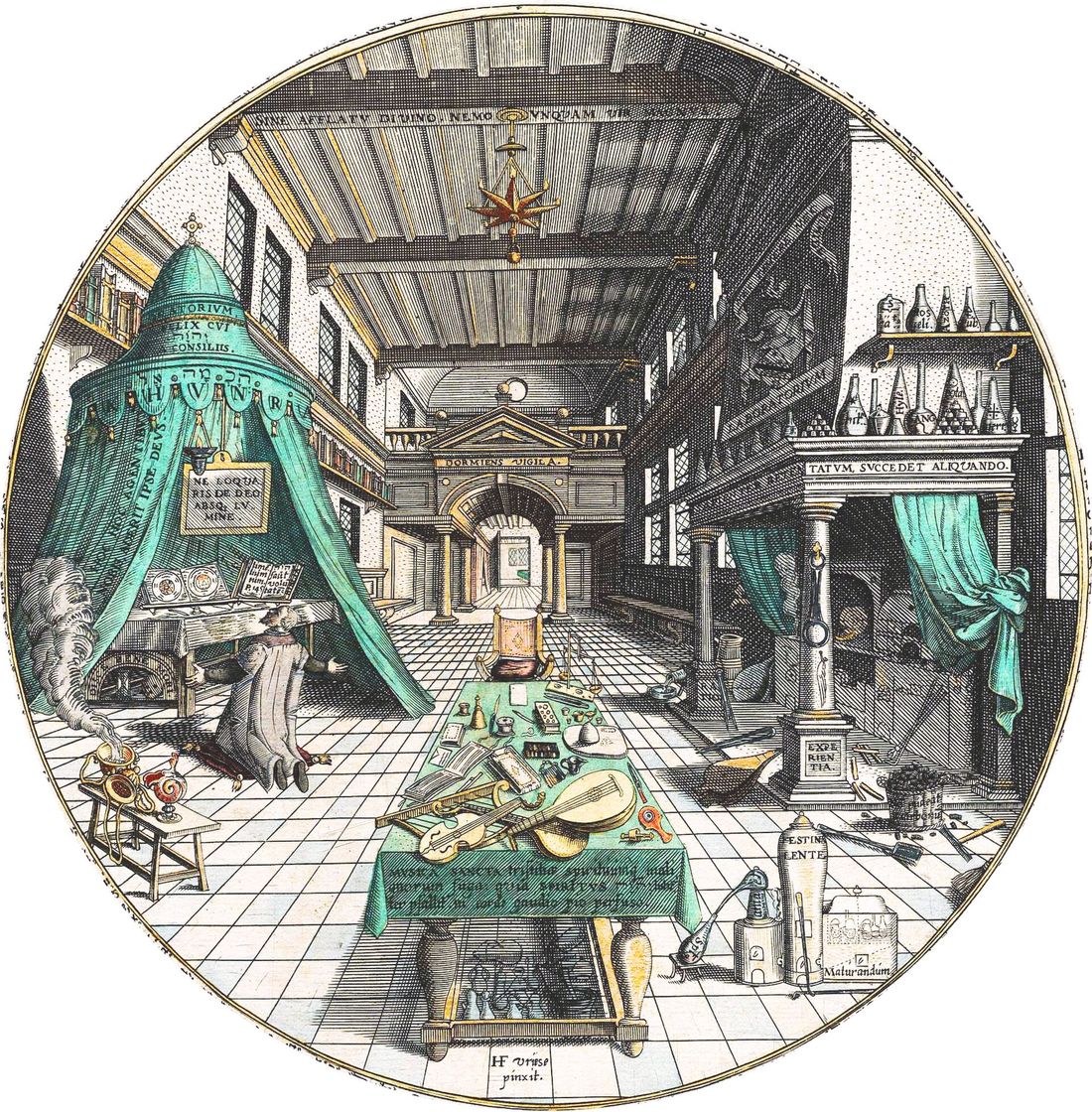
And yet the inward side is not simply invented. Many alchemists understood their work as a spiritual work. The practitioner was to be pure, to pray and to work humbly, or nothing would succeed. Around 1600 Heinrich Khunrath had his workroom pictured as a double room, the place of prayer on the left, the furnace on the right. This was later called the laboratory-oratory, after the old rule ora et labora, “pray and work”. The honest answer is therefore: alchemy was both at once, and precisely that distinguishes it from later chemistry, which took the inner life of the researcher out of the matter.
What became of it
Chemistry grew out of alchemy, and the transition was fluid. Robert Boyle, whose book The Sceptical Chymist (1661) counts as a founding text of chemistry, himself sought the transmutation of metals. Isaac Newton wrote more than a million words on alchemy. And the young Goethe experimented in Frankfurt at a small furnace of his own before taking the images of the alchemists into his Faust (see Goethe’s Faust). The economist John Maynard Keynes, who had bought Newton’s manuscripts, therefore called him in 1946 “not the first of the age of reason” but “the last of the magicians”. And the Hamburg alchemist Hennig Brand, who in 1669 sought the philosophers’ stone in urine, found a new element in the process, phosphorus.
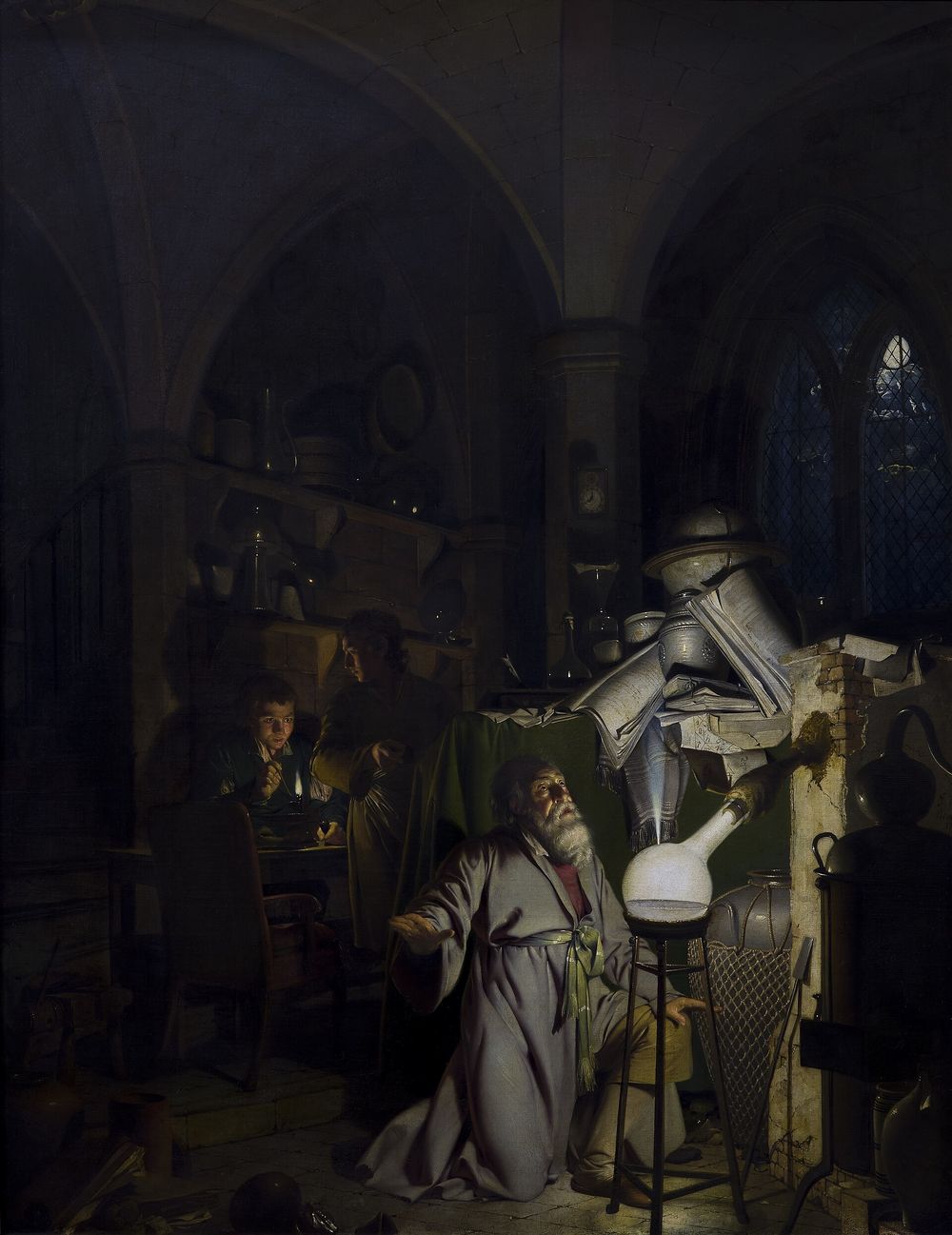
Only Antoine Lavoisier drew a sharp line in 1789. He defined a chemical element as a substance that cannot be broken down further by chemical means, and gold was one of them. With that the transformation of metals seemed ruled out for ever.
The twist came in the twentieth century. In 1919 Ernest Rutherford bombarded nitrogen with alpha particles and knocked out hydrogen nuclei, and in 1925 Patrick Blackett showed that oxygen arises in the process. This was the first artificial transformation of an element. In 1980 Glenn Seaborg and his colleagues in Berkeley produced a few thousand gold atoms from bismuth, a neighbour of lead. And in 2025 physicists at CERN reported that gold nuclei keep arising when lead nuclei graze each other in the particle accelerator, only for fractions of a second and in tiny amounts. The old dream has come true, then, but not as imagined: not through sulphur and mercury but through interventions in the atomic nucleus, and far too expensive to make anyone rich.
What remains
The alchemists did not find the gold. But they left three things that still hold today. The apparatus and procedures of the laboratory, from the water bath to distillation. The conviction that the world consists of a few basic substances that combine and separate according to rules. And a language of images for inner transformation that poets, psychologists and Freemasons still use: whoever wants to change must first dissolve the old, unite the opposites within himself and purify the result.
Sources and further reading
Sources
- Aristotle, On Generation and Corruption II 4
- Chrysopoeia of Cleopatra, Codex Marcianus graecus 299, 10th or 11th century
- Robert of Chester, Liber de compositione alchemiae, 1144
- Paracelsus, Opus paramirum, around 1531 (the three principles)
- Pieter Bruegel the Elder and Philips Galle, The Alchemist, engraving, around 1558
- Heinrich Khunrath, Amphitheatrum sapientiae aeternae, Hamburg 1595, enlarged Hanau 1609
- Johann Daniel Mylius, Opus medico-chymicum, Frankfurt 1618
- Robert Boyle, The Sceptical Chymist, London 1661
- John Maynard Keynes, Newton, the Man, 1946, printed in Newton Tercentenary Celebrations, Cambridge 1947
- Antoine Lavoisier, Traité élémentaire de chimie, Paris 1789
- Ernest Rutherford, Collision of α particles with light atoms, Philosophical Magazine 37, 1919
- Mary Anne Atwood, A Suggestive Inquiry into the Hermetic Mystery, London 1850
- Carl Gustav Jung, Psychology and Alchemy, Zurich 1944
Further reading
- Lawrence M. Principe, The Secrets of Alchemy, Chicago 2013
- William R. Newman and Lawrence M. Principe, Alchemy Tried in the Fire, Chicago 2002