The union of opposites
Heraclitus' bow and lyre, Aristotle's mean, the coincidence of opposites in Cusanus, the chymical wedding and Bohr's coat of arms with yin and yang. What kinds of opposites there are, in how many ways they can be joined and which are better not united.
On many pages of this website opposites appear that join together: the odd and the even, sun and moon, king and queen, compasses and square, and not least the pillars Jachin and Boaz. On the page The masculine and the feminine the question arises whether man and woman are really opposites at all. This page pursues the question in principle: what is an opposite, and what does it mean to unite opposites?
Bow and lyre
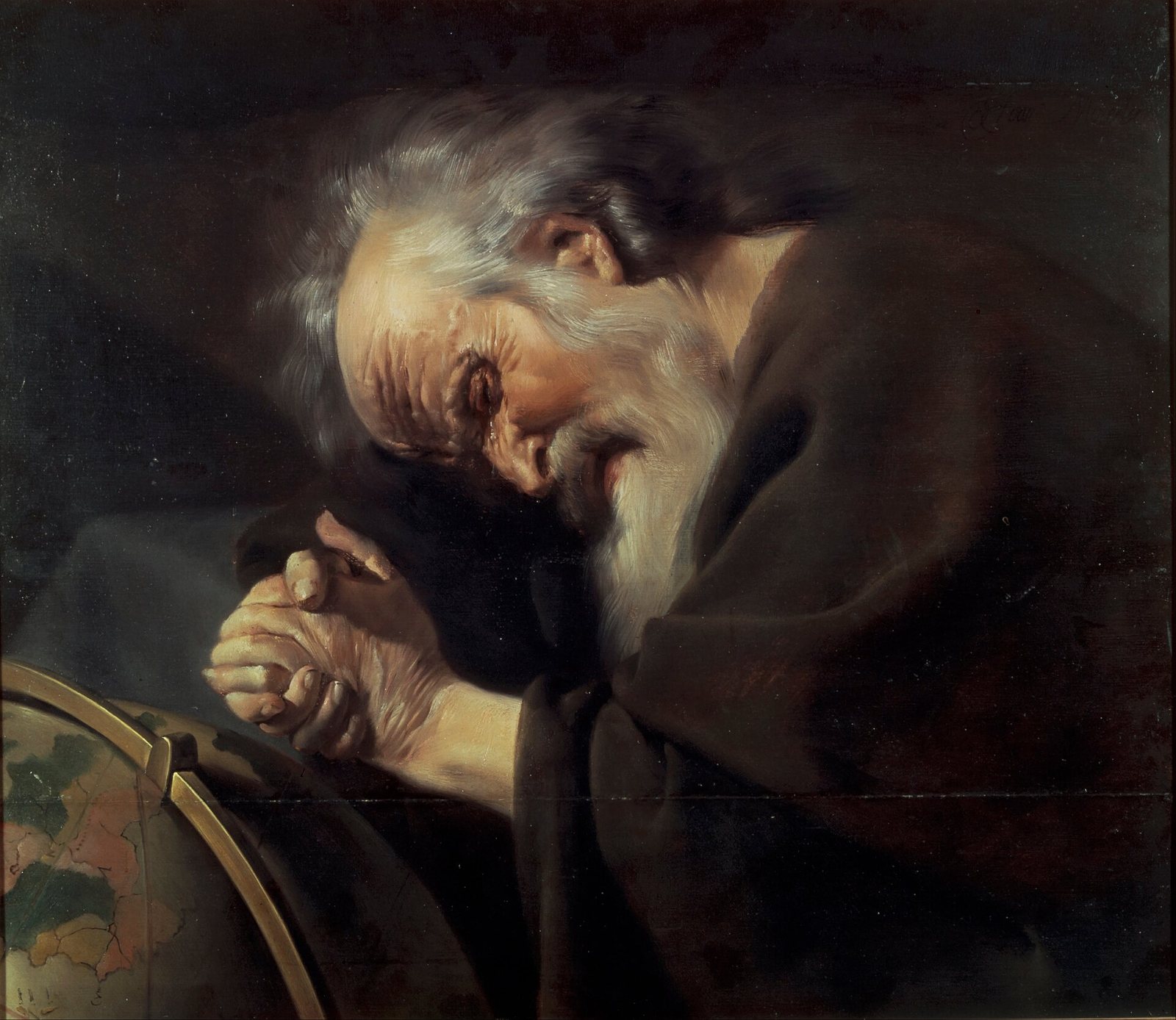
The first to make the tension of opposites the core of his thought was Heraclitus of Ephesus, around 500 BC. “They do not understand,” he writes, “how what is at variance agrees with itself: a back-stretched connection, as in the bow and the lyre.” A bow works only because wood and string pull in opposite directions. If the tension slackens, it is useless. A lyre sounds only because its strings are taut.
Other sayings of Heraclitus say the same in other ways. “The way up and the way down are one and the same.” “God is day and night, winter and summer, war and peace, satiety and hunger.” For Heraclitus the world is no quiet balance but a constant alternation, and order lies precisely in this alternation.
The Pythagoreans thought similarly and yet differently. They set up a table of ten pairs of opposites, limit and unlimited, odd and even, one and many, light and darkness (see Pythagoras: the philosopher). And a sentence attributed to Philolaus says that what joins the opposites is harmony: “Harmony is the unification of the variously mixed and the agreement of the disagreeing.” The word harmonia originally meant the joint with which a carpenter fits two timbers together (see Number and sound).
Four kinds of opposites
Not everything called an opposite is of the same kind. Aristotle set this out precisely, and his division helps to this day.
- Contraries: hot and cold, white and black, healthy and sick. They lie at the two ends of a scale, with steps in between. Lukewarm is neither hot nor cold.
- Contradictories: a statement and its negation, “it is raining” and “it is not raining”. Here there is no third: one of the two is true, the other false. Even and odd, incidentally, Aristotle does not count here but among the contraries that simply happen to have no middle.
- Correlatives: the double and the half, teacher and pupil, above and below. Each is what it is only through the other. Without a pupil no one is a teacher.
- Possession and privation: sight and blindness, knowledge and ignorance. The one is there, the other is its absence.
With this division the question about man and woman can be put more precisely. They are not contradictory, for there is no law of logic by which the one would be the no of the other. They are rather correlative, as the old teachings meant: each becomes fully understandable only through the other, just as odd and even together make up the numbers. And for much that was called “masculine” and “feminine”, active and receptive, they are rather contrary, with all the steps between and mixed in every person.
Six ways of union
Likewise there are different ways of joining opposites. Tradition knows at least six.
The mean. Aristotle found virtue in the mean between two faults. Courage lies between cowardice and recklessness, generosity between meanness and extravagance. The mean is no weak compromise but a summit, as hard to hit as the centre of a target. This holds only for contraries, which have a scale.
The third. Two opposites bring forth something new that is neither of them. In alchemy the stone arises from sun and moon, metal from sulphur and mercury, the child from man and woman. In the tetractys this is the three that follows from one and two (see Alchemy).
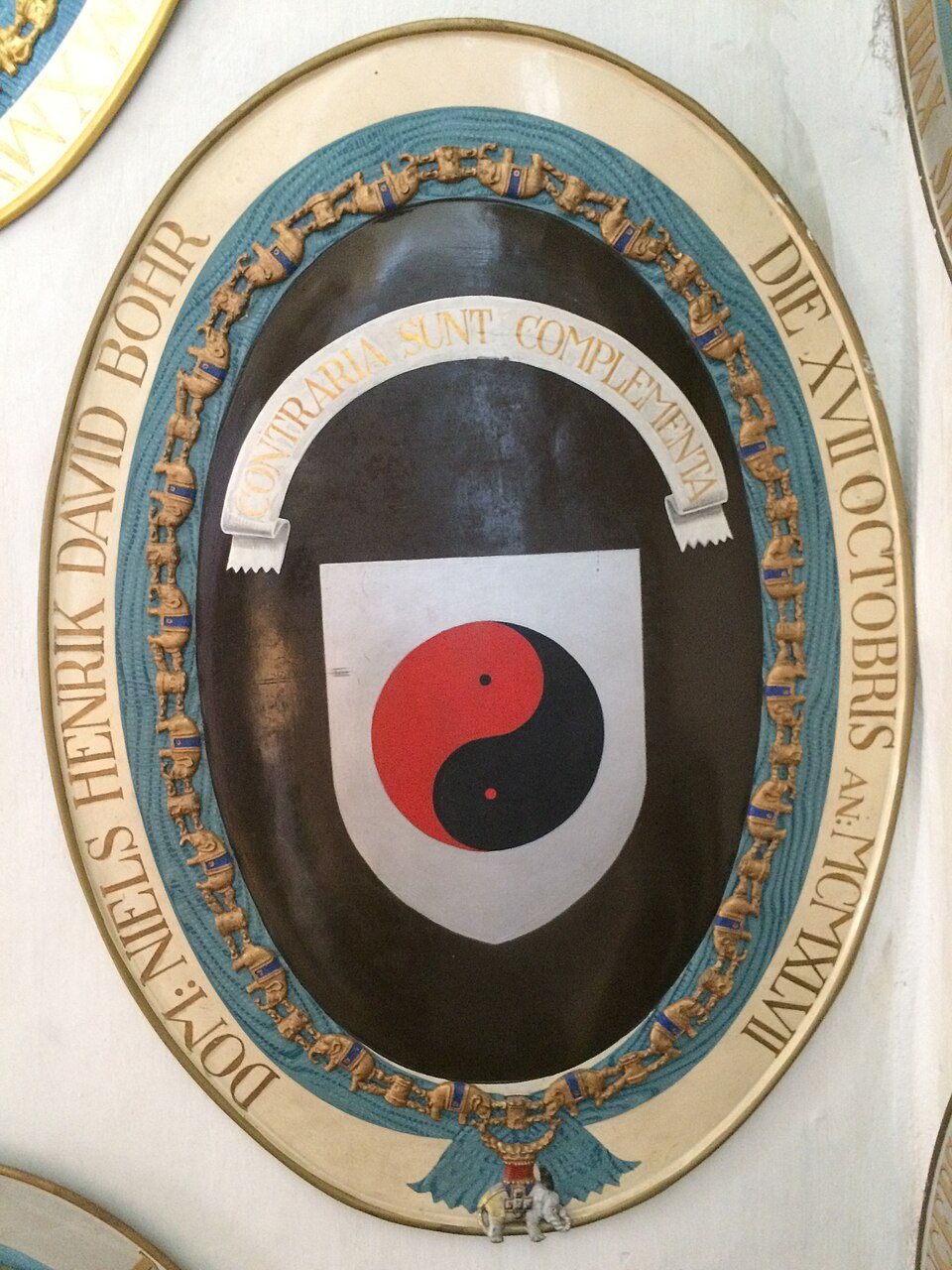
The complement. Yin and yang do not fight each other, they complement each other, and each carries a seed of the other within it. When the Danish physicist Niels Bohr was admitted to the Order of the Elephant in 1947, he chose a coat of arms bearing the yin-yang sign, with the motto Contraria sunt complementa, “opposites are complementary”. He was thinking of the fact, found by Einstein, de Broglie and others, that light and electrons behave like waves or like particles depending on the experiment. Both pictures are needed, neither suffices alone, and one can never see both at once. Bohr called this complementarity.
Coincidence in the infinite. For Nicholas of Cusa opposites coincide in the infinite. A circle of infinite radius is a straight line, the greatest and the smallest are one in God. He called this coincidentia oppositorum (see Measure, number and weight). This union cannot be produced, only thought, and even that only at the limit of thinking.
The wedding. The alchemists depicted the union of opposites as the wedding of king and queen, the coniunctio. First both must dissolve, then they can join, and the result is a new being that carries both within it, the rebis (see The masculine and the feminine). In his late work Mysterium Coniunctionis Carl Gustav Jung saw in this an image of the union of opposites in the soul.
Sublation. For the union of opposites the philosopher Hegel chose a German word, aufheben, because, as he writes himself, it has a double sense. It means to end, as one adjourns a meeting, and to keep, as one puts something aside for later. Later interpreters added a third meaning, lifting up to a higher level. Where two opposites are sublated, their conflict ends, both are preserved, and something higher arises.
What is not to be united
Beautiful as the thought is, it has a limit, and it is important. Contradictories cannot be united. A statement cannot be true and false at once. Aristotle called this the most certain of all principles, and whoever denies it must already presuppose it in denying. Whoever claims that in a higher unity true and false are one has not thought further but stopped thinking (see Dialectic: reasoning soundly). Even Nicholas of Cusa, who later spoke of a coincidence of contradictories, meant God beyond all comprehension, not a rule for thinking about the world.
Good and evil, too, are not united in the great traditions but distinguished. The mosaic pavement of the lodge shows light and dark side by side, but it does not invite one to choose the dark (see Freemasonry). Whoever wants to join opposites must therefore first ask what kind they are. Tensions like those between strictness and gentleness, order and freedom, thinking and feeling want to be endured and joined. Contradictions want to be resolved.
In the language of numbers
The tetractys tells the whole path in four steps. One is the origin, still without opposition. Two is the first split, opposition itself. Three joins both, and four returns to unity, but now unfolded, as a solid in space. This is the axiom of Maria handed down by the alchemists: “One becomes two, two becomes three, and out of the third comes the one as the fourth.”
And numbers have a still simpler image. On the number line plus and minus lie opposite each other, and in the middle lies zero, which is neither and from which both proceed. Multiply two minuses and a plus arises (see The tetractys and the Cartesian coordinate system). This too is a way of uniting opposites, and it holds without any interpretation.
Exercise
Write down five pairs of opposites you meet in your own life, such as work and rest, closeness and freedom or strictness and leniency. Assign each to one of Aristotle’s four kinds. Then ask of each: am I looking here for the mean, a third, a complement or a decision? You will notice that the right answer depends on the kind of opposite.
Sources and further reading
Sources
- Heraclitus, fragments B 8, B 10, B 51, B 53, B 60 and B 67 (Diels and Kranz)
- attributed to Philolaus, fragment B 10 (authenticity disputed)
- Aristotle, Categories 10 and 11, Metaphysics A 5 and Γ 3, Nicomachean Ethics II 6 to 9
- Nicholas of Cusa, De docta ignorantia, 1440
- Georg Wilhelm Friedrich Hegel, Science of Logic, Nuremberg 1812, remark on the expression “sublation”
- Carl Gustav Jung, Mysterium Coniunctionis, 2 vols., Zurich 1955 and 1956
- Niels Bohr, coat of arms for the Order of the Elephant, 1947
Further reading
- Charles H. Kahn, The Art and Thought of Heraclitus, Cambridge 1979
- Jasper Hopkins (trans.), Nicholas of Cusa On Learned Ignorance, Minneapolis 1981