Measure, number and weight: number in Christian thought
“Thou hast ordered all things in measure and number and weight”: how a verse from the Book of Wisdom carried Pythagorean number teaching into Christianity. Augustine and the 153 fish, Boethius and the quadrivium, the school of Chartres and the Trinity as unity, equality and connection.
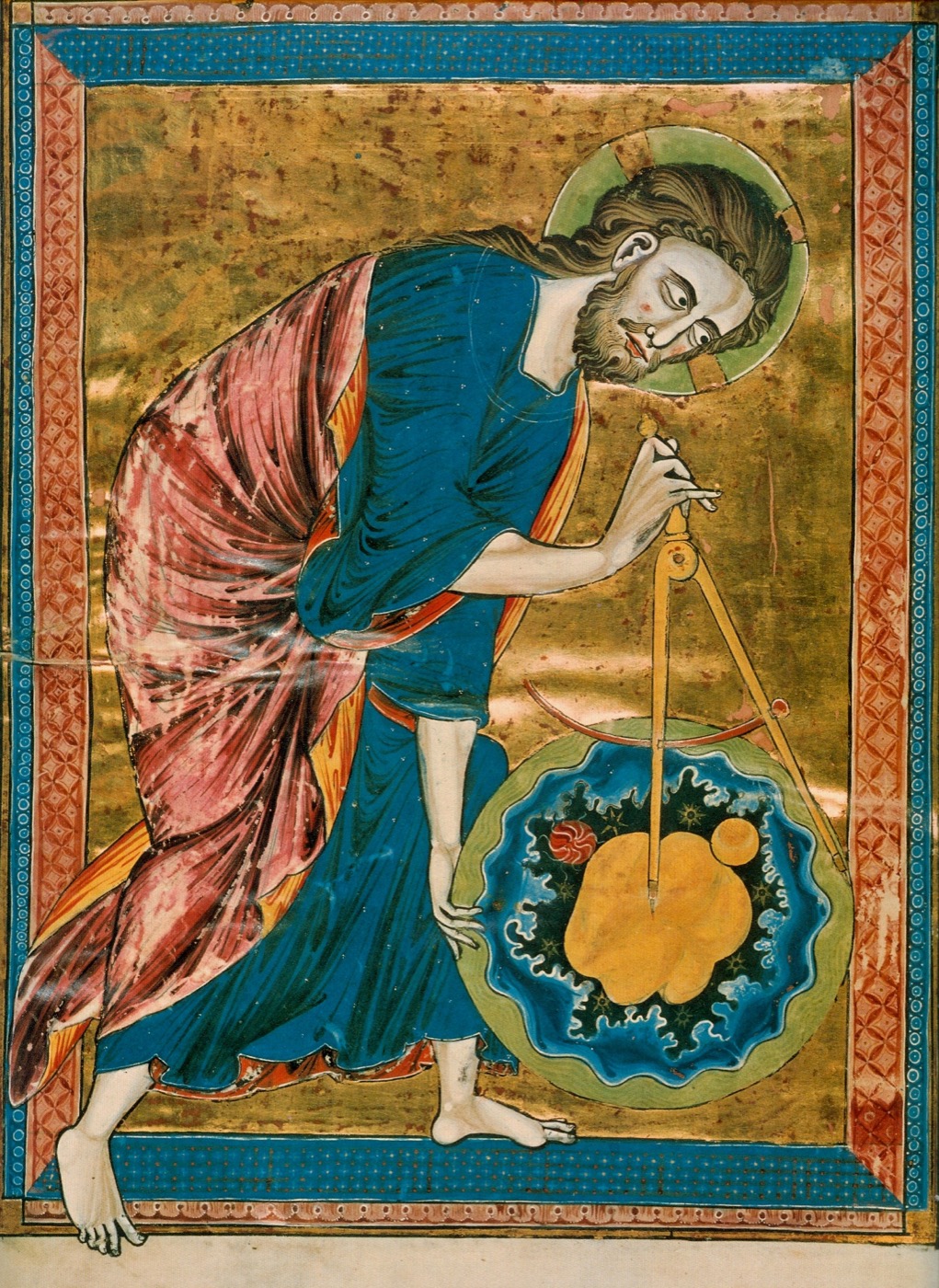
In the Book of Wisdom, a Jewish writing from Alexandria composed shortly before Christ, there is a sentence that shaped the history of number in Europe like hardly any other. It is addressed to God:
Thou hast ordered all things in measure and number and weight.
The verse (Wisdom 11:20) stands in the Old Testament of the Catholic and Orthodox Bible. Luther placed the book among the Apocrypha, “books not held equal to Holy Scripture and yet useful and good to read”. For the Middle Ages, however, the sentence was a key. If God ordered the world by numbers, then the study of number is a way of thinking God’s thoughts after him. On this sentence rests the bridge over which Pythagorean number teaching reached Christian thought.
Augustine
Before his conversion the Church Father Augustine (354 to 430) had read the Neoplatonists, and he took his love of number with him into his faith. In his work On Free Choice of the Will he says that the truth of number is common to all who think and unchangeable: that seven and three make ten holds for everyone and at all times, and no one can change it. In this he saw a pointer to a truth above the human mind.
In On Christian Doctrine he advises interpreters of the Bible to study numbers, because many passages of Scripture would otherwise remain unintelligible. And in the City of God he writes about six: it is not perfect because God created the world in six days, but God created it in six days because six is perfect, the sum of its divisors 1 + 2 + 3 (see The numbers from one to ten). For him number was not a human work but lay in the mind of God before creation.
The 153 fish
Best known is Augustine’s interpretation of a number from the Gospel of John. After the resurrection Jesus appears to the disciples by the lake, and they draw a net “full of great fishes, an hundred and fifty and three” to land (John 21:11). Why this exact number?
Augustine notes that 153 is the sum of all numbers from 1 to 17, a triangular number like the ten of the tetractys. And 17 is 10 + 7, the ten commandments and the seven gifts of the Spirit, law and grace together. Lay 153 pebbles out as a triangle, and seventeen stand in the bottom row.
This is a fine example of two things. The calculation is right: 153 is the seventeenth triangular number. The interpretation, though, is an interpretation, and Augustine could have found something similar in many numbers (see Chance and pattern). He probably knew that himself. His interpretations are meditations, not proofs, and he wrote them for people who were meant to enjoy reflecting on Scripture.
Boethius and the quadrivium
Boethius (around 480 to 524), a Roman statesman at the court of the Gothic king Theoderic, wanted to rescue Greek science into Latin. He translated Nicomachus’ arithmetic and wrote a textbook of music, a geometry by him is lost. The word quadrivium, the “fourfold way” of the arts of number, comes from him, and from his books the Middle Ages learned the theory of number and music theory, the music even far into the modern age (see From apprentice to master).
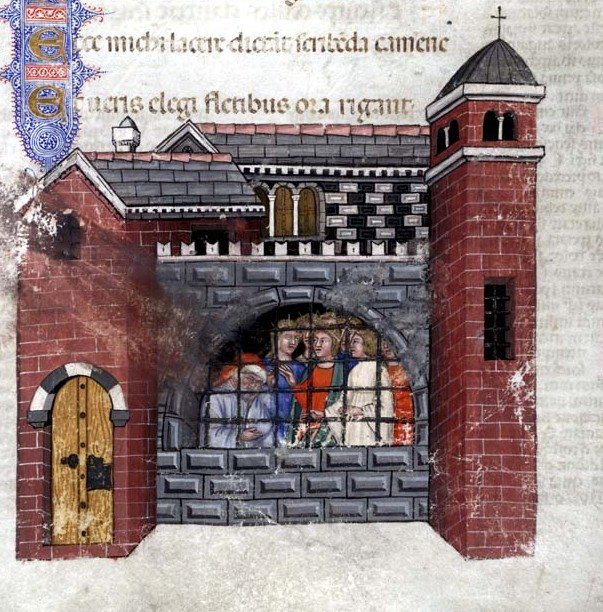
Boethius was condemned to death for alleged high treason. In prison he wrote The Consolation of Philosophy, one of the most read books of the Middle Ages. At its centre stands a prayer that sums up the Timaeus in a few verses: God steers the world by an eternal plan, binds the elements “by numbers” and lets the soul move in harmonious circles (see Plato’s Timaeus).
The school of Chartres
In the twelfth century the cathedral school of Chartres became the centre of this thought. Its teachers read the Timaeus and the Bible side by side, and they sought not contradiction between the two but agreement. On the west portal of the cathedral the seven liberal arts were carved in stone around 1150, each with an ancient teacher, music with Pythagoras (see Music: number in relation).
Around 1140 Thierry of Chartres tried to explain the creation story with the means of the quadrivium. In doing so he found an image for the Trinity from arithmetic. Unity, he says, begets equality from itself, for one times one is one. And between unity and equality there is a connection that proceeds from both. Unity, equality and connection are for Thierry Father, Son and Spirit. This is not mathematics in today’s sense, but it shows how seriously these scholars took the word about measure and number.
Nicholas of Cusa
At the end of the Middle Ages Nicholas of Cusa (1401 to 1464) pushed the thought to its limit. In On Learned Ignorance of 1440 he says that God cannot be grasped, but one can approach him with mathematical images by driving them to infinity. A circle whose radius grows without end becomes a straight line. A triangle with infinitely long sides coincides with the line and the circle. In the infinite the opposites coincide, and so, Cusanus holds, it is in God (see The union of opposites).
Later he wrote that the first archetype of things in the mind of the creator is number (see Great thinkers on the structure of the world). From here a straight path leads to Kepler, who called Cusanus “divine” (see Johannes Kepler).
What the verse means
One can read the sentence about measure, number and weight in two ways. As number mysticism, seeking a secret in every number of the Bible. This reading has borne beautiful fruit and some wild speculation. Or as a foundation of natural science: if the world is ordered by measure and number, then one can measure and calculate it, and one may expect the effort to be worthwhile. Many historians see in this expectation one of the reasons why modern natural science arose precisely in Europe. Galileo, Kepler and Newton were believers, and they understood their work as thinking God’s thoughts after him.
Both readings have their place. The first belongs to contemplation, the second to testing. Whoever keeps them apart can take both seriously.
Sources and further reading
Sources
- Wisdom 11:20 (11:21 in the Vulgate), King James Version
- John 21:11 (the 153 fish)
- Augustine, City of God XI 30, On Christian Doctrine II 16, Tractates on the Gospel of John 122, On Free Choice of the Will II 8 to 11
- Boethius, De institutione arithmetica I 1, and The Consolation of Philosophy III, poem 9
- Thierry of Chartres, Tractatus de sex dierum operibus, around 1140
- Nicholas of Cusa, De docta ignorantia I 11 to 15, 1440
Further reading
- Otto von Simson, The Gothic Cathedral. Origins of Gothic Architecture and the Medieval Concept of Order, New York 1956
- Heinz Meyer and Rudolf Suntrup, Lexikon der mittelalterlichen Zahlenbedeutungen (Lexicon of medieval number meanings), Munich 1987