Paracelsus: physician, alchemist and wanderer
Four pillars of medicine, three principles, five causes of disease, man as a small world and the famous sentence that the dose makes the poison. Who Paracelsus was, what he taught, where he was right, where not, and why his influence reaches as far as Goethe and C. G. Jung.
On a portrait that the etcher Augustin Hirschvogel made of him in 1540 stands a motto: Alterius non sit qui suus esse potest, “Let no one belong to another who can belong to himself”. Hardly a sentence fits better the man who called himself Paracelsus. He was physician and alchemist, naturalist and lay theologian, a tireless wanderer and an incorrigible fighter. On this website he appears in many places, in alchemy, in Hermeticism and in Goethe’s Faust. Here is who he was.
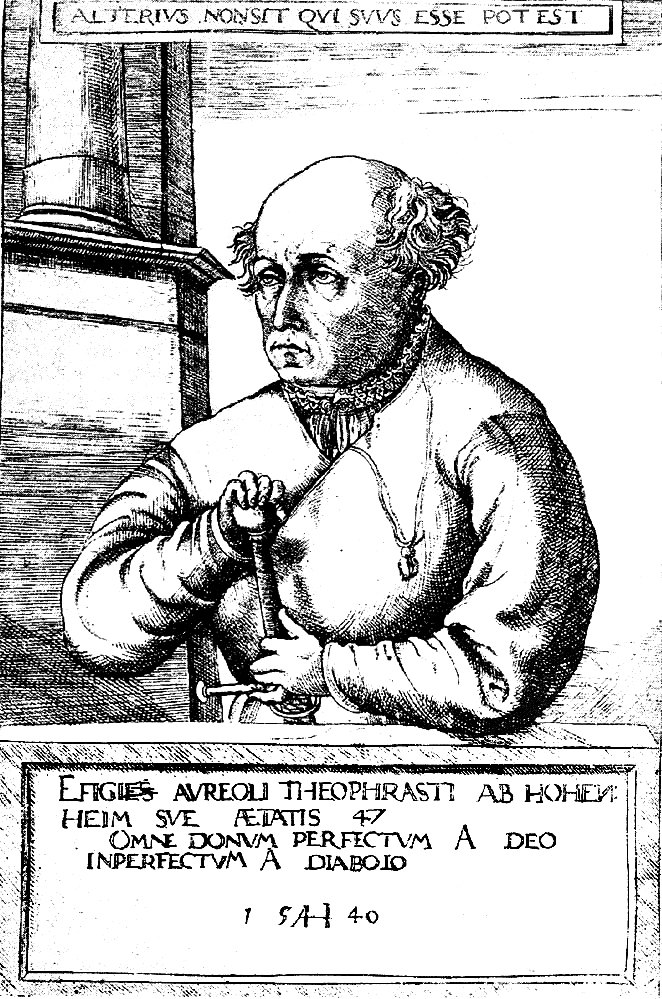
A restless life
His real name was Theophrastus Bombast von Hohenheim, and he was born in 1493 or 1494 near Einsiedeln in Switzerland. His father was a physician and moved with him in 1502 to Villach in Carinthia, a region full of mines and smelting works. There the boy came to know the metals, smelting and separating, and the diseases of the miners. After studies, probably in Italy, he travelled for many years through Europe, as an army surgeon in wars and as an itinerant physician who learned from bath keepers, midwives and herb women as much as from scholars.
In 1527 the city of Basel appointed him city physician and professor, after he had treated the famous printer Johann Froben. Erasmus of Rotterdam also asked him for advice. In Basel Paracelsus did something unheard of: he lectured in German instead of Latin, so that anyone could understand him. And on St John’s Day 1527, so it is reported, he threw one of the authoritative textbooks of medicine into the St John’s fire. True knowledge, so his principle went, stands not in old books but in the book of nature. After a few months he had fallen out with the whole city and had to flee.
From then on he wandered again, through Switzerland, southern Germany, Bohemia and Austria, often poor and almost always in dispute, and wrote without pause. Around 1529 he began to call himself Paracelsus, which has often been read as “beyond Celsus”, after the Roman physician Celsus. More probably it is a Latinised form of Hohenheim. He died in 1541 in Salzburg. Little of his was printed in his lifetime. In the 1560s his followers published many of his writings, and the collected edition of Johannes Huser, Basel 1589 to 1591, made his work accessible as a whole for the first time.
The light of nature
Paracelsus distinguished two lights by which man knows. The light of nature shows him the visible world, if only he looks closely enough, experiences and tests. The light of the spirit, or of grace, shows him what lies above nature, and to this belongs faith. Paracelsus was a devout, self-willed Christian and left, besides his medical writings, numerous theological ones. For him both lights come from God, and neither may replace the other.
From this followed his attitude as a physician. The physician should not repeat what Galen and Avicenna wrote but experience for himself. “Experience” was one of his favourite words. With it he stands at the beginning of the road that leads to empirical medicine, even though much of what he himself took for experience was, from today’s point of view, speculation (see What is a proof?).
Four, three and five
As with the Pythagoreans, much in Paracelsus is ordered by numbers.
Four pillars. In the Paragranum of 1530 he names four pillars on which medicine rests. Philosophy is the knowledge of nature, astronomy the knowledge of the heavens and their effects in man, alchemy the art of preparing remedies, and virtue the integrity of the physician himself. Without the fourth pillar, says Paracelsus, the other three are of no use.
Three principles. Beside the four elements of Aristotle he set three basic substances, the tria prima: sulphur, mercury and salt. His example was a burning piece of wood, which he explained in substance like this: what burns is the sulphur, what rises as smoke is the mercury, and what remains as ash is the salt. He did not mean the substances of the same name but principles: the combustible, the volatile and the fixed, or in another image soul, spirit and body (see Alchemy).
Five causes. According to his Volumen paramirum disease has five origins, which he called entia: the stars, poisons from food, man’s own nature, the spirit and finally God himself. The last cause the physician does not remove, and that is why, says Paracelsus, he should remain humble.
Three, four and five together make twelve, but Paracelsus built no system out of this. He thought in numbers without being possessed by them, and that distinguishes him from many of his followers (see The numbers from one to ten).
Man as a small world
For Paracelsus man is an extract of the whole creation, a microcosm. Everything there is in the great cosmos, stars, metals, herbs and animals, has a counterpart in him. That is why the physician must know the heavens to understand the body. Not in the sense that the stars determine fate, but because man’s “inner heaven” runs by the same laws as the outer one (see Man as the measure and Hermeticism).
This is the Hermetic sentence “as above, so below”, applied to medicine. It led physicians astray for a long time where it was taken literally. And yet it contains an insight that remains: man is no closed-off thing but is connected in everything he is with his surroundings, with what he eats and breathes and with the place where he lives.
The dose alone
Against the charge that he prescribed poisonous remedies such as mercury and antimony, Paracelsus defended himself in 1538 in his Seven Defences with a sentence that has become famous:
All things are poison, and nothing is without poison.
The dose alone makes that a thing is no poison.
This is a thought about measure. No substance is good or evil in itself, it depends on the amount. Too little does nothing, too much harms, and in between lies a range in which a remedy helps. With some substances this range is wide, with others dangerously narrow. A famous example of a narrow window is the foxglove, from which a heart remedy was later obtained: the healing and the deadly amount lie close together.
How the dose works, schematically and without real amounts. The solid curve shows how many people a substance helps at a given amount, the dashed one how many it harms. The range of the right measure is shaded. With the narrow window the two curves lie so close together that the right measure can hardly be hit.
The sentence counts today as a principle of pharmacology and toxicology. It leads from alchemy straight into modern medicine, and it fits a thought that recurs again and again on this website: that the order of things often lies less in the things themselves than in their ratio (see Ratios and Measure, number and weight).
The signs of the plants
If everything in the world is connected, so it was thought, then God has also stamped on things a sign that betrays their power. This doctrine of signatures is found in Paracelsus and was developed by others after him into a whole system. The best-known example is St John’s wort. If one holds its leaves against the light, one sees tiny bright dots, as if they had been pierced. So, it was concluded, it helps against stab wounds. Lungwort has spotted leaves that recall a diseased lung, so it helps the lung.
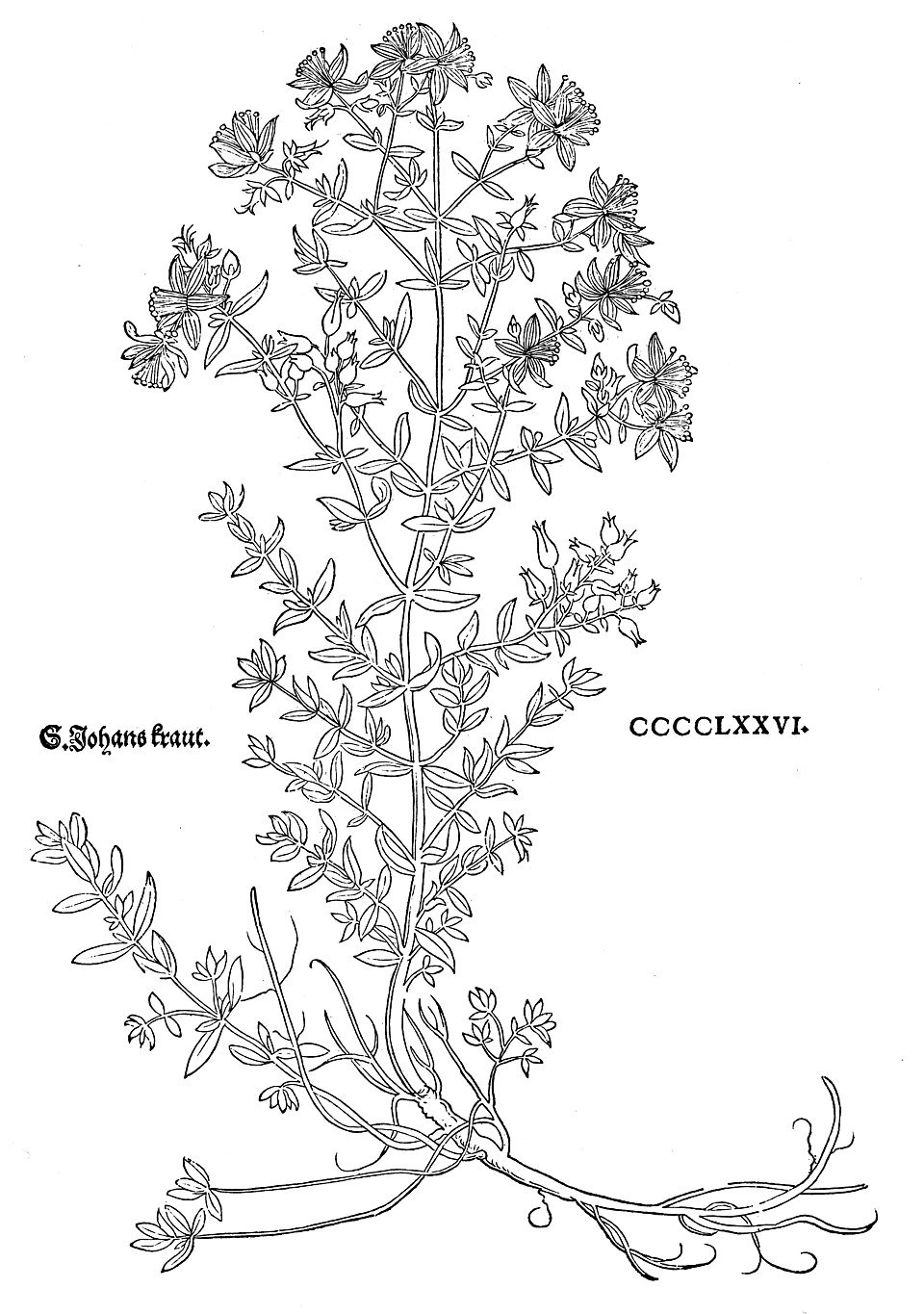
Here an honest test is worthwhile (see Chance and pattern). Lungwort does not particularly help the lung. St John’s wort is indeed used as a medicine today, above all against mild depression. Externally, St John’s wort oil is also used for minor wounds, and here the signature happened to hit something true, only not because of the dots in the leaves. The doctrine of signatures thus sometimes hit by chance and mostly did not. It is a fine example of how the human mind sees patterns where it looks for them.
The spirits of the elements
One of the strangest books of Paracelsus deals with the beings of the four elements: the undines or nymphs in water, the sylphs in air, the gnomes or pygmies in earth and the salamanders in fire. The word “gnome” probably comes from him. These beings, he writes, live like humans but have no immortal soul. An undine can gain a soul only by marrying a human.
From this thought came literature. Friedrich de la Motte Fouqué wrote his tale Undine in 1811, and Goethe has Faust conjure the poodle with the four elemental spirits: “Salamander shall glow, Undine shall writhe, Sylph shall vanish, Kobold shall toil” (see Goethe’s Faust).
True and false Paracelsus
After his death Paracelsus became famous, and soon many writings circulated under his name that he had not written. With some the authorship is disputed to this day, for instance with the treatise On the Nature of Things, which contains the recipe for an artificial man, the homunculus. Goethe took him into the second part of Faust. Other writings with seals of the planets and magical signs are certainly spurious. When Eliphas Lévi later claimed that Paracelsus had called the pentagram the mightiest of all signs, he relied on such traditions (see Eliphas Lévi).
This too belongs to a person’s influence: he becomes a figure to which others attach their own thoughts. In 1614 the Rosicrucians wrote in their Fama Fraternitatis that Paracelsus had been none of their brothers but had diligently read their secret book (see The Rosicrucians).
What remains
Paracelsus was often wrong, he was immoderate in his polemics, and much in his writings is obscure. And yet his influence reaches far.
He counts as the founder of iatrochemistry, chemistry in the service of healing. Instead of herbs alone he prescribed specially prepared minerals and metals, and so the alchemist’s workshop gradually became the pharmacy. With his treatise on the miners’ sickness he wrote the first monograph on the diseases of miners, an early work of occupational medicine. The name of zinc probably goes back to him. And he demanded that the physician be guided by experience rather than by authority.
In the twentieth century the psychologist Carl Gustav Jung rediscovered him. Jung saw in the alchemy of Paracelsus an image of the transformation of the soul, and in 1941, for the 400th anniversary of his death, he gave two lectures on him. Whether one follows him in this or not, Paracelsus stands on a threshold. Behind him lies the world of correspondences and signs, before him the world of measuring and testing. He had a foot in both, and precisely that makes him so instructive for this subject.
Exercise
Watch a match or a log in the fireplace while it burns. Look for the three principles of Paracelsus: the flame, the smoke and the ash. Then ask yourself what today’s chemistry says about the same three appearances, about combustion, gases and minerals. Both descriptions see the same thing, but they ask different questions.
Sources and further reading
Sources
- Paracelsus, Volumen medicinae paramirum, around 1520 (the five entia)
- Paracelsus, Paragranum, 1530 (the four pillars of medicine)
- Paracelsus, Opus paramirum, 1531 (the three principles)
- Paracelsus, Septem Defensiones, 1538, third defence (the dose)
- Paracelsus, Von der Bergsucht oder Bergkrankheiten (On the miners’ sickness), written around 1533, printed Dillingen 1567
- Paracelsus, Liber de nymphis, sylphis, pygmaeis et salamandris et de caeteris spiritibus, printed Basel 1566
- Johannes Huser (ed.), Bücher und Schrifften des Paracelsus, 10 parts, Basel 1589 to 1591
- Fama Fraternitatis, Kassel 1614
Further reading
- Udo Benzenhöfer, Paracelsus, Reinbek 1997
- Charles Webster, Paracelsus. Medicine, Magic and Mission at the End of Time, New Haven 2008
- Walter Pagel, Paracelsus. An Introduction to Philosophical Medicine in the Era of the Renaissance, Basel 1958
- Carl Gustav Jung, Paracelsica, Zurich 1942, in English in Alchemical Studies (Collected Works 13)